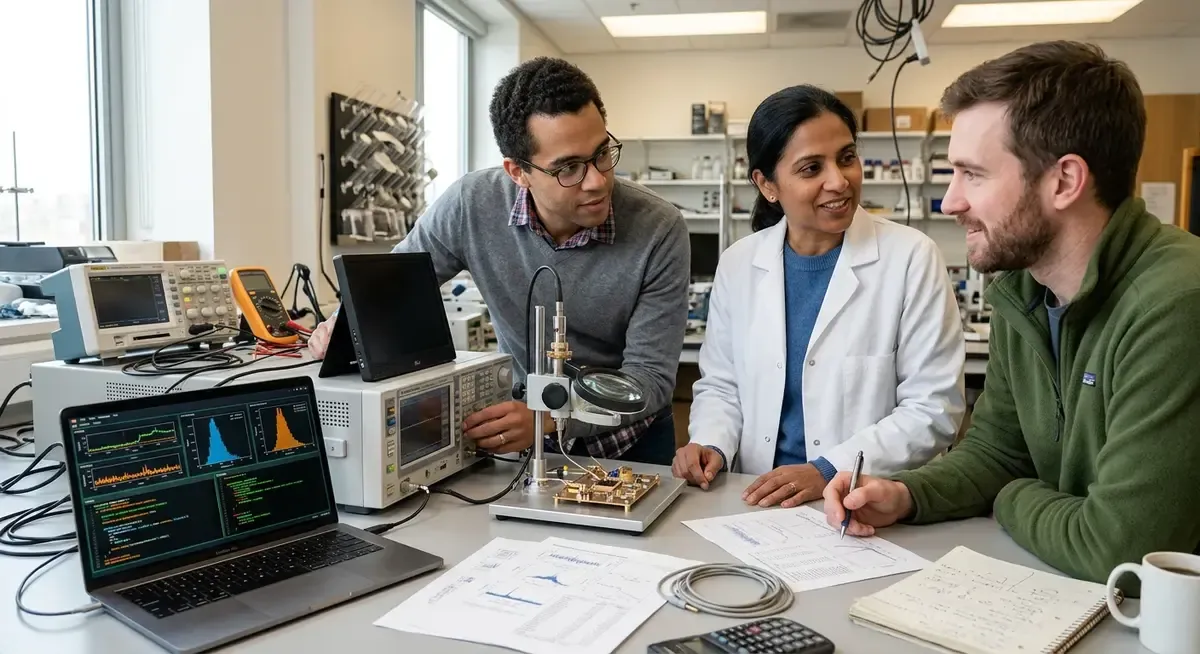
Editorial illustration for AI Agents Run Quantum Experiments Through Software
AI Agents Run Quantum Experiments at MIT
AI Agents Run Quantum Experiments Through Software
Beatriz Yankelevich spends her days running experiments on superconducting qubits in MIT's Engineering Quantum Systems Group, work that typically demands months of preliminary measurements before a single meaningful result emerges. Her chips sit inside dilution refrigerators, cooled to near absolute zero, controlled entirely through software once fabrication and packaging are done. That software-only interface made her lab an obvious testing ground for AI agents, since there's no physical hardware to touch once the qubits are running, just code and data.
Yankelevich connected GPT-5.6 Sol, paired with Codex, directly to the lab software that coordinates her experiments. The goal was to see whether an AI agent could handle the repetitive parts of quantum measurement: running tests, reading results, deciding what comes next, without her sitting at the console for every step. Superconducting qubits operate fast and get controlled with microwave signals, which means the measurement cycles pile up quickly, often into the thousands before an experiment is ready for real analysis.
That volume of routine work is where Yankelevich started asking whether an AI agent could take over the parts of the process that don't require her judgment call at every turn.
Connecting GPT‑5.6 Sol to laboratory software to run and refine routine measurements on quantum chips freed Beatriz Yankelevich to focus on experiment design and data analysis.
Why this matters
This is a narrow but telling case study in what AI agents are actually good for right now: not discovery, but the tedious software plumbing between a scientist and a piece of hardware. Once a superconducting qubit chip is fabricated and cooled, every interaction happens through code, and that's exactly the kind of closed, well-defined loop where a model like GPT-5.6 Sol can run and refine measurements without much oversight. For researchers, the value proposition here isn't "AI discovers new physics," it's "AI frees Beatriz Yankelevich to spend her time on experiment design and data analysis instead of babysitting instrument software." Founders building lab-automation or research-tooling products should notice that pattern: the win came from wiring an agent into existing lab software, not building new infrastructure around the model. Worth watching whether this generalizes beyond superconducting qubits to messier experimental setups where the software layer isn't as clean, and whether "routine measurement" work quietly becomes the default job description for agents in physical science labs.
Related Reading
 Research & Benchmarks
 Microsoft AI Chief: "If It Isn't Safe We Shouldn't Build It
 Research & Benchmarks
 Google's FACTS benchmark shows 70% factuality ceiling across four tests
 Research & Benchmarks
 Nvidia's DLSS 4.5 beta adds 6x Multi Frame Generation for RTX 50 GPUs
 From Archives
 Google's AI Weather Model Gains Accuracy with Reanalysis Data
 From Archives
 Google’s Genome Atlas Predicts Effects of 9 Billion Variants
Common Questions Answered
How does GPT-5.6 Sol assist researchers working with superconducting qubits at MIT?
GPT-5.6 Sol connects to laboratory software to automatically run and refine routine measurements on quantum chips, eliminating the need for manual software control. This integration allows researchers like Beatriz Yankelevich to focus their time on higher-level experiment design and data analysis rather than tedious coding tasks. The AI agent handles the software plumbing between the scientist and the quantum hardware through a closed, well-defined loop.
Why is the software-only interface of superconducting qubits ideal for AI agent integration?
Once superconducting qubit chips are fabricated and cooled in dilution refrigerators to near absolute zero, every interaction with the hardware occurs entirely through software rather than physical manipulation. This software-only control system creates a closed, well-defined environment where AI models like GPT-5.6 Sol can operate reliably and run measurements with minimal human oversight. The absence of physical hardware constraints makes it a perfect testing ground for AI agents.
What is the primary value proposition of using AI agents in quantum computing experiments?
The main benefit of AI agents in quantum research is not enabling scientific discovery itself, but rather automating the tedious software work that connects scientists to their hardware. By handling routine measurement refinement and code-based interactions, AI agents free researchers to concentrate on the creative aspects of their work, such as designing experiments and analyzing results. This represents a practical application where AI excels at well-defined, repetitive computational tasks.
How long does quantum chip experimentation typically take before producing meaningful results?
Quantum chip research typically demands months of preliminary measurements before a single meaningful experimental result can be obtained. This extended timeline reflects the complexity of working with superconducting qubits and the need for extensive calibration and data collection. By automating routine measurement tasks, AI agents can help researchers use this time more efficiently.
Further Reading
- Automating quantum computing laboratory experiments with an AI-agent framework - PubMed
- AI Agents Are Now Running Quantum Experiments. Here's How - Aspuru-Guzik Substack
- Case Study: Agentic Calibration of Superconducting Qubits - OpenAI
- Scalable Superconducting Quantum Systems - APS Summit
- Agents for self-driving laboratories applied to quantum computing - AlphaXiv
