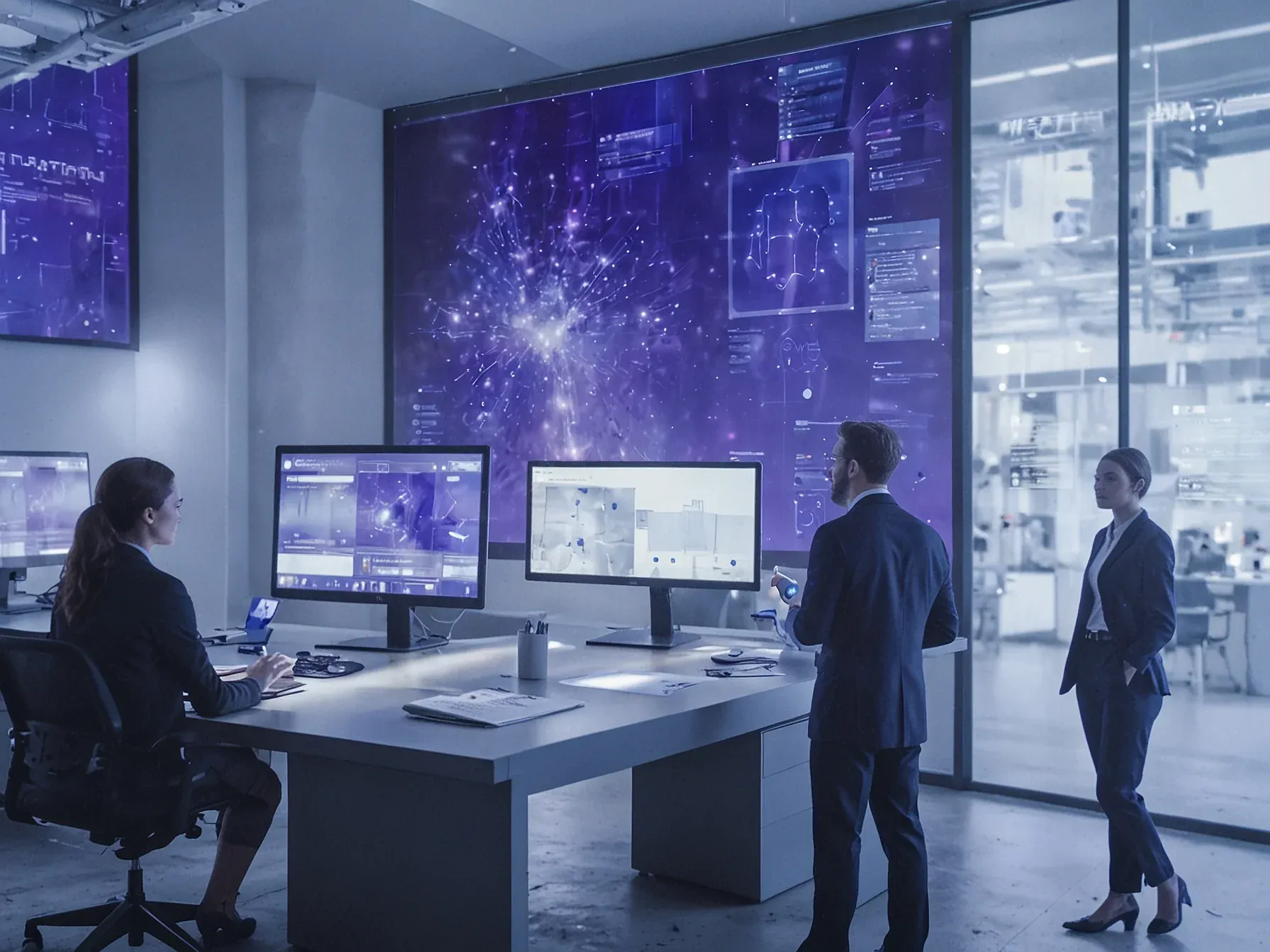
Editorial illustration for AI Takes Tasks, Humans Steer Strategy and Team Dynamics
AI Transforms Work: Human Vision Guides Collaborative Future
AI handles tasks; humans lead vision, keep team ties, guide uncertainty
Talk of the future of work is everywhere. Almost all of it is wrong. This isn't a story of replacement.
It's a slower, grinding reallocation of the tedious and the thoughtful. AI now processes invoices at companies like Stripe. It triages support tickets for Shopify.
It summarizes meetings. Humans are left with the messy stuff: strategic vision, team morale, guiding people through the unease of working with a system no one fully understands. These aren't premium skills.
They are the only ones left that matter. The psychological adjustment is far harder than the technical one. Workers aren't being upgraded.
They are being sorted. AI excels at execution within defined parameters. Human judgment operates in the fog.
The real problem, as managers at Google are finding, is mapping the border between the two and managing the relentless tension along that frontier.
While the AI is doing the doing, you are doing the visioning, maintaining team connections, and providing support around the uncertainty of working alongside intelligence systems. You will be helping your team understand the difference between what decisions could be made by AI and what decisions need to be made by people. Or create a climate of psychological safety for leaders and team members to admit when they don't understand how the AI proposed a conclusion.
You will consistently be evaluating whether people are automatically moving to the AI and ensuring independent thinking happens. This also means having legitimate conversations about the evolution of jobs and assisting individuals to understand they have their own unique 5%. Leaders are coaching their teams to inform those uniquely human skills while utilizing AI to increase efficiencies.
Leaders are cultivating cultures where it is acceptable and expected to not just ask the question, "Should we let AI take care of this task, or is this an opportunity for human judgment?" A lot of robots can speak different languages and even change their tone according to the data, but none has ever experienced cultural intelligence.
That quote nails it. The job now is border patrol and therapist. Leaders must constantly ask that simple, brutal question: is this for the machine or for us?
They must build rooms, like those at consulting firm Slalom, where admitting confusion about an AI's output is safer than blindly accepting it. This isn't about cultivating human skills. It's about protecting them from atrophy.
When every process begs for automation, independent thought becomes a conscious act of rebellion. Team connections aren't a nice-to-have. They are the critical infrastructure for managing collective disorientation.
The next era of work will be defined by a single metric: a company's tolerance for uncertainty. Organizations that mistake machine efficiency for wisdom will fail. The winners, perhaps a firm like Patagonia, will be paranoid about preserving human judgment in the loop.
Especially when it's slower. Especially when it's less confident.
Related Reading
 LLMs & Generative AI
 ChatGPT's 'Nerdy' tweak rewards goblin metaphors in answers, study finds
 LLMs & Generative AI
 Google tests visual 'magazine-style' UI for Gemini 3 Pro users
 LLMs & Generative AI
 AI Engineers Face Rising Costs, Need New Strategies for Efficiency
 From Archives
 Brumby-14B-Base Qwen3 variant uses Power Retention, avoids full training cost
 From Archives
 Amazon adds Alexa Plus to Music app for nuanced song picks and vibe playlists
Common Questions Answered
How are humans redefining their role alongside AI in the workplace?
Humans are shifting from task executors to strategic conductors who provide vision, maintain team connections, and create psychological safety. They are focusing on high-level decision-making, interpreting AI outputs, and guiding teams through the complexities of AI collaboration.
What key responsibilities do leaders have in an AI-integrated work environment?
Leaders must help teams understand the distinction between AI-driven and human-driven decisions, create a climate of psychological safety, and support team members in navigating uncertainty with AI systems. They are responsible for evaluating AI recommendations and ensuring human strategic oversight.
Why is strategic thinking still considered a uniquely human capability in the age of AI?
Strategic thinking requires nuanced understanding, emotional intelligence, and contextual reasoning that AI currently cannot replicate. Humans excel at visioning, interpreting complex scenarios, and making decisions that require empathy, ethical considerations, and long-term organizational goals.
Further Reading
- When humans and AI work best together — and when each is better alone — MIT Sloan
- Generative AI in Human-AI Collaboration: Validation of Collaborative AI Literacy and Metacognition Scales — International Journal of Human-Computer Interaction
- AI and VR: A model for human-AI collaboration — Deloitte Insights
- AI-Generated “Workslop” Is Destroying Productivity — Harvard Business Review
- AI Predictions for 2025: Embracing the Future of Human and Machine Collaboration — DATAVERSITY
