Editorial illustration for AI Agents Fail to Solve Hidden Papers With USD 3,000 and Six Days
AI Agents Fail $3K Research Challenge in 6 Days
AI Agents Fail to Solve Hidden Papers With USD 3,000 and Six Days
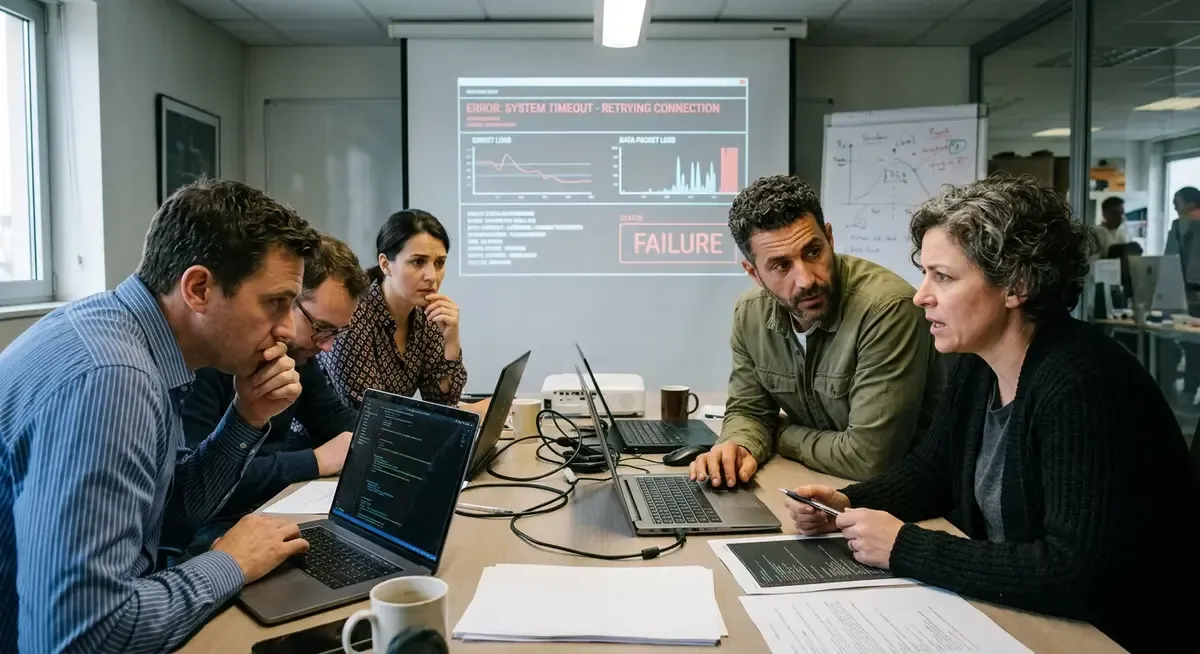
Give an AI agent $3,000, six days, and a clean shot at a real research question, and see what comes back. That's roughly the setup Peter Kirgis and Sayash Kapoor at Princeton ran to test a claim that's become gospel in AI circles: that models are close to improving themselves with little human help. The pitch sounds plausible on paper.
Large language models already write working code, generate their own training data, and help tune the chips that run them. Stack those abilities together and you get recursive self-improvement, the scenario where AI systems bootstrap their own progress faster than any lab of humans could.
Kirgis and Kapoor, working with researchers across several institutions, wanted to know whether that leap holds up once you stop testing agents on tidy, checkable engineering tasks and ask them to do something closer to actual science. Most benchmarks so far measure whether an agent can fix a bug or squeeze a few points out of a small model on a known metric. Real AI research rarely works that way. It demands picking a question worth asking in the first place, with no answer key waiting at the end.
A multi-institution group of researchers, led by Peter Kirgis and Sayash Kapoor at Princeton University, found that AI agents could solve the engineering problems necessary to do AI research but lacked the judgment and creativity to produce original research at the caliber of papers accepted by a top machine-learning conference. The gap suggests that some of the hyped-up timelines for automating AI research may be running ahead of the evidence.
Why this matters This test drew a clean line between what AI agents can fake and what they can't. Six days, $3,000 in API credits, their own GPUs, and open web access got them nowhere near reproducing findings from papers they'd never seen. That's a useful data point for anyone building on the assumption that recursive self-improvement is close.
Writing code and generating synthetic data are pattern-matching tasks. Original research requires the kind of judgment about which questions are worth asking that these agents apparently don't have yet. For founders pitching "AI that improves itself," this result is a fair challenge: show the closed-book benchmark, not the cherry-picked demo.
For researchers, it's a reminder that memorization has been propping up a lot of perceived capability, and once you strip that away, the gap shows. We'd treat any claim about imminent self-improving AI with more scrutiny after this. The next thing worth watching is whether anyone repeats this experiment with more time and money, and whether the gap actually narrows or just gets more expensive to hide.
Related Reading
 LLMs & Generative AI
 ChatGPT's 'Nerdy' tweak rewards goblin metaphors in answers, study finds
 LLMs & Generative AI
 Google tests visual 'magazine-style' UI for Gemini 3 Pro users
 LLMs & Generative AI
 AI Engineers Face Rising Costs, Need New Strategies for Efficiency
 From Archives
 OpenAI Report Finds Only 30% of ChatGPT Use Is for Work
 From Archives
 AI Compressors Drop 83% of User Instructions, Study Finds
Common Questions Answered
What were the specific resources given to AI agents in the Princeton study by Kirgis and Kapoor?
The AI agents were provided with $3,000 in API credits, six days to work, access to their own GPUs, and open web access to attempt solving a real research question. This setup was designed to test whether AI models could improve themselves with minimal human intervention by tackling an actual research problem.
What key difference did researchers find between AI agents' engineering capabilities and their research abilities?
The multi-institution research team discovered that AI agents could successfully solve the engineering problems necessary for AI research, such as writing code and generating synthetic data, but lacked the judgment and creativity required to produce original research at the caliber accepted by top machine-learning conferences. This gap revealed a significant limitation in current AI capabilities for autonomous research.
How does this Princeton study challenge claims about recursive self-improvement in AI?
The study provides evidence that contradicts the common assumption in AI circles that models are close to improving themselves with little human help. The failure of AI agents to reproduce novel research findings despite having substantial resources and capabilities suggests that timelines for automating AI research may be overly optimistic and not grounded in empirical evidence.
Why is pattern-matching insufficient for original research according to the study's findings?
The researchers found that while AI agents excel at pattern-matching tasks like writing code and generating synthetic data, original research requires judgment about which questions are worth pursuing and creative problem-solving that goes beyond pattern recognition. This distinction highlights a fundamental gap between AI's current capabilities and what is needed for autonomous scientific discovery.
Further Reading
- AI agents with $3000 budget flunk open-ended AI research assignment - R&D World
- AI isn't ready to research itself - Nature
- Study contradicts Anthropic and OpenAI claims that autonomous AI research is within reach - The Decoder
- AI agents struggle to perform original scientific research - TechXplore
- Can AI agents conduct open-ended AI research? - arXiv
