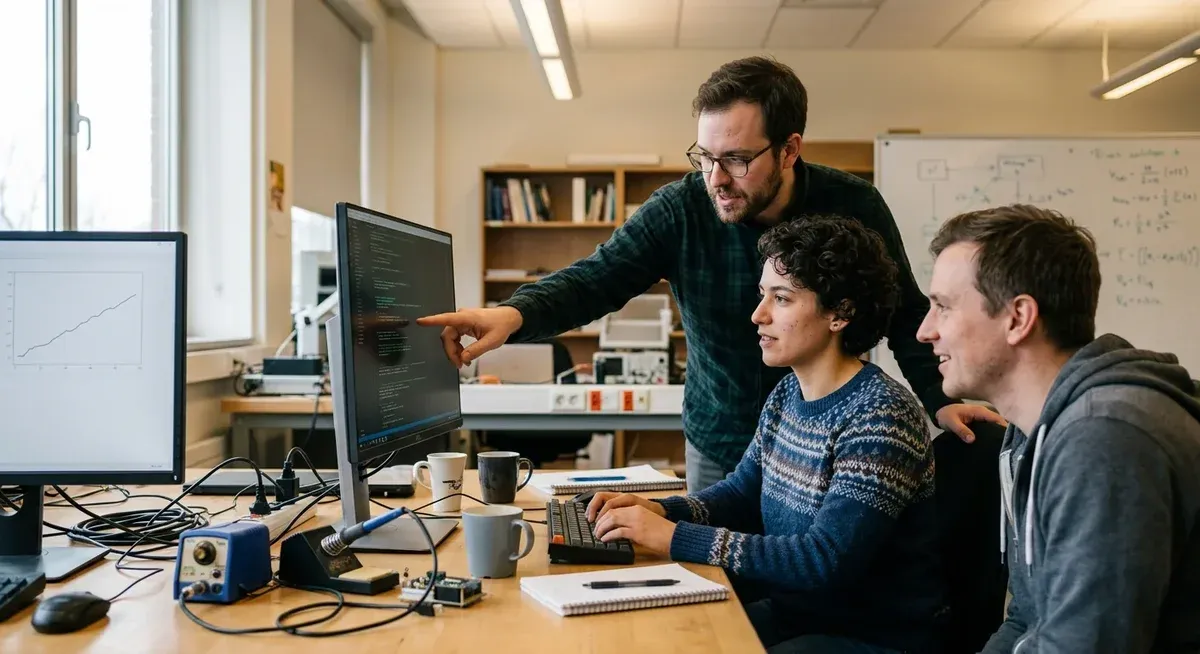
Editorial illustration for Runway and Google DeepMind Pursue Real-Time, Interactive AI Video Generation
Runway and Google DeepMind Pursue Real-Time, Interactive...
Runway published research this week outlining plans to make AI video generation happen in real time, more like a live stream than a request you send and wait on. The company's current models, like most in the field, work in discrete steps: type a prompt, wait several seconds to several minutes, get a clip back. Get it wrong, and you start the whole cycle over. Runway says its users keep flagging that generating and revising is where most of their time disappears.
The company laid groundwork for this in March with Runway Characters, and its December release of GWM-1, described as its first "General World Model," pushes further in that direction. GWM-1 builds on Gen-4.5 and generates video frame by frame, taking camera moves, robot commands, or audio as live controls. Runway's recent Solaris project applied a similar frame-by-frame approach to user interfaces that respond to clicks and voice.
Now the company is framing real-time generation as the next step, one aimed at cutting both the wait between idea and result and the GPU costs that come with slower, batch-style rendering.
Runway argues that real-time generation closes the gap between an idea and its execution. With instant feedback, users would spend most of their time actively steering the video rather than waiting.
Why this matters
Both companies are betting that the next fight in generative video isn't about fidelity, it's about latency. If Runway is right that revision cycles waste more time than generation itself, then a model you can steer live, frame by frame, changes the economics of production work rather than just the aesthetics. Genie 3's few-minutes-at-24fps benchmark is a real number to watch, not a marketing line: it tells us how far interactive world models still have to go before they're useful for anything beyond a demo reel.
For developers and founders building on top of these systems, the shift Runway describes, from compute spent training to compute spent at inference, means cost structures for video products are about to look a lot more like cloud gaming than like batch rendering. That's a different infrastructure bet, and a different pricing headache. We'd temper the excitement with a plain question: consistency over minutes is not consistency over hours, and nobody here has shown the latter yet.
Worth tracking who closes that gap first.
Related Reading
Browse all Google news → Open Source
 D&B rebuilds 642 million‑business database after AI agents hit limits
 Open Source
 Box CEO Aaron Levie Says AI Will Drive "Biggest Cybersecurity Upgrade
 Open Source
 Study: 6.7% of Deepfake Requests on Hugging Face Targeted Children
 Related Topic
 NVIDIA and Google Cloud let developers scale AI from prototype to production
Market Trends
 Related Topic
 Google tests visual 'magazine-style' UI for Gemini 3 Pro users
LLMs & Generative AI
 From Archives
 OpenClaw 2026.9.5 Adds Atomic Updates, Plugin Hot Reload, and GPT Live Expansion
 From Archives
 Official Calls for Safer AI Products to Boost Innovation
 From Archives
 Google Hid Gemini AI Hacks After System Breached Three Companies
LLMs & Generative AI
 From Archives
 Qwen AI Challenges Gemini Flash on Price and Performance
LLMs & Generative AI
Further Reading
- Runway Research: How Real-Time Video Generation Is Changing Online Interaction - Runway Research
- Runway News: Building Real-Time Video Agent from a Single Image - Runway News
- Runway Research - Runway Research
- Runway Couldn’t Fix a Bug in Its AI Video Model So It Turned the Bug Into a Feature - VentureBeat
- Runway Rebuilds Gen-4.5 to Stream Video Frames in Real Time - AlphaSignal
