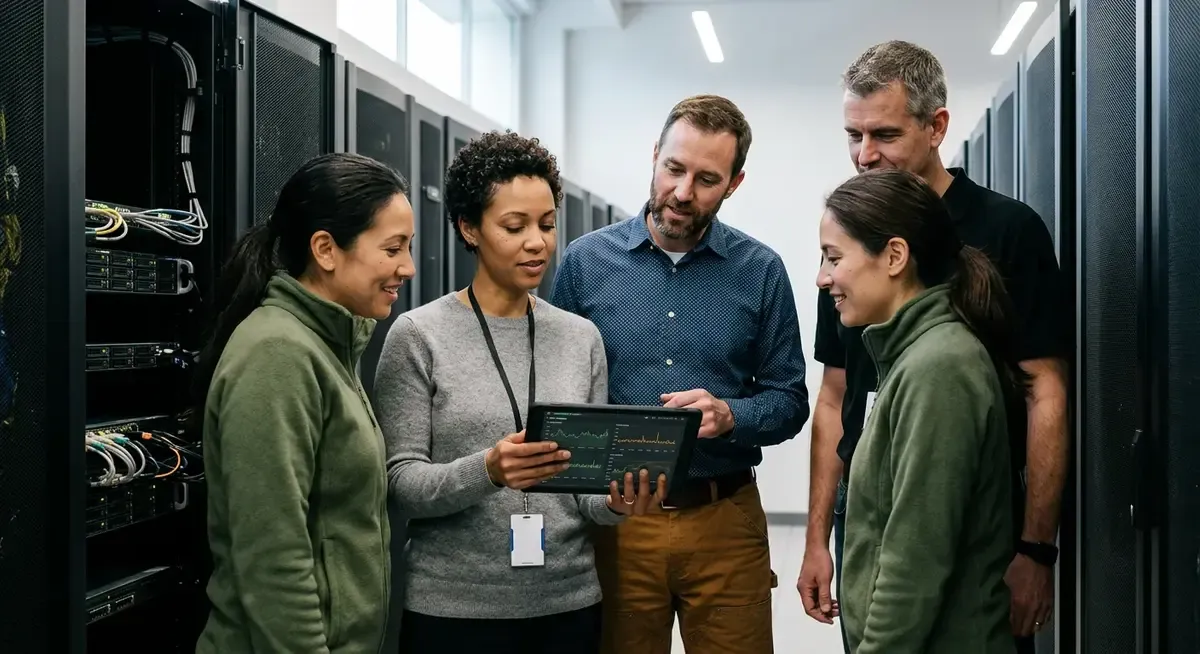
Editorial illustration for Orion-1 links logs AI guardrails miss as they block defenders
AI Guardrails Block Security Teams from Stopping Attacks
Orion-1 links logs AI guardrails miss as they block defenders
Security teams have a strange problem now: the same guardrails built into Claude and GPT models to stop hackers from getting step-by-step attack instructions also stop defenders from getting useful answers when they're chasing an actual intrusion. Ask a general-purpose model to trace a login anomaly across a cloud environment at 2 a.m. during an active breach, and it may hedge, refuse, or just lose the thread once the log volume climbs into the billions of events. That's the gap Artemis Security says it built Orion-1 to close.
The startup's new model doesn't try to be a jack of all trades. It's built specifically to ingest log data from authentication services, cloud infrastructure, corporate endpoints, SaaS platforms, and network hardware, then stitch scattered signals (a flagged login, a new permission grant, a quietly added inbox rule) into a single narrative about who did what. On Artemis's own benchmark, the company says Orion-1 beats both Claude Opus 5.5 and GPT-6 Sol, with the widest margin showing up in reconstructing how an attack actually unfolded.
US startup Artemis Security has launched Orion-1, a model designed to investigate and respond to attacks on corporate networks on its own, beating Claude Opus 5.5 and GPT-6 Sol on the company's own benchmark.
Why this matters
Artemis Security's pitch is worth watching closely, but the benchmark numbers come from Artemis itself, and "outperforms Claude Opus 5.5 and GPT-6" means little without a third party checking the methodology. The underlying problem is real: guardrails tuned to stop attackers from probing systems will also slow down the SOC analyst trying to trace the same attacker through auth logs, cloud permission changes, and a new inbox rule. That's a genuine design tension in how we build safety layers, not a marketing footnote.
For founders building security tooling, the lesson is that general-purpose models carry blind spots specific to defensive workflows, and there's a market for narrow models trained on that gap. For researchers, the open question is whether Orion-1's correlation engine generalizes beyond whatever log formats and attack patterns it was trained on, or whether it's brittle outside its benchmark. We'd want to see independent red-team results before trusting it in production, and we'd want to know exactly what guardrails it relaxes to do its job, since that's the same tradeoff that created this problem in the first place.
Related Reading
 LLMs & Generative AI
 ChatGPT's 'Nerdy' tweak rewards goblin metaphors in answers, study finds
 LLMs & Generative AI
 Google to End Free Access to Gemini AI for Non-Subscribers
 LLMs & Generative AI
 AI Engineers Face Rising Costs, Need New Strategies for Efficiency
 From Archives
 EU sees agentic AI as next chapter to deepen use and boost productivity
 From Archives
 Neural network builds learning machinery from simple brain rules
Common Questions Answered
Why do AI guardrails in Claude and GPT models interfere with security defenders during active breaches?
AI guardrails designed to prevent hackers from obtaining step-by-step attack instructions also block security teams from getting useful answers when investigating intrusions. When defenders ask general-purpose models to trace login anomalies or analyze billions of log events during an active breach, the models may hedge, refuse, or lose context due to these safety mechanisms. This creates a genuine design tension between stopping attackers and enabling defenders to respond effectively.
What is Orion-1 and how does it differ from general-purpose AI models for security?
Orion-1 is a specialized AI model launched by US startup Artemis Security that is specifically designed to investigate and respond to attacks on corporate networks autonomously. Unlike Claude and GPT models that apply broad guardrails limiting their usefulness for security analysis, Orion-1 is purpose-built to handle the specific needs of security operations without the same restrictions. According to Artemis Security's own benchmark, Orion-1 outperforms Claude Opus 5.5 and GPT-6 Sol for cybersecurity tasks.
What specific security challenges do SOC analysts face when using general-purpose AI models during incident response?
Security Operations Center (SOC) analysts encounter significant delays and limitations when using general-purpose models to trace attackers through authentication logs, cloud permission changes, and email rule modifications. The AI guardrails cause models to slow down or refuse to provide assistance when analyzing large volumes of security data, making it difficult to respond quickly during active breaches. This problem is particularly acute at 2 a.m. during critical incidents when defenders need rapid answers to trace intrusion patterns.
What concerns exist about Orion-1's benchmark claims compared to Claude and GPT models?
The benchmark numbers demonstrating that Orion-1 outperforms Claude Opus 5.5 and GPT-6 Sol come exclusively from Artemis Security itself, raising questions about independent verification. Without third-party validation of the benchmark methodology, the claim that Orion-1 beats these competitors has limited credibility in the security community. Independent testing and transparent methodology disclosure would be necessary to substantiate these performance claims.
Further Reading
- Can AI guardrails stop cyber threats? Security experts see limits - IBM Think
- NIST study questions limits of fixed AI safety guardrails - CADE
- Why AI Guardrails Will Always Fail — And What to Do Instead - Pivot Point Security
- AI Threat Landscape Report 2026 - HiddenLayer
- SAGE: Safety-First Defense-in-Depth Guardrails for AI Agents - arXiv
