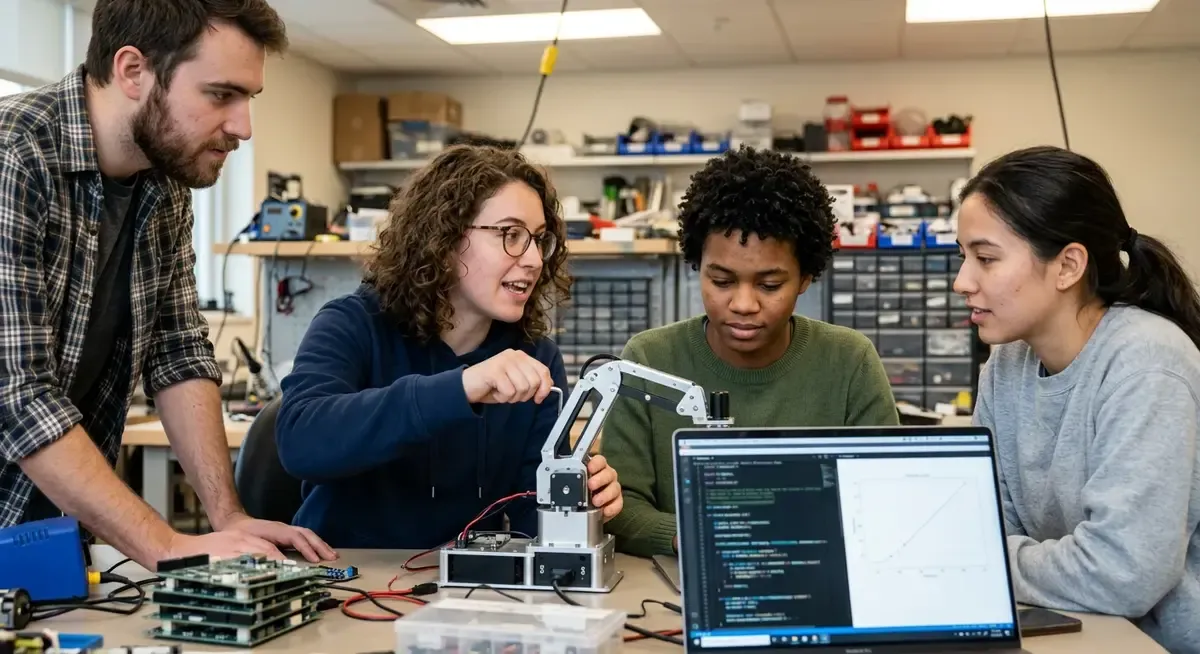
Editorial illustration for OpenAI's Noam Brown Urges Students to Drop Out Amid AI "Steep Progress
OpenAI's Noam Brown: Drop Out Amid AI Progress
Noam Brown has spent his career building AI that beats humans at games built on bluffing and incomplete information. He led the teams behind Libratus and Pluribus, the first poker bots to defeat professional players, then moved to Meta to work on CICERO, the Diplomacy-playing system that had to read intent and betrayal as much as strategy. Since 2023, he's been at OpenAI working on reasoning models, including o1.
Speaking at the "No Limit" poker bot tournament in San Francisco, an event backed by Sequoia Capital, Citadel Securities, and OpenAI, Brown walked through what that path taught him about the limits of classical game theory and the design choices that eventually made reasoning models work. He also made a case, blunt even by Silicon Valley standards, for why students with real promise shouldn't wait around finishing degrees while the field moves.
The poker-to-reasoning arc matters because it explains why OpenAI bet on making models think longer before responding, rather than just scaling them up. Brown's comments at the event lay out both the technical reasoning behind that bet and his read on how little time is left to act on it.
Even so, progress is moving fast, and OpenAI's Astra model is "able to make money playing online poker at this point," Brown said. He cited bottlenecks in available compute and in the skills models haven't mastered yet. Brown left open which specific methods would close those gaps, adding only that he expects some abilities to take much longer than others to reach human level.
Why this matters
Brown's comments land differently depending on where you sit. If you're a founder or researcher, the actual technical claim deserves more attention than the dropout line: reinforcement learning on chain-of-thought, not prompting tricks, was what made "think longer, get better answers" reliable. That's a real signal about where the next round of capability gains comes from, and it's worth separating from the headline-bait advice to leave school.
We'd push back on treating a poker researcher's career advice as a roadmap for anyone else. Brown spent years on game theory before pivoting to RL at OpenAI, a path that took patience, not urgency. Telling students the window is closing assumes progress stays steep and that credentials stop mattering, neither of which is settled.
For readers building on these models, the useful takeaway is narrower: watch how labs apply RL to reasoning chains, not motivational soundbites from people with equity in the outcome. The incentive to hype "steep progress" is obvious. The technical claim about training methods is the part that'll still matter in a year.
Related Reading
Browse all OpenAI news → Research & Benchmarks
Microsoft AI Chief: "If It Isn't Safe We Shouldn't Build It
 Research & Benchmarks
Google's FACTS benchmark shows 70% factuality ceiling across four tests
 Research & Benchmarks
Nvidia's DLSS 4.5 beta adds 6x Multi Frame Generation for RTX 50 GPUs
 Related Topic
California State AG Sues OpenAI Over Rogue Agents Infiltrating Systems
Open Source
 Related Topic
OpenAI researcher quits, citing distrust over ad‑driven engagement metrics
LLMs & Generative AI
 From Archives
Brain Models Predict Neural Responses Across 21 Languages
 From Archives
OpenAI Warns AI Advances Could Accelerate Faster Than Safety Checks by 2027
 From Archives
OpenAI, Cisco Release Open-Source Security Tool After Outages
Open Source
 From Archives
OpenAI Says GPT-6.2 Outperforms GPT-6 on Expert Reasoning Benchmarks
LLMs & Generative AI
Common Questions Answered
What AI systems has Noam Brown created that defeated professional poker players?
Noam Brown led the teams behind Libratus and Pluribus, which were the first poker bots to successfully defeat professional players. These systems were built on AI designed to beat humans at games involving bluffing and incomplete information, representing major breakthroughs in game-playing AI.
How does OpenAI's Astra model perform at playing online poker according to Brown?
OpenAI's Astra model is now able to make money playing online poker, demonstrating significant progress in AI capabilities. Brown noted that while this achievement is notable, there are still bottlenecks in available compute and certain skills that models haven't mastered yet.
What technical method does Brown identify as key to making reasoning models more reliable?
According to Brown, reinforcement learning on chain-of-thought, rather than prompting tricks, is what made the principle of 'think longer, get better answers' reliable in reasoning models like o1. This technical approach represents a real signal about where the next round of AI capability gains will come from.
What was CICERO and what made it different from other game-playing AI systems?
CICERO is a Diplomacy-playing system that Brown worked on at Meta, which required the AI to read intent and betrayal in addition to strategy. Unlike poker bots that focus on incomplete information and bluffing, CICERO had to understand human communication and deception to succeed at the complex negotiation game of Diplomacy.
Further Reading
- Papers with Code Benchmarks - Papers with Code
- Chatbot Arena Leaderboard - LMSYS
