
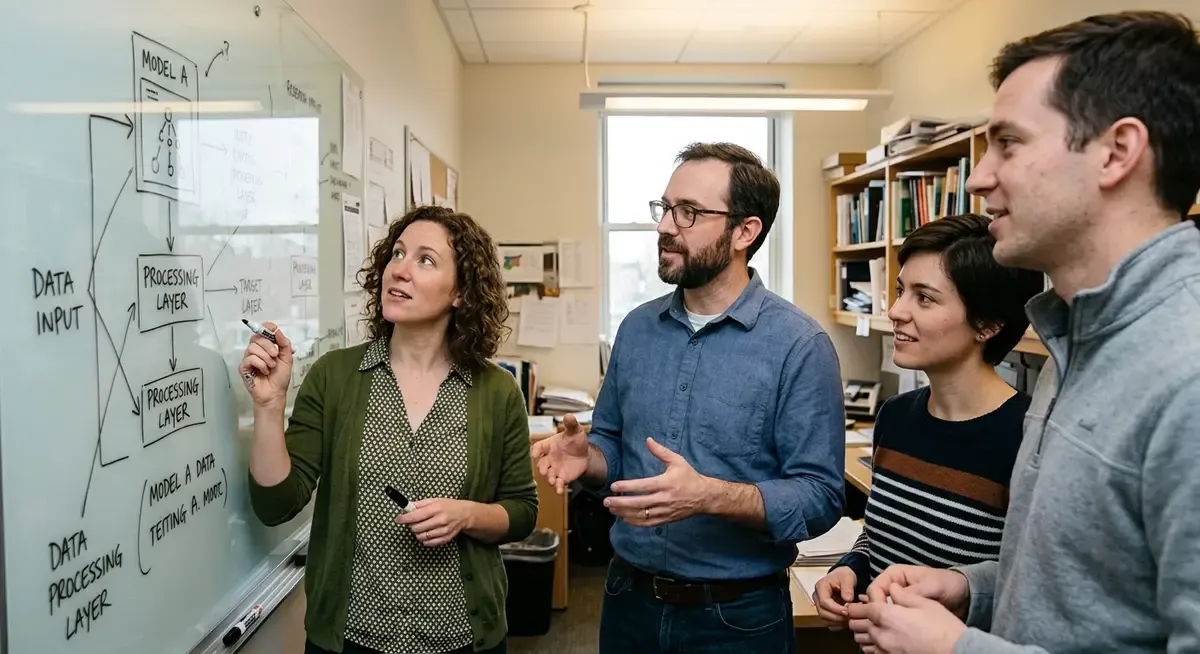
Editorial illustration for Brain Models Predict Neural Responses Across 21 Languages
Brain Processes All Languages the Same Way, MIT Study Finds
Brain Models Predict Neural Responses Across 21 Languages
MIT researchers have found evidence that the brain processes language the same way no matter which one a person speaks, whether it's tonal Vietnamese, word-order-flexible Russian, or rigid English syntax. The study, published today in Nature Neuroscience, used multilingual AI models to predict how the human brain responds to speech and text, then tested those predictions against brain activity from people speaking 21 different languages. The models picked up on a shared neural pattern that held across all of them.
It's the first study to use multilingual models this way, matching AI predictions against real brain data across such a wide range of languages. Evelina Fedorenko, an investigator at MIT's McGovern Institute for Brain Research and senior author on the paper, led the work alongside her lab. The finding has practical stakes beyond linguistics.
AI tools built to diagnose brain disorders through language have so far been trained mostly on English and a handful of other major languages. A shared neural code across languages could let those tools reach speakers of languages that currently have no such diagnostic support, including some at risk of disappearing altogether.
In the study published today in Nature Neuroscience, the researchers used multilingual models to predict how the human brain responds to various languages. Those models also helped the researchers detect a shared brain process across people who collectively spoke 21 different languages.
Why this matters
For anyone building multilingual AI systems, this is a useful data point: the MIT team's encoding models, trained on outputs from multilingual language models, predicted brain activity across 21 languages, including Marathi and Lithuanian, which have little structural overlap with English. That suggests the models are picking up on something beyond surface grammar, maybe a shared computational signature of meaning-making that survives translation across tonal, inflected, and fixed-order languages alike. For researchers, that's a hint about where to look next, not proof that we've found a universal grammar in silicon or neurons.
We'd want to see this replicated with different model architectures and more typologically distant languages, like click languages or polysynthetic ones, before calling it universal. For founders building multilingual products, the practical takeaway is narrower: models trained predominantly on English and a few major languages may already be capturing more cross-linguistic structure than their training data would suggest. That's worth testing directly, not assuming.
The real payoff here is methodological: pairing brain imaging with model outputs gives researchers a new lens for checking whether language models understand something real, or just pattern-match convincingly.
Related Reading
 Research & Benchmarks
Microsoft AI Chief: "If It Isn't Safe We Shouldn't Build It
 Research & Benchmarks
Google's FACTS benchmark shows 70% factuality ceiling across four tests
 Research & Benchmarks
Nvidia's DLSS 4.5 beta adds 6x Multi Frame Generation for RTX 50 GPUs
 From Archives
OpenAI Warns AI Advances Could Accelerate Faster Than Safety Checks by 2027
 From Archives
Meta's Wang: AI Industry Not Ready for Post-Riemann Era
Common Questions Answered
What did MIT researchers discover about how the brain processes different languages?
MIT researchers found that the human brain processes language in the same way regardless of which language a person speaks, whether it's tonal Vietnamese, word-order-flexible Russian, or rigid English syntax. This discovery was made by using multilingual AI models to predict neural responses and testing those predictions against brain activity from speakers of 21 different languages.
How did the MIT study use multilingual AI models to predict brain activity?
The researchers trained encoding models on outputs from multilingual language models to predict how the human brain responds to various languages. These models were then tested against actual brain activity data collected from multilingual speakers to identify shared neural patterns across different language structures.
What languages were included in the MIT study and what does this reveal?
The study examined brain activity from speakers of 21 different languages, including languages with little structural overlap with English such as Marathi and Lithuanian. The fact that the multilingual models successfully predicted brain responses across these linguistically diverse languages suggests the models are detecting a shared computational signature of meaning-making that transcends surface grammar differences.
Why is this MIT research significant for building multilingual AI systems?
This research provides valuable evidence that multilingual AI models can identify universal neural patterns in language processing that go beyond surface-level grammatical structures. Understanding this shared neural code can help developers of multilingual AI systems create more effective models that capture the fundamental cognitive processes underlying language comprehension across different languages.
Further Reading
- Many languages, one common neural code - MIT News
- Multilingual Computational Models Reveal Shared Brain Responses to 21 Languages - bioRxiv
- Multilingual Computational Models Capture a Shared Meaning Component in Brain Responses across 21 Languages - bioRxiv
- Multilingual Computational Models Reveal Shared Brain Responses to 21 Languages - Cognitive Computational Neuroscience Conference
- Not Lost in Translation: Neural Responses Shared Across Languages - Proceedings of the National Academy of Sciences
