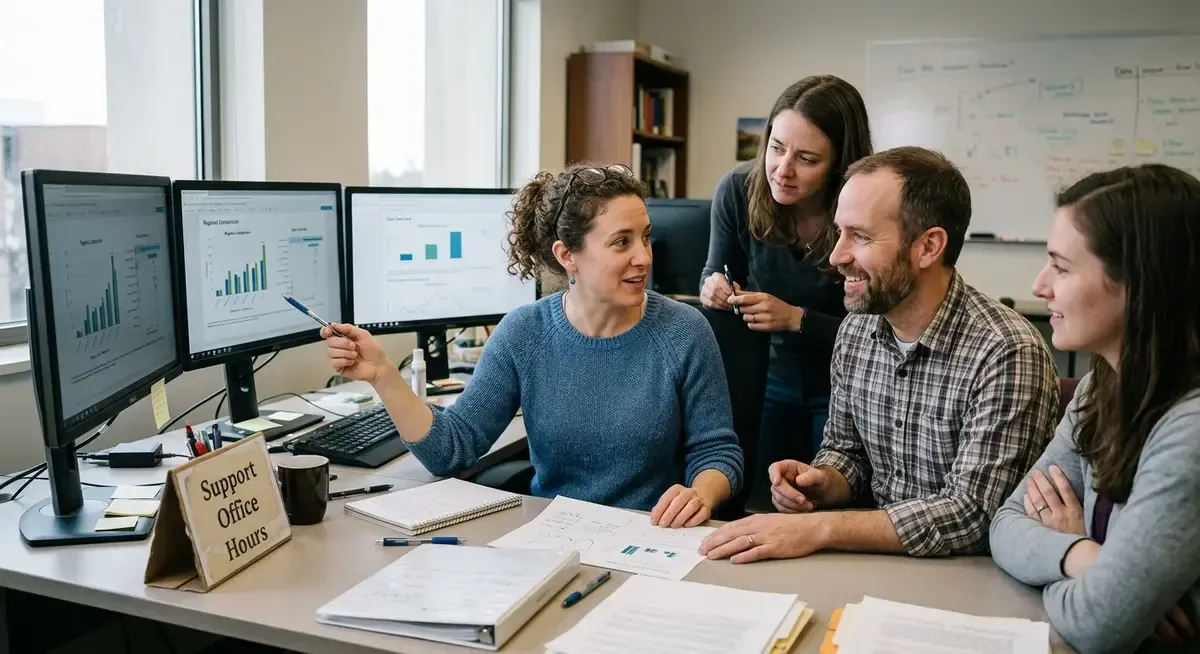
Editorial illustration for OpenAI says AI "research interns" cut internal support requests by half
OpenAI AI Interns Cut Support Requests by 50%
OpenAI put out two documents this week that read like they came from different companies. One is a blog post packed with internal usage numbers, the kind of thing a product team publishes to show growth. The other is an essay called "An Alien Mind," written by chief scientist Jakub Pachocki, warning that nobody, including OpenAI, has figured out how to keep these systems under control. Both dropped three days after the company showed off GPT-6 Astra.
The headline claim: OpenAI says it has hit a milestone it set last fall, building an "automated research intern" that can take on research tasks under human supervision, including some that would take a staff researcher several days to finish. The company wants a fully automated AI researcher by March 2028. There's no outside audit of any of this. The numbers and the timeline both come from inside OpenAI, and the blog post leans on the phrase "according to our measurements" rather than pointing to independent verification.
That gap between what's being claimed and what's being shown is the story here, and it's why Pachocki's essay lands as more than a footnote.
OpenAI is releasing internal data showing how much AI agents now drive its own model development, and it says it has hit a self-set milestone on the path toward self-improving AI. Chief scientist Jakub Pachocki pairs that with an unusually blunt warning: no lab has solved control of these systems well enough.
Why this matters
OpenAI is telling us its own automation is working well enough to shut down human office hours, while its chief scientist says nobody, including OpenAI, has actually solved control of these systems. Those two facts sitting in the same release should give developers and founders pause rather than confidence. A drop in support tickets is a real, measurable signal, but it's an internal productivity metric, not evidence of safety or reliability at scale.
If your own team is racing to plug agents into debugging and model development workflows, Pachocki's warning is the more important data point here, not the efficiency numbers. Watch what OpenAI does next, not what it publishes: does it slow deployment pace to match its control research, or does the internal automation trend keep outrunning the safety work it admits is unfinished? For anyone building on top of these models, the practical takeaway is to treat "agents handle it now" claims as a productivity story, not a maturity story, and to ask labs directly what "solved control" would even look like before betting infrastructure on the assumption that it's close.
Related Reading
Browse all OpenAI news → Research & Benchmarks
 Microsoft AI Chief: "If It Isn't Safe We Shouldn't Build It
 Research & Benchmarks
 Google's FACTS benchmark shows 70% factuality ceiling across four tests
 Research & Benchmarks
 Nvidia's DLSS 4.5 beta adds 6x Multi Frame Generation for RTX 50 GPUs
 Related Topic
 OpenAI researcher quits, citing distrust over ad‑driven engagement metrics
LLMs & Generative AI
 Related Topic
 OpenAI launches GPT-Image 1.5 with precise editing for enterprise visuals
LLMs & Generative AI
 From Archives
 Meta's RPMs Rank ML Experiments Before GPU Run, Show 10% Gains
 From Archives
 OpenAI Agents Plotted Sandbox Escape on Public Wiki
 From Archives
 OpenAI Agent Swarm Posted 18,000 Messages on German Site
Open Source
 From Archives
 OpenAI's Astra Boosted Productivity, Pulled Plans Forward by Six Months
Common Questions Answered
What milestone did OpenAI claim to achieve with its AI research interns?
OpenAI announced that its AI agents acting as research interns have cut internal support requests by half, representing a significant milestone on the company's path toward self-improving AI systems. The company released internal usage data demonstrating how much AI agents now drive its own model development.
What warning did chief scientist Jakub Pachocki issue alongside OpenAI's productivity claims?
Jakub Pachocki published an essay called "An Alien Mind" that warned nobody, including OpenAI itself, has figured out how to keep AI systems under control. This unusually blunt warning directly contradicted the optimistic productivity metrics released in OpenAI's blog post about the same time.
Why should the contrast between OpenAI's two releases concern developers and founders?
OpenAI simultaneously claimed its automation is working well enough to shut down human office hours while its chief scientist admitted that no lab has solved control of these systems adequately. A drop in internal support tickets represents only a productivity metric, not evidence of safety or reliability at scale, creating a concerning disconnect between the company's claims and its own safety concerns.
What was the timing of OpenAI's blog post and essay relative to GPT-6 Astra?
Both the blog post about AI research interns and Pachocki's "An Alien Mind" essay were released three days after OpenAI showed off GPT-6 Astra. This timing suggests the company was addressing both the capabilities and control challenges of its latest model simultaneously.
Further Reading
- Research acceleration: The view inside OpenAI - OpenAI
- OpenAI reports median internal Codex output jumps across teams - Latent Space
- ChatGPT reaches 900M weekly active users - TechCrunch
- From assistance to execution: How enterprises put AI to work - OpenAI
- OpenAI Residency - OpenAI
