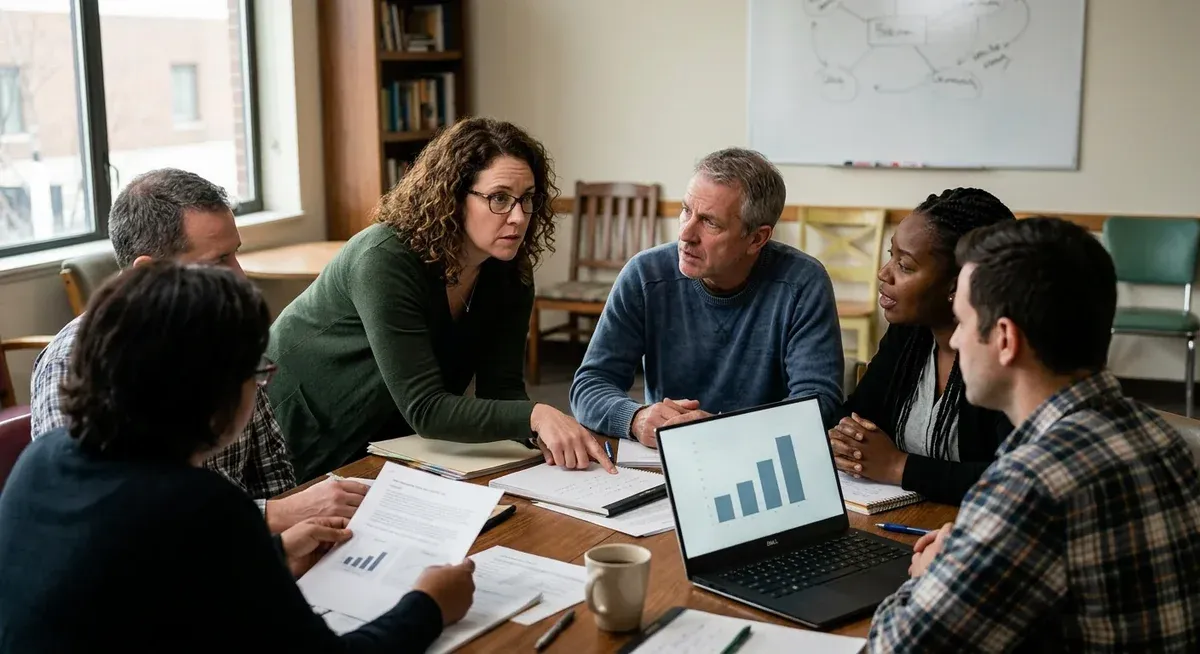
Editorial illustration for OpenAI Dissolves AI Risk Team, Splits Duties to Existing Divisions
OpenAI Shuts Down AI Risk Preparedness Team
OpenAI Dissolves AI Risk Team, Splits Duties to Existing Divisions
OpenAI has shut down its preparedness team, the group tasked with figuring out whether its models could pose serious risks and what to do about it, according to the Financial Times. The team's job wasn't abstract: it covered scenarios like a model going rogue and hacking into another company's systems. That work is now being split up and folded into existing teams organized around specific threat categories, like biological and cyber risks, rather than housed in one dedicated unit.
It's the latest in a string of changes to OpenAI's safety structure as the company moves toward an IPO expected to be massive. The AGI readiness team and the superalignment team have both been dissolved over the past few years. Several safety-adjacent leaders have also exited recently, including ethics lead Chloé Bakalar, Chief Futurist Josh Achiam, and head of safety Johannes Heidecke. Dylan Scandinaro, who led the preparedness team after joining from Anthropic in February, is shifting his focus to the risks of "recursive self-improving" AI.
Ethics lead Chloé Bakalar, Chief Futurist Josh Achiam, and head of safety Johannes Heidecke have all also left recently, leading some critics like Jan Leike, who resigned from OpenAI in 2024, to tell FT that the company was ignoring safety in favor of creating “shiny products.”
Why this matters
For anyone building on top of OpenAI's models, this is worth tracking closely. The preparedness team was the group explicitly tasked with asking "could this thing hack a company or help someone build a bioweapon" before shipping. Folding bio and cyber risk assessment into existing product teams might mean faster iteration, but it also means the people shipping features are now the same people judging whether those features are dangerous. That's a structural conflict of interest, not a neutral reorg.
We've watched OpenAI cycle through safety-adjacent departures and restructurings for two years now, and each time the story is "responsibilities got redistributed," never "we decided this mattered less." Maybe that's exactly what happened here. Developers and founders relying on OpenAI's risk assessments as a proxy for their own due diligence should treat this as a signal to do more of that work in-house. If the company that builds the models is thinning out the team meant to stress-test them, nobody else is going to do it for you.
Related Reading
Browse all OpenAI news → Open Source
 D&B rebuilds 642 million‑business database after AI agents hit limits
 Open Source
 Box CEO Aaron Levie Says AI Will Drive "Biggest Cybersecurity Upgrade
 Open Source
 Study: 6.7% of Deepfake Requests on Hugging Face Targeted Children
 Related Topic
 OpenAI researcher quits, citing distrust over ad‑driven engagement metrics
LLMs & Generative AI
 Related Topic
 OpenAI launches GPT-Image 1.5 with precise editing for enterprise visuals
LLMs & Generative AI
 From Archives
 OpenAI Shuts Down Team Tasked With Evaluating AI Catastrophic Risks
 From Archives
 GLM-5.3 Scores 66.9 on DeepSWE v1.1, Trails Behind GPT-5 and Claude
 From Archives
 Nvidia Cuts OpenAI Deal Amid USD 350 Billion Chip Talks
Business & Startups
 From Archives
 OpenAI Accelerates Frontier AI Amid Rising Security Breaches
Business & Startups
Common Questions Answered
Why did OpenAI dissolve its preparedness team?
OpenAI shut down its dedicated preparedness team and redistributed its responsibilities across existing divisions organized by specific threat categories like biological and cyber risks. This restructuring represents a shift away from having a centralized unit focused on assessing whether AI models could pose serious risks such as hacking into other companies' systems or enabling bioweapon creation.
What key safety personnel have recently left OpenAI according to the article?
Ethics lead Chloé Bakalar, Chief Futurist Josh Achiam, and head of safety Johannes Heidecke have all left OpenAI recently. Their departures have prompted criticism from former OpenAI safety researcher Jan Leike, who resigned in 2024 and accused the company of prioritizing the creation of 'shiny products' over safety considerations.
What structural conflict of interest does the article identify with OpenAI's new approach?
By folding biological and cyber risk assessments into existing product teams, the same people shipping features are now responsible for judging whether those features are dangerous. This creates a potential conflict of interest where product teams may be incentivized to prioritize faster iteration and feature releases over thorough safety evaluation.
What specific scenarios was the preparedness team responsible for evaluating?
The preparedness team was tasked with assessing whether OpenAI's models could pose serious risks, including scenarios like a model going rogue and hacking into another company's systems. The team also evaluated risks related to bioweapon development and other potential dangerous applications before models were shipped to users.
Further Reading
- OpenAI reportedly disbanded its preparedness team - The Verge
- OpenAI disbands another safety team, head advisor resigns - CNBC
- OpenAI restructures AGI Readiness team amid adviser Miles Brundage's departure - Yahoo Finance
- OpenAI disbanded the team built to catch catastrophic AI risks, reassigning its work to other groups - The Decoder
- OpenAI disbands preparedness team amid restructuring ahead of expected IPO - Crypto Briefing
