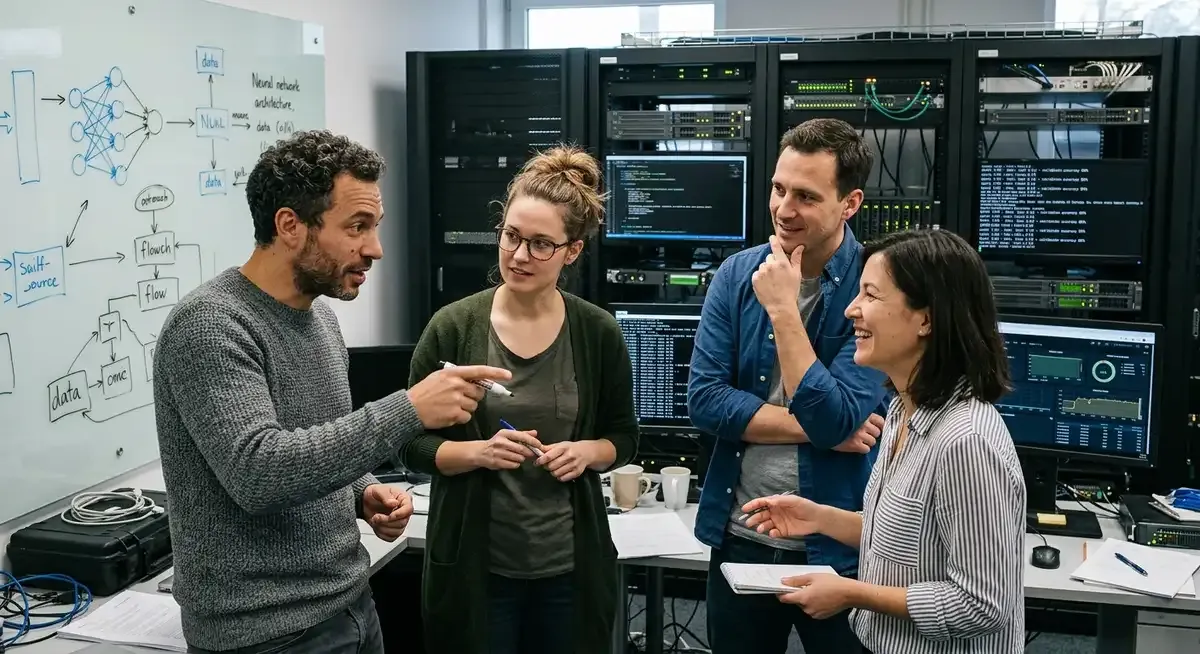
Editorial illustration for NVIDIA's AI Development Constraint: Isolation as a Scaling Unit
NVIDIA TensorRT Model Connect Simplifies AI Dev
NVIDIA's AI Development Constraint: Isolation as a Scaling Unit
NVIDIA's TensorRT team started with a narrow goal: give developers who don't know TensorRT's internals a way to get its performance without becoming experts in it. TensorRT Model Connect, an open source set of C++ model reference implementations built on TensorRT, was the result. But the project's real story isn't the code itself. It's how the code got written.
The team began by testing coding agents on the project almost as a side experiment. Within days, the question changed shape. Instead of asking how an agent could speed up an existing workflow, the team started asking what a project would look like if it were built around AI agents from day one.
No elaborate orchestration layer emerged, and no growing pile of prompt engineering. What emerged instead was a handful of structural decisions about how work gets scoped, isolated, checked, and undone when it fails. Those decisions, more than any tooling choice, shaped what "AI native" ended up meaning for this codebase, and why the team defines that term narrowly rather than as a general claim about intelligence or automation.
AI increases the rate at which candidate implementations can be produced. Architecture and validation determine whether that increased output becomes reliable software.
Why this matters
NVIDIA's TensorRT Model Connect experience is a useful data point for anyone building agentic workflows into real engineering teams, not demos. The finding that isolation, not raw task completion, is the binding constraint on scaling coding agents cuts against a lot of the current hype about agent capability benchmarks. It suggests the bottleneck for teams adopting Claude, Cursor, or in-house agents won't be whether the model can write correct code, it will be whether your repo structure, review process, and rollback mechanisms can contain the blast radius when it doesn't.
For founders and engineering leads, that's a concrete architectural question to answer before hiring agents onto a codebase: can changes be isolated by model family, feature, or module, and can they be reversed cheaply. NVIDIA's rule of adding constraints only after repeated evidence, rather than pre-emptively hard-coding process, is also worth borrowing. It's a more disciplined approach than most "AI-native" playbooks currently offer, and it comes from a team validating against actual GPU workloads rather than synthetic benchmarks.
Related Reading
 Research & Benchmarks
 Microsoft AI Chief: "If It Isn't Safe We Shouldn't Build It
 Research & Benchmarks
 Google's FACTS benchmark shows 70% factuality ceiling across four tests
 Research & Benchmarks
 Nvidia's DLSS 4.5 beta adds 6x Multi Frame Generation for RTX 50 GPUs
 Related Topic
 NVIDIA NeMo powers telco reasoning model for autonomous network workflows
Industry Applications
 Related Topic
 China offers cheaper electricity to AI firms abandoning NVIDIA chips
Business & Startups
 From Archives
 BBC's Re-Released 2000 Exhibition Shows How We Imagined Internet's Future
 From Archives
 Timnit Gebru Says AI's Real Issues Are Labor Exploitation and Data Documentation
 From Archives
 NVIDIA VSS Blueprint 3.3 Cuts Cost of Deploying Visual AI Agents
LLMs & Generative AI
 From Archives
 NVIDIA DSX MaxLPS Handles Mixed AI Workloads on 140 GPUs
Industry Applications
Common Questions Answered
What is TensorRT Model Connect and what problem does it solve?
TensorRT Model Connect is an open source set of C++ model reference implementations built on TensorRT that enables developers to access TensorRT's performance without requiring deep expertise in TensorRT's internals. The NVIDIA TensorRT team created it to make high-performance AI development more accessible to a broader range of developers.
How did NVIDIA's experience with coding agents change their understanding of scaling constraints?
NVIDIA discovered that isolation, not raw task completion capability, is the binding constraint on scaling coding agents. This finding emerged when the team tested coding agents on the TensorRT Model Connect project and found that while agents could produce implementations quickly, the real bottleneck was managing and validating the increased output reliably.
What does NVIDIA mean by 'isolation' as a scaling unit for AI development?
According to NVIDIA's findings, isolation refers to the ability to compartmentalize and manage coding agent outputs independently, which becomes critical as AI increases the rate of candidate implementation production. Architecture and validation mechanisms determine whether this increased output can be reliably integrated into production software systems.
How does NVIDIA's discovery about coding agents challenge current AI capability benchmarks?
NVIDIA's experience suggests that capability benchmarks focusing on whether models can write correct code miss the actual bottleneck for real engineering teams adopting agents like Claude or Cursor. The real constraint is not model capability but rather how teams can effectively isolate, manage, and validate the high volume of code that agents produce.
Further Reading
- TensorRT-Model-Connect - NVIDIA GitHub Pages
- Project Overview | TensorRT-Model-Connect - NVIDIA GitHub Pages
- Deploy an Open Model from Checkpoint to Inference in Two Commands with NVIDIA TensorRT Model Connect - NVIDIA Technical Blog
- NVIDIA/TensorRT-Model-Connect - GitHub - GitHub
- How TensorRT Works - NVIDIA Documentation - NVIDIA Documentation
