
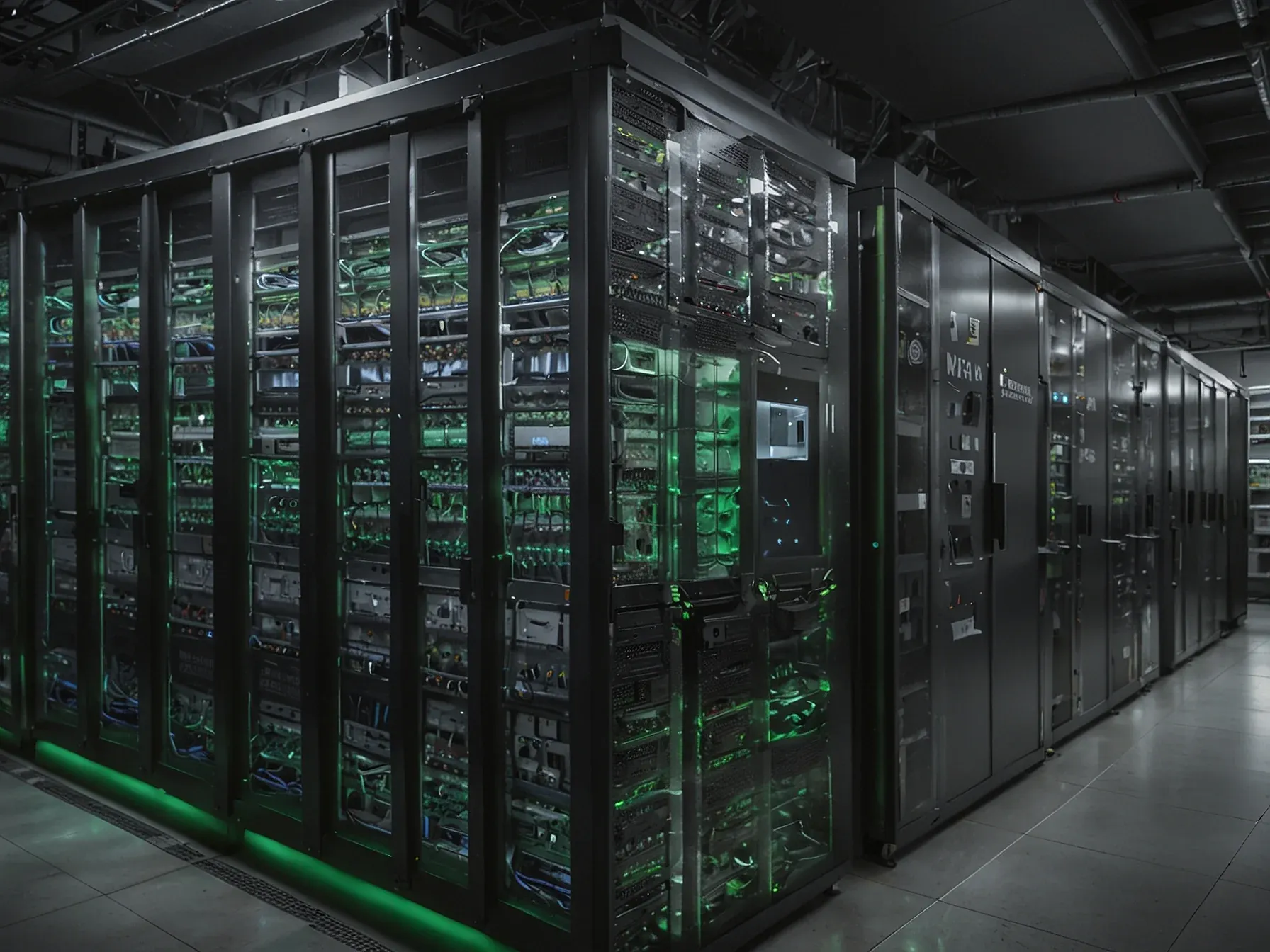
Editorial illustration for NVIDIA's 288-GPU Blackwell Ultra Sets New MLPerf Inference Throughput Record
NVIDIA Blackwell Ultra Shatters MLPerf Inference Records
NVIDIA's 288-GPU Blackwell Ultra Sets New MLPerf Inference Throughput Record
For the first time in MLPerf Inference history, a single submission deployed 288 Blackwell Ultra GPUs. The result: millions of tokens processed every second, a system-level throughput record that redefines what’s possible. This isn’t just a numbers game.
It’s the payoff of extreme co-design, where chip architecture, data center infrastructure, and software converge without compromise. From massive LLMs to vision-language models and generative recommenders, NVIDIA’s latest MLPerf v6.0 sweep proves that scale and speed can coexist, even as model sizes explode and context windows stretch beyond what we once considered practical.
In this latest round, systems powered by NVIDIA Blackwell Ultra GPUs delivered the highest throughput across the widest range of models and scenarios. This brings the cumulative NVIDIA MLPerf training and inference wins since 2018 to 291, which is 9x of all other submitters combined.
This is what happens when you stop thinking in terms of individual chips and start engineering entire systems as a single machine. 288 GPUs, working in lockstep, turning tokens into torrents. The record isn’t the headline, it’s the proof.
Proof that co-design scales: from the silicon up through the rack, the network, the software stack, all the way to the data center’s cooling grid. The workloads themselves keep sprinting. Larger models, longer contexts, more modalities.
NVIDIA met that pace again, not just on one benchmark, but across the entire MLPerf catalog. From LLMs to vision to recommenders, the same architecture that processes millions of tokens per second for a chatbot can serve a generative ad system in the next breath. That versatility matters.
Real-world AI doesn’t live on a single benchmark; it lives in a messy, heterogeneous data center. So what comes next? The Endpoints track hints at it.
Inference is no longer a batch job, it’s a continuous, low-latency service. And as models grow, the only way to deliver that service at scale is to repeat this exercise: rethink the rack, rebalance the interconnect, recompile the kernel. Blackwell Ultra is a snapshot of that philosophy in motion.
The next one will be faster.
Related Reading
 Research & Benchmarks
 Microsoft AI Chief: "If It Isn't Safe We Shouldn't Build It
 Research & Benchmarks
 Google's FACTS benchmark shows 70% factuality ceiling across four tests
 Research & Benchmarks
 Nvidia's DLSS 4.5 beta adds 6x Multi Frame Generation for RTX 50 GPUs
 Related Topic
 NVIDIA NeMo powers telco reasoning model for autonomous network workflows
Industry Applications
 Related Topic
 China offers cheaper electricity to AI firms abandoning NVIDIA chips
Business & Startups
 From Archives
 DeepMind study finds six traps that let a few poisoned docs hijack AI agents
 From Archives
 AI productivity gap: top agent beats baseline in 1 of 15 runs, 26.5% subtasks
 From Archives
 Nvidia-backed ThinkLabs raises USD 28M, shows AI power‑grid results with SCE
Business & Startups
 From Archives
 Nvidia's 3B Nemotron-Cascade 2 wins math and coding gold; recipe open‑source
Open Source
Common Questions Answered
How many GPUs were used in NVIDIA's Blackwell Ultra MLPerf Inference submission?
NVIDIA deployed 288 Blackwell Ultra GPUs in its MLPerf Inference v6.0 submission, which represents the largest scale ever attempted in this benchmark. This massive GPU cluster enabled unprecedented system-level throughput, processing millions of tokens per second.
What makes the Blackwell Ultra MLPerf Inference result significant beyond raw speed?
The result demonstrates NVIDIA's ability to achieve extreme co-design across multiple system components, including chips, system architecture, data center design, and software. The achievement highlights that performance is not just about individual GPU capabilities, but the integrated optimization of the entire computing stack.
What key performance metric did NVIDIA achieve in the MLPerf Inference v6.0 benchmark?
NVIDIA's 288-GPU Blackwell Ultra system set a new record for inference throughput, processing millions of tokens per second. This benchmark result represents the highest throughput ever reported for a single submission in MLPerf Inference.
Further Reading
- NVIDIA Blackwell Ultra Sets New Inference Records in MLPerf Debut — NVIDIA Developer Blog
- NVIDIA Blackwell Ultra Sets the Bar in New MLPerf Inference ... — NVIDIA Blogs
- NVIDIA Blackwell Ultra sets new performance records in MLPerf ... — The Tech Revolutionist
- Nvidia claims software and hardware upgrades allow Blackwell Ultra GB300 to dominate MLPerf benchmarks — touts 45% DeepSeek R-1 inference ... — Tom's Hardware
