
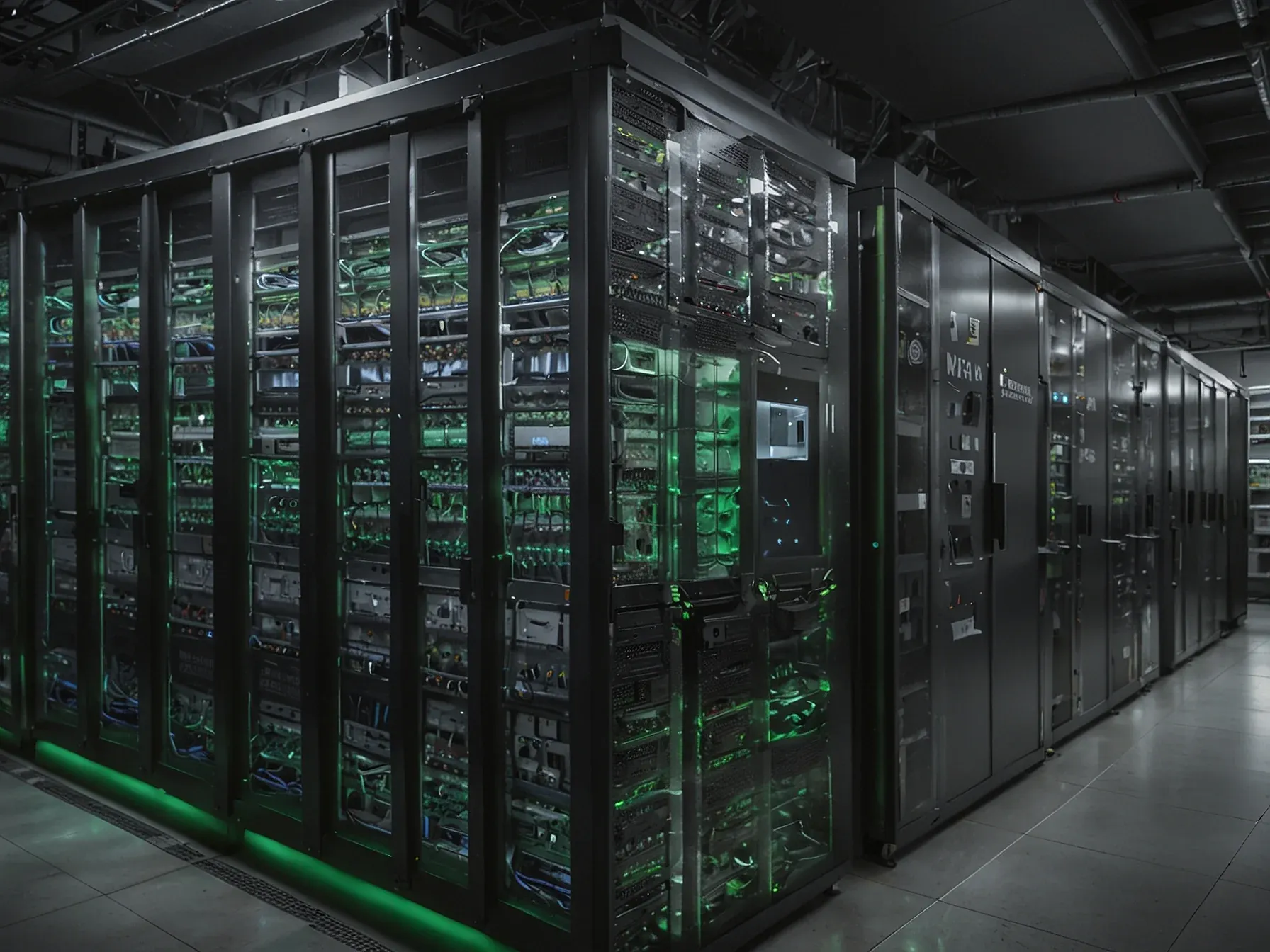
Editorial illustration for NVIDIA Nemotron 3.5 Lightning Designed as Efficient AI Agent Workhorse
NVIDIA Nemotron 3.5 Lightning: Fast AI Agent Model
A coding agent doesn't spend most of its time thinking. It spends its time running commands, reading files, checking outputs and formatting results, hundreds of small steps that follow from a single plan. NVIDIA built Nemotron 3.5 Lightning for that gap.
The model is an open-weight reasoning and instruction system aimed at the execution layer of agentic workflows, not the planning stage. NVIDIA's NVFP4 model card lists single-GPU deployment on a DGX Spark GB10 or an H100, with support across Blackwell, Hopper and Ampere hardware depending on quantization. English and programming languages are the primary targets, with Spanish, French, German, Italian and Japanese also officially supported.
The pitch is narrower than the specs suggest. NVIDIA isn't positioning this as another general-purpose 30B model competing on broad benchmarks. It's built for a specific division of labor: a frontier model handles the hard reasoning step, like diagnosing a bug and drafting a fix, and Lightning handles everything that comes after. The question is whether that split actually holds up once an agent is running at scale, and what NVIDIA's own numbers say about the tradeoff.
Nemotron 3.5 Lightning takes a different approach: a fast, efficient model designed for high-volume agent execution. The idea is simple: use the expensive model to think and the fast model to work.
Why this matters
For anyone building agents that run for hours instead of seconds, Nemotron 3.5 Lightning is a bet worth watching closely. NVIDIA's architecture choice, leaning on Mamba-2 for the bulk of sequence processing while keeping attention around for the parts that need it, is a direct response to a cost problem most teams already know intimately: routing every file read or tool call through a frontier reasoning model burns money for no real gain. If the hybrid approach holds up outside NVIDIA's own benchmarks, it points toward a two-tier future for agent stacks, where a heavyweight model plans and a lightweight one executes.
That's a meaningful shift for founders pricing out agent products at scale, and for researchers, it's a real test of whether state-space models can handle long, messy execution sequences as well as they handle throughput on paper. We'd want to see independent numbers on latency and error rates during long tool-call chains before treating this as settled. Worth tracking what third parties report once they put it through actual production workloads.
Related Reading
 Research & Benchmarks
 Microsoft AI Chief: "If It Isn't Safe We Shouldn't Build It
 Research & Benchmarks
 Google's FACTS benchmark shows 70% factuality ceiling across four tests
 Research & Benchmarks
 Nvidia's DLSS 4.5 beta adds 6x Multi Frame Generation for RTX 50 GPUs
 Related Topic
 NVIDIA NeMo powers telco reasoning model for autonomous network workflows
Industry Applications
 Related Topic
 China offers cheaper electricity to AI firms abandoning NVIDIA chips
Business & Startups
 From Archives
 Z.ai's GLM-5.3 Boosts Coding, Long Tasks Without Model Retraining
 From Archives
 Anthropic's AI Agents With Incompatible Goals Started a Turf War
 From Archives
 Nvidia's Nemotron 4 Aims for One Trillion Parameters, a Scale China Already Passed
Open Source
 From Archives
 NVIDIA RTX 5090 Powers Local AI Agents for Private Files and Apps
Open Source
Common Questions Answered
What is the primary purpose of NVIDIA Nemotron 3.5 Lightning compared to other AI models?
Nemotron 3.5 Lightning is specifically designed as an efficient execution layer for agentic workflows, focusing on the operational tasks that follow planning rather than the reasoning stage itself. Unlike expensive frontier models, it handles high-volume agent execution tasks like running commands, reading files, and formatting results at a fraction of the cost.
How does Nemotron 3.5 Lightning's hybrid architecture approach improve AI agent efficiency?
The model combines Mamba-2 for bulk sequence processing with attention mechanisms reserved for critical components, creating a cost-effective solution for long-running agents. This architecture eliminates the inefficiency of routing every file read or tool call through expensive reasoning models, allowing teams to use powerful models for thinking and fast models for execution.
What hardware deployments does NVIDIA support for Nemotron 3.5 Lightning?
According to NVIDIA's model card, Nemotron 3.5 Lightning supports single-GPU deployment on platforms including the DGX Spark GB10 and NVIDIA H100, making it accessible for various enterprise and research environments.
Why should teams building long-running agents consider Nemotron 3.5 Lightning?
For agents that operate for hours rather than seconds, Nemotron 3.5 Lightning addresses a critical cost problem by preventing unnecessary routing of routine execution tasks through expensive frontier models. This architectural approach directly reduces operational expenses while maintaining performance for agents that need sustained, high-volume task execution.
Further Reading
- NVIDIA Nemotron 3.5 Lightning Delivers Fast, Accurate Specialized Task Execution for Long-Running Agents - NVIDIA Developer Blog
- NVIDIA launches Nemotron 3.5 Lightning - Artificial Analysis
- Introducing NVIDIA Nemotron 3.5 Lightning - Baseten
- Testing NVIDIA Nemotron 3.5 Lightning Against Real Enterprise Agentic Workloads - Uniphore
- Nemotron 3.5 Lightning: Features & Benchmarks - DataCamp
