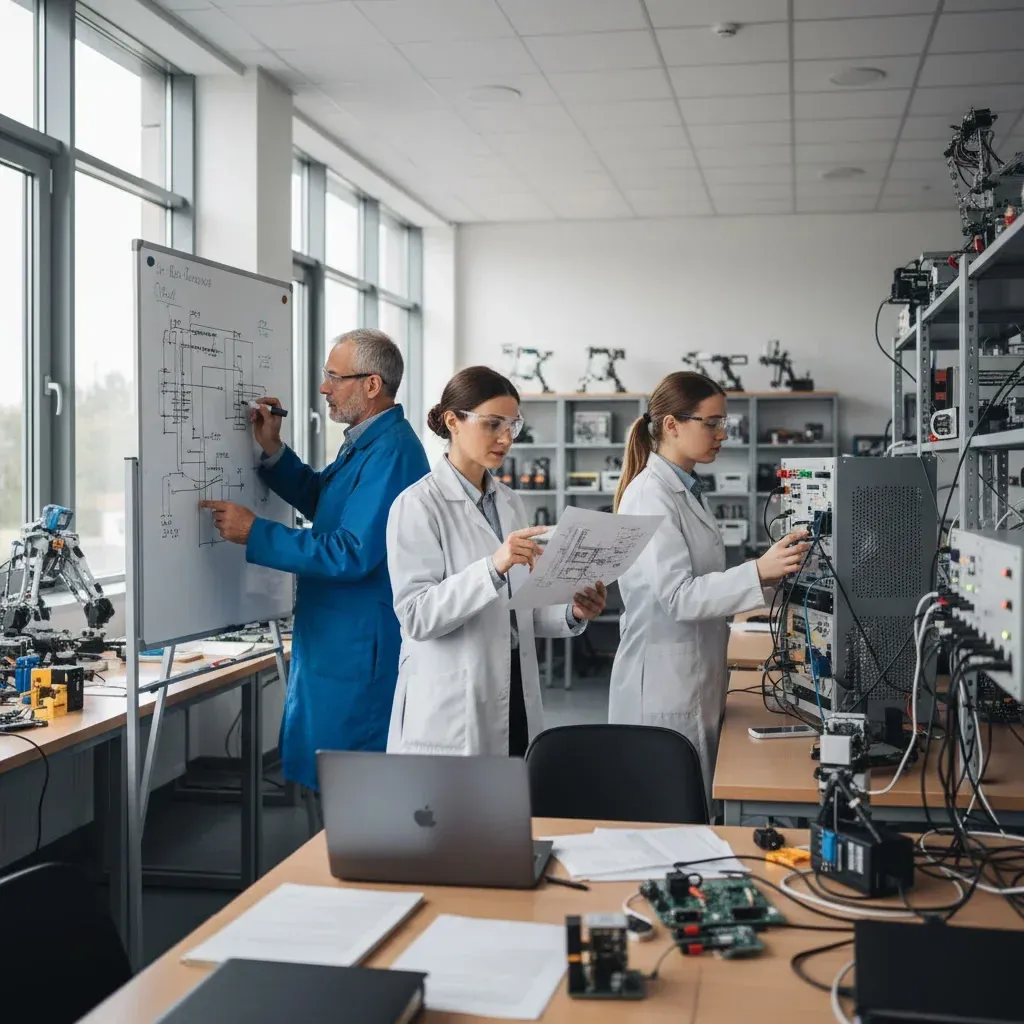
Editorial illustration for NVIDIA Halos for Robotics unifies hardware and software safety in three layers
NVIDIA Halos for Robotics unifies hardware and software...
For years, the dream of intelligent robots crashed against a simple, non-negotiable fact: a two-ton factory arm cannot fail like a chatbot. Safety wasn't just a feature; it was the entire barrier. Now, Nvidia's new Halos for Robotics platform bets everything on a core idea. AI and industrial safety must be the same system.
Marking a major milestone in the arrival of physical AI, NVIDIA is today announcing the launch of NVIDIA Halos for Robotics which brings together powerful AI compute and safety in one single platform. NVIDIA Halos OS is a comprehensive, full-stack safety system built on years of NVIDIA investing in autonomous vehicle (AV) safety, now extended into the world of industrial robots, humanoids, and autonomous mobile robots (AMRs).
The certified solution is a trilogy. First, the silicon: chips designed to meet ISO 26262. A second software layer controls critical motion.
Then a system-wide monitor enforces predictable failure. This full-stack approach, from transistor to behavior, lets builders avoid becoming safety auditors. Nvidia sells a sealed environment.
Build inside its walls, and the daunting paperwork is pre-approved. That transforms a philosophical hurdle into an engineering spec. For robots to finally leave their cages, trust cannot be an afterthought.
Halos is that blueprint, rendered in hardware and code.
Related Reading
 Industry Applications
 Westinghouse teams with Google Cloud to build AI platform for nuclear power
 Industry Applications
 NVIDIA NeMo powers telco reasoning model for autonomous network workflows
 Industry Applications
 Month-1 Agent Adds Holistic Observability with Trace IDs and Token Tracking
 Related Topic
 NVIDIA and Google Cloud let developers scale AI from prototype to production
Market Trends
 Related Topic
 China offers cheaper electricity to AI firms abandoning NVIDIA chips
Business & Startups
 From Archives
 AI helps physicians diagnose rare pediatric genetic diseases, 4.8% rate
 From Archives
 HPE AI Factory and NVIDIA unveil Vera, first CPU built for agents
 From Archives
 NVIDIA XR AI equips AR glasses with LabOS co‑scientist to aid CRISPR work
AI Tools & Apps
 From Archives
 Nvidia AI Agent Trains Robots Autonomously, Editing Code from Papers
Research & Benchmarks
Common Questions Answered
What are the three layers of safety in NVIDIA Halos for Robotics?
NVIDIA Halos for Robotics implements safety through three integrated layers: first, ISO 26262-certified silicon chips designed for safety-critical applications; second, a software layer that controls critical motion functions; and third, a system-wide monitor that enforces predictable failure modes. This full-stack approach ensures safety is built into every level from hardware to behavior.
How does NVIDIA Halos for Robotics address the safety challenges of industrial robots?
Industrial robots like two-ton factory arms cannot fail like chatbots because they pose serious physical risks, making safety non-negotiable. NVIDIA Halos unifies AI and industrial safety into a single system, eliminating the traditional separation between safety and functionality. This approach transforms safety from a philosophical concern into an engineering specification that can be verified and certified.
What advantage does NVIDIA's sealed environment provide for robot builders?
By building robots within NVIDIA's Halos for Robotics sealed environment, builders can avoid becoming safety auditors themselves since the platform comes with pre-approved, certified safety documentation. This significantly reduces the daunting paperwork and compliance burden typically required for industrial robot deployment. Developers can focus on engineering rather than navigating complex safety certification processes.
Why is combining AI and industrial safety into one system important for robotics?
For years, the dream of intelligent robots has been hindered by the fundamental incompatibility between AI systems (which can fail unpredictably) and industrial safety requirements (which demand predictability and certification). By unifying AI and safety into a single system, NVIDIA Halos enables robots to be both intelligent and reliably safe. This integration removes a critical barrier that has prevented robots from being widely deployed in industrial environments.
Further Reading
- NVIDIA Isaac, Omniverse, and Halos to aid European robotics developers — The Robot Report
- Safe AI Automation and Robot Safety for Industrial Operations — NVIDIA
- Building Trust Into AI Systems: Inside NVIDIA's Halos for Physical AI Safety — Computer
- Develop Safer Robots with NVIDIA Halos Outside-In Perception — NVIDIA / YouTube
- Accelerating Physical AI Certification With NVIDIA Halos — NVIDIA / YouTube
