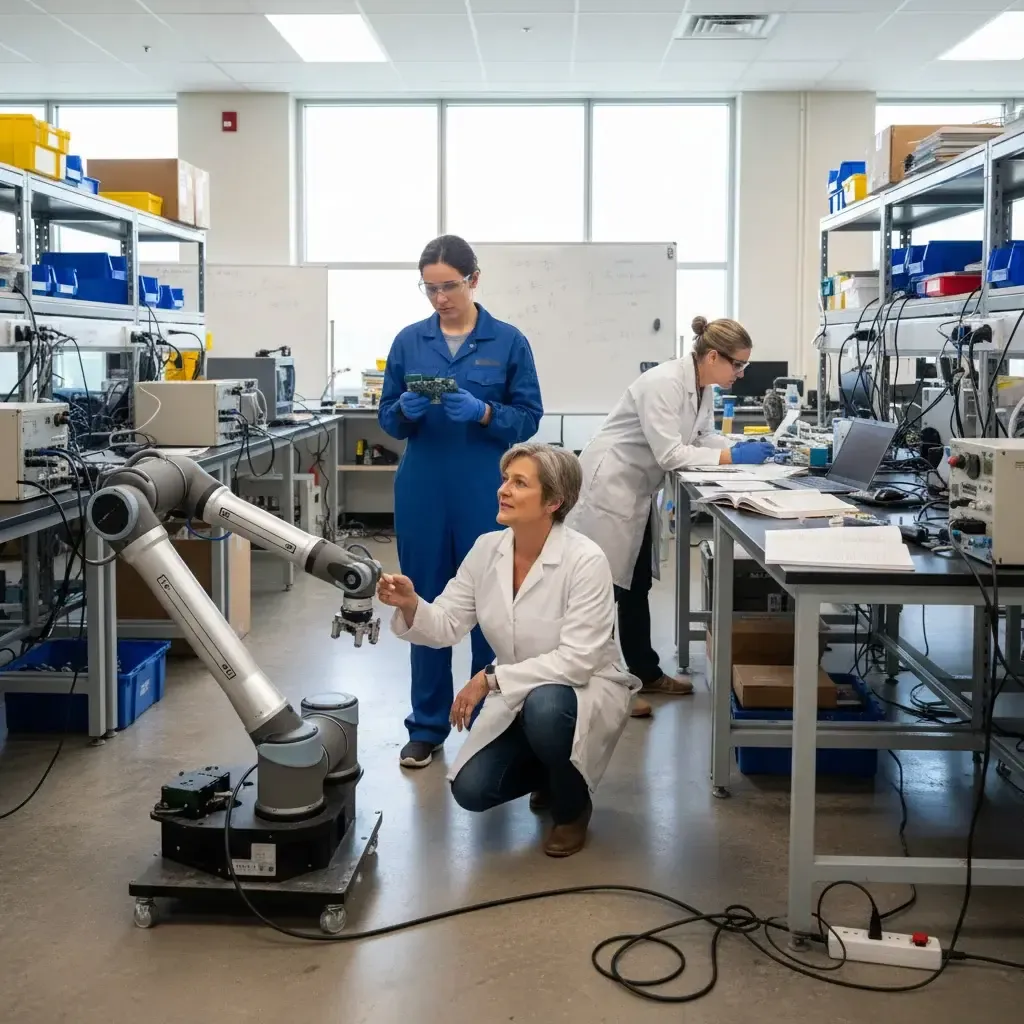
Editorial illustration for Nvidia AI Agent Trains Robots Autonomously, Editing Code from Papers
Nvidia AI Agent Trains Robots Autonomously, Editing Code...
Nvidia has built a robot that reads academic papers and rewrites its own training code. It corrects itself. The system, which the company calls an AI agent, works in two parts.
The first part needs a person. The second does not.
In that autonomous phase, the software reads research, forms a hypothesis, and edits the code that controls a physical robot. It chooses between two training methods: copying human movements, or learning through trial and error. The choice depends on what gets results.
The process is not theoretical. It runs on actual hardware.
Researchers from Nvidia, Carnegie Mellon University, and UC Berkeley are using AI coding agents to teach robots dexterous grasping in the real world. A fleet of eight robots hits up to 99 percent success on tricky tasks.
That fleet is eight separate robot stations. Each with two arms, a computer, and its own coding agent. They all run different experiments at once.
They coordinate not through a central brain, but through Git. They share only their successful results via the version control software. No human intervention is required.
This changes the problem. If a machine can read a paper, write code, test it on hardware, and then improve the code based on the outcome, the hard limit is no longer software. It's the physical world.
The robot becomes the experiment. We are not just training machines to perform tasks. We are building machines that run their own labs.
Related Reading
 Research & Benchmarks
 Microsoft AI Chief: "If It Isn't Safe We Shouldn't Build It
 Research & Benchmarks
 Google's FACTS benchmark shows 70% factuality ceiling across four tests
 Research & Benchmarks
 Nvidia's DLSS 4.5 beta adds 6x Multi Frame Generation for RTX 50 GPUs
 Related Topic
 NVIDIA NeMo powers telco reasoning model for autonomous network workflows
Industry Applications
 Related Topic
 China offers cheaper electricity to AI firms abandoning NVIDIA chips
Business & Startups
 From Archives
 XGBoost, ALBERT, BioBERT, Med‑LLaMA evaluated for pharmacovigilance
 From Archives
 OpenAI's Deployment Simulation Beats Baseline, Adds Risk Checks to Agentic Code
 From Archives
 NVIDIA XR AI Enables Real‑Time Multimodal Agents for AR Glasses
LLMs & Generative AI
 From Archives
 NVIDIA Blackwell scales to 8,192 GPUs on DeepSeek‑V3 671B for MLPerf 6.0
Policy & Regulation
Common Questions Answered
How does Nvidia's AI agent autonomously edit robot training code without human intervention?
The AI agent reads academic research papers, forms hypotheses based on the findings, and automatically rewrites the code controlling the physical robot. It independently chooses between two training methods—copying human movements or learning through trial and error—depending on which approach is most effective for the task at hand.
What is the two-part system structure of Nvidia's AI agent for robot training?
The system consists of an initial phase that requires human input and guidance, followed by a fully autonomous phase where the software operates independently. During the autonomous phase, the agent reads research, develops hypotheses, and modifies the robot's training code without any human intervention needed.
How do multiple robot stations coordinate experiments in Nvidia's fleet without a central brain?
The eight robot stations, each equipped with two arms, a computer, and their own coding agent, coordinate through Git version control software rather than a centralized control system. They share only their successful experimental results with each other via Git, allowing them to run different experiments simultaneously while learning from each other's successes.
What training methods can Nvidia's AI agent choose between for robot learning?
The AI agent can select between two distinct training approaches: imitation learning, where the robot copies human movements, or reinforcement learning, where it learns through trial and error. The agent makes this selection based on which method is predicted to achieve better results for the specific task.
Further Reading
- Nvidia Research Breakthrough Puts New Spin on Robot Training with Eureka — NVIDIA Blog
- New Nvidia AI agent, powered by GPT-4, can train robots — VentureBeat
- NVIDIA Releases Major Collection of Open Source Agent Tools and Skills for Physical AI — NVIDIA Newsroom
- How Nvidia AI Robot Trained 42 Years In 32 Hours And Did THIS — YouTube
