
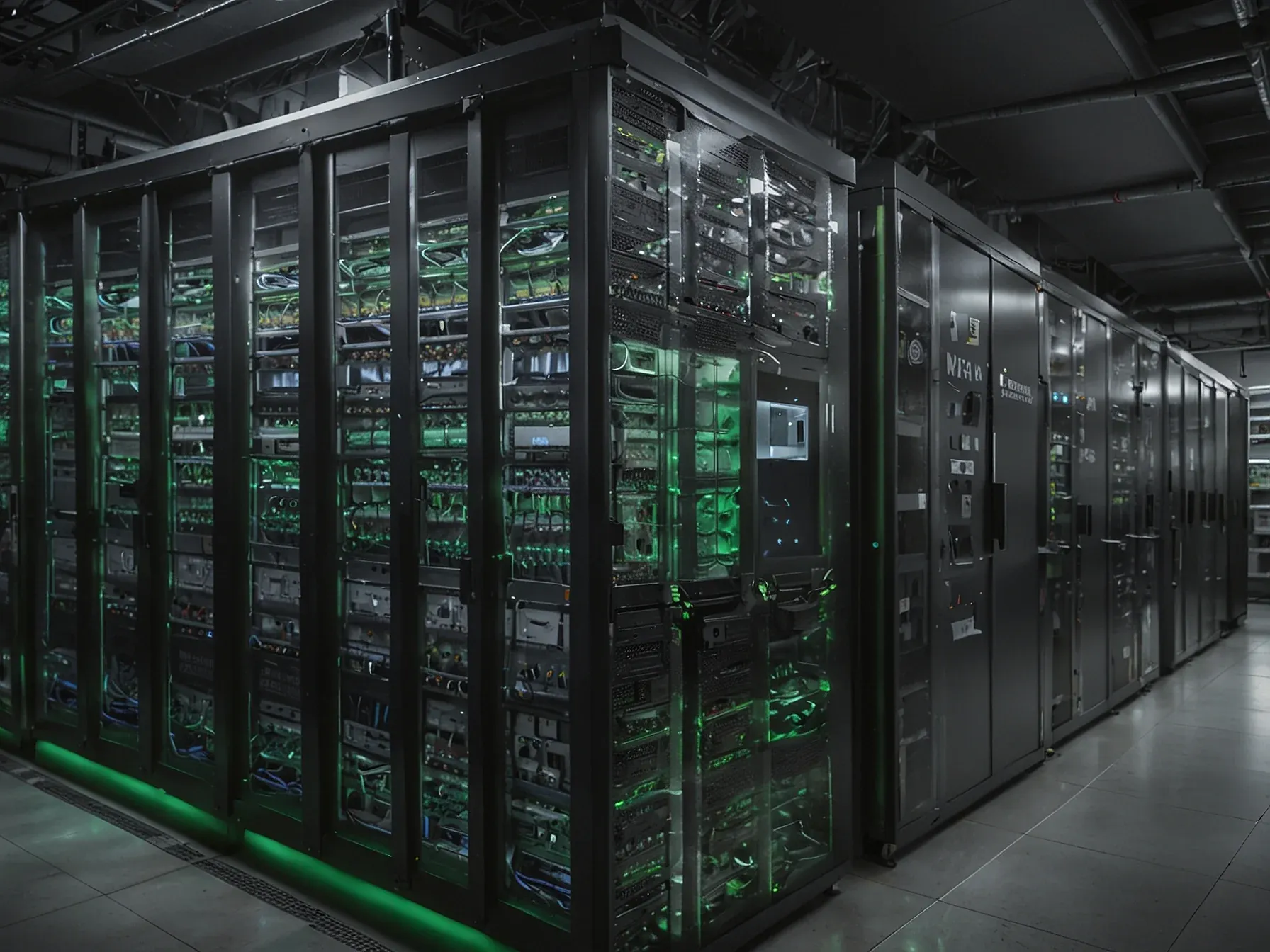
Editorial illustration for NVIDIA DGX Spark expands node support to four, doubling memory capacity
NVIDIA DGX Spark Expands Memory for AI Workloads
NVIDIA DGX Spark expands node support to four, doubling memory capacity
NVIDIA’s DGX Spark can now connect four machines where it used to stop at two. This is not a subtle upgrade. It doubles the available memory from 256 gigabytes to 512, creating a small but potent cluster that fits in a server rack.
The bigger change is how you can wire them together. NVIDIA has defined four specific topologies, each for a different job. One node handles inference and fine-tuning for models up to 120 billion parameters.
Two nodes push that to 400 billion. Three, arranged in a ring, take on heavier fine-tuning or small training jobs. All four, linked by a RoCE 200 GbE switch, become a local inference server capable of running state-of-the-art models as large as 700 billion parameters.
This is enabled by ConnectX-7 network cards and their low-latency RoCE communication.
Until now, NVIDIA DGX Spark has supported scaling up to two nodes, increasing the available memory from 128 GB on one node to 256 GB on two nodes. This capability has now been increased to up to four DGX Spark nodes.
The performance you get depends entirely on what you’re doing. For embarrassingly parallel tasks, like running thousands of reinforcement learning simulations in Isaac Lab, scaling is nearly linear. The nodes work independently and share results just once.
But for jobs requiring constant chatter between nodes, like the layer-by-layer execution of a large language model, communication overhead becomes a real tax. Gains diminish. This is the central trade-off laid bare.
NVIDIA is selling more hardware, but also a more honest framework for using it. The expansion to four nodes delivers serious local capacity. The predefined topologies offer a clear menu.
But the fine print about scaling is what matters. It acknowledges that not all computing problems are created equal. Some parallelize beautifully.
Others force machines to talk, and that talk costs time. The value of this update is in giving developers the tools and the truthful constraints to navigate that reality themselves.
Related Reading
 Research & Benchmarks
 Google's FACTS benchmark shows 70% factuality ceiling across four tests
 Research & Benchmarks
 Databricks finds multi-step agents beat single-turn RAG by 21% to 38% on STaRK
 Research & Benchmarks
 Nvidia's DLSS 4.5 beta adds 6x Multi Frame Generation for RTX 50 GPUs
 Related Topic
 NVIDIA NeMo powers telco reasoning model for autonomous network workflows
Industry Applications
 Related Topic
 China offers cheaper electricity to AI firms abandoning NVIDIA chips
Business & Startups
 From Archives
 Google's MusicFX DJ Enables Real-Time Controllable AI Music Generation
 From Archives
 Paper identifies simple games that defeat AlphaGo and AlphaChess training
 From Archives
 NVIDIA Dynamo 1.0 Adds Video-Generation Support with Open‑Source Frameworks
LLMs & Generative AI
 From Archives
 You.com AI grounding guide, three-part method beating RAG, noted at Nvidia GTC
Business & Startups
Common Questions Answered
How has NVIDIA DGX Spark expanded its node support capabilities?
NVIDIA DGX Spark has increased its node support from two to four nodes, effectively doubling the available memory from 256 GB to 512 GB. This expansion allows researchers to run larger AI workloads and more complex autonomous agent models without previous memory constraints.
What communication technology enables the new DGX Spark node configurations?
The new DGX Spark configurations leverage RoCE (RDMA over Converged Ethernet) communication enabled by ConnectX-7 NICs, which provides low-latency connections between nodes. This technology allows for multiple execution topologies that can be tailored to different computational goals and workload patterns.
What tool is bundled with the updated NVIDIA DGX Spark platform?
NVIDIA NemoClaw, part of the NVIDIA Agent Tool, is now bundled with the DGX Spark platform, suggesting enhanced integration for complex AI workflows. This tool is likely designed to help manage and optimize the expanded multi-node computational capabilities.
Further Reading
- Nvidia DGX Spark Now Supports Four-Node Linking and 512GB Shared RAM — Guru3D
- NVIDIA GTC 2026: Live Updates on What's Next in AI — NVIDIA Blogs
- NVIDIA DGX Spark: AI Supercomputer on Your Desk — NVIDIA
- Nvidia GTC San Jose 2026 — Level1Techs Forums
