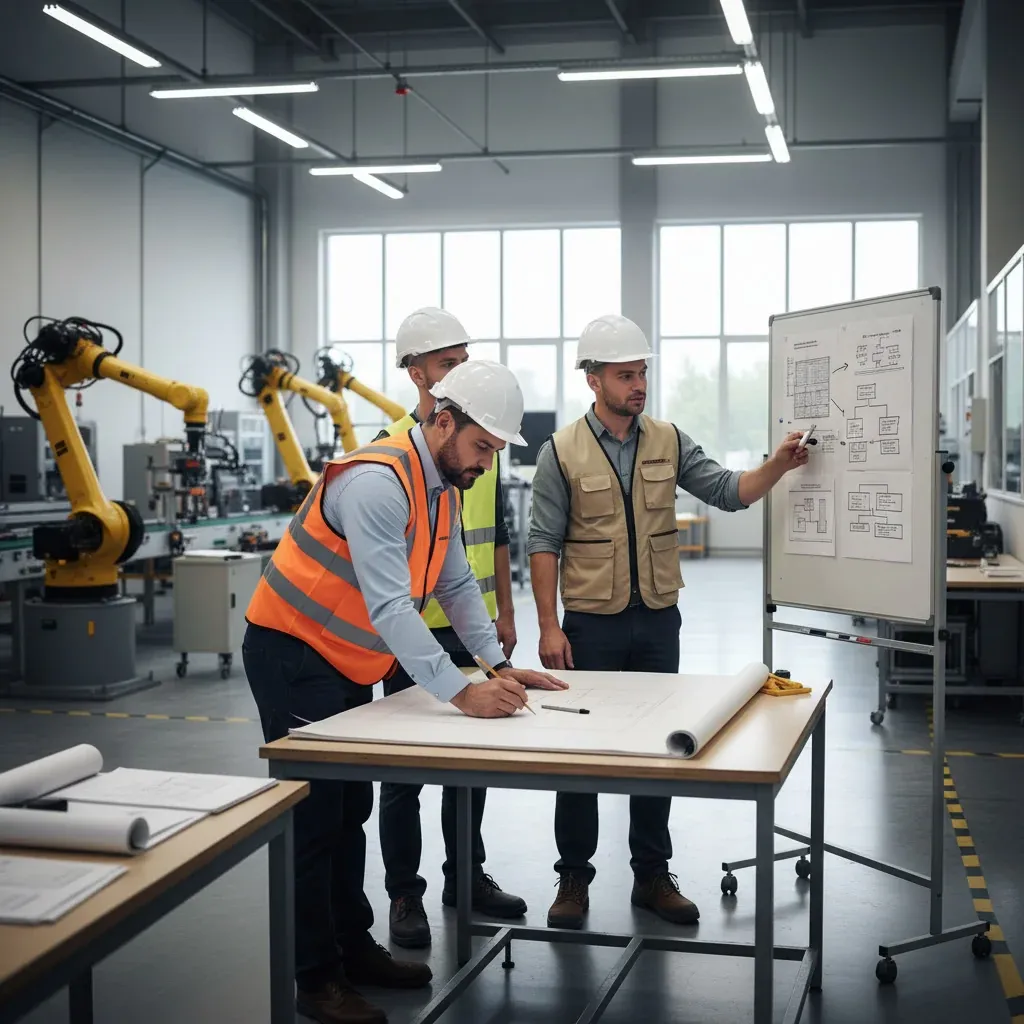
Editorial illustration for New Engineers Should Build End‑to‑End Projects to Attract AI‑Era Employers
New Engineers Should Build End‑to‑End Projects to...
The era of the lone coder solving isolated puzzles is fading. Today’s AI-driven market demands something broader: engineers who see the whole picture, from messy requirement to scaled product. A fragmented GitHub snippet won’t cut it.
Employers want proof you can wield AI responsibly, design for failure, and explain your architecture to a skeptical stakeholder. They’ll ask how you fall back when a model hallucinates. They’ll probe your scalability logic.
This isn’t about grinding LeetCode, it’s about showing you can build a system that lives, breathes, and survives real pressure. The prize? Roles where you’re not replaceable by the very tool you’re learning to master.
The most successful engineers treat artificial intelligence as leverage, not competition. Here are seven tips to help keep young professionals in demand no matter how quickly the field’s tools evolve.
The line between an engineer who codes and an engineer who builds is drawn by end-to-end thinking. That’s the differentiator. Employers don’t just want someone who can feed a prompt into an AI tool; they want someone who can design a system around it, anticipating failure, managing scale, and explaining trade-offs to a room full of non-technical stakeholders.
The engineer who can do that? Irreplaceable. The pace of AI only sharpens this truth.
Routine tasks get automated. Ethics get complicated. Systems get larger.
Yet the core of engineering, problem-framing, architectural judgment, responsible risk-spotting, remains stubbornly human. Cultivate those habits now. Build the project that spans from a fuzzy idea to a deployable product.
Stay curious about the tools, but never let them replace the craft. In an age of acceleration, the engineers who thrive are the ones who understand the whole machine, not just the piece they’re told to touch. That’s how you flourish.
That’s how you lead.
Related Reading
 Market Trends
 AI drives three initiatives to accelerate global action for planet protection
 Market Trends
 Akamai data shows AI training bots and content‑fetching bots rise since July
 Market Trends
 NVIDIA and Google Cloud let developers scale AI from prototype to production
 From Archives
 Figma Make adds two-way GitHub link to turn designs into code; stock falls 81%
 From Archives
 AI token futures to trade like gold and oil despite thin token infrastructure
Common Questions Answered
Why are end-to-end projects more valuable than isolated coding puzzles for attracting AI-era employers?
AI-era employers seek engineers who understand the complete product lifecycle, from requirements to scaled deployment, not just isolated problem-solving skills. End-to-end projects demonstrate your ability to design systems around AI tools, anticipate failures, manage scalability, and communicate trade-offs to non-technical stakeholders—capabilities that LeetCode grinding alone cannot showcase.
What specific AI-related competencies do modern employers expect engineers to demonstrate?
Employers expect engineers to show they can wield AI responsibly, design systems that handle model hallucinations through fallback mechanisms, and explain their architecture decisions to skeptical stakeholders. These competencies go beyond basic prompt engineering to include understanding scalability logic and ethical implications of AI systems.
How does the ability to design for failure differentiate engineers in the AI job market?
Engineers who can anticipate and design for failure—such as planning fallback strategies when AI models hallucinate—demonstrate systems-level thinking that employers value highly. This capability shows you understand that AI systems are not infallible and can architect robust solutions that maintain functionality when models underperform.
What is the key difference between a coder and a builder in the context of AI employment?
A coder can feed prompts into AI tools and write isolated solutions, while a builder designs entire systems around AI capabilities, anticipates failure modes, manages scale, and explains trade-offs to non-technical audiences. The builder's end-to-end thinking and ability to contextualize technical decisions within business constraints make them irreplaceable in today's market.
Further Reading
- AI Will Reshape More Jobs Than It Replaces — BCG
- The Impact of AI on Engineering Jobs — Intuit Blog
- Why AI Is A Massive Job-Creation Technology, Despite What You Think — Josh Bersin
- AI impacts in BLS employment projections — Bureau of Labor Statistics
- How AI Affects Careers in Computing — Michigan Technological University
