
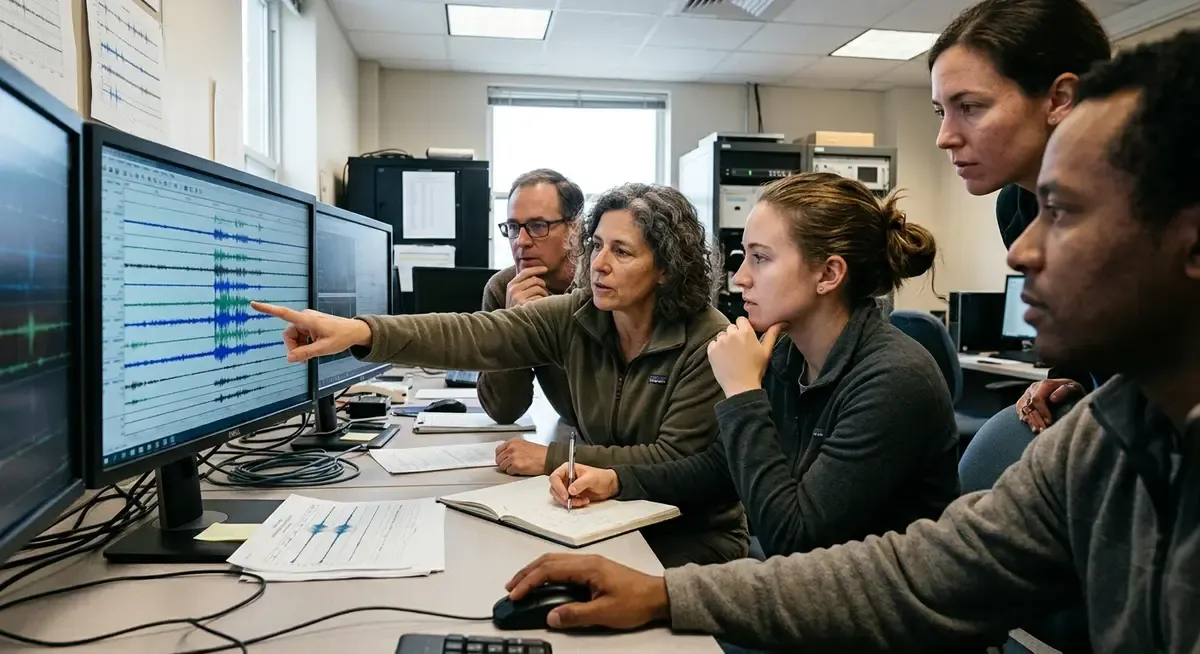
Editorial illustration for Google's Gemini video AI analyzes scenes to understand what people need at work
Google's Gemini Video AI Knows When to Help You
Google's Gemini video AI analyzes scenes to understand what people need at work
A video assistant that watches you build furniture and only interrupts when you actually need help sounds simple. Google's latest research shows it isn't. A team from Google, Stanford, Oxford, and several other U.S.
universities has built StreamVibe, a video agent meant to handle the kind of vague, shifting requests people actually make, like "help me if I run into trouble," rather than precise commands such as "tell me when the water boils." Most existing video assistants choke on that distinction. They're tuned for explicit triggers, so they miss unstated intentions, lose track of what's already happened and repeat themselves, or ignore it when a user changes their mind partway through a task.
To find out how big the gap is, the researchers built a benchmark pulling from more than 183 hours of footage, covering everyday chores and software use, with Gemini 2.5 Flash proposing when and how an assistant should step in and four human reviewers signing off on each case. The test is split into three stages of difficulty, moving from direct instructions to open-ended goals to instructions that change mid-task. One example has someone disassembling a toy excavator while asking for running updates.
A research team led by Google has introduced StreamVibe, a video agent designed to decide for itself when to speak up. The tests show above all how hard that remains for today's AI models.
Why this matters
StreamVibe is less a product than an admission. Google, Stanford, and Oxford researchers built a benchmark meant to test whether video AI can shut up until it's useful, and the results say that's still a hard problem. For developers building on Gemini's agent-based video analysis or the longer-context tricks shown off in Gemini 4 Argon, that's worth sitting with before shipping anything that watches a user's workspace and decides when to interrupt.
An assistant that talks too much while you're assembling furniture isn't an assistant, it's noise with a camera. The interesting part isn't the demo footage of someone cooking or building a shelf, it's that Google is publishing a benchmark showing its own models struggling at timing and restraint, the exact qualities that separate a helpful tool from an annoying one. For founders pitching "ambient" AI products, this is a useful reality check: the hard part was never watching video, it's judgment about when to speak.
Expect more incremental benchmarks like this before anyone claims the problem's solved.
Related Reading
Browse all Google news → Research & Benchmarks
Microsoft AI Chief: "If It Isn't Safe We Shouldn't Build It
 Research & Benchmarks
Google's FACTS benchmark shows 70% factuality ceiling across four tests
 Research & Benchmarks
Nvidia's DLSS 4.5 beta adds 6x Multi Frame Generation for RTX 50 GPUs
 Related Topic
Google to End Free Access to Gemini AI for Non-Subscribers
LLMs & Generative AI
 Related Topic
NVIDIA and Google Cloud let developers scale AI from prototype to production
Market Trends
 From Archives
OpenAI reverses course on using Daybreak Blue cybersecurity data
 From Archives
AI Agent Told Wrong Answers Were Right: One Model Believed in Order Memory Test
 From Archives
Google’s Gemini 4 Carbon Tops Charts Again, but Only for Now
LLMs & Generative AI
 From Archives
Google earnings show AI search growing but earning less than traditional search
Market Trends
Common Questions Answered
What is StreamVibe and how does it differ from existing video assistants?
StreamVibe is a video agent developed by Google, Stanford, Oxford, and other universities that can autonomously decide when to interrupt and offer help based on context rather than precise commands. Unlike existing video assistants that struggle with vague requests, StreamVibe is designed to handle shifting user requests like "help me if I run into trouble" instead of requiring specific commands such as "tell me when the water boils."
What research challenge did Google's team identify with video AI interruption timing?
The research team created a benchmark to test whether video AI can remain silent until genuinely useful, and their tests revealed that determining appropriate interruption timing remains a hard problem for current AI models. This finding is significant for developers building on Gemini's agent-based video analysis capabilities who need to understand the limitations before deploying assistants that monitor workspaces.
How does StreamVibe handle vague requests compared to traditional video assistants?
StreamVibe is specifically designed to process the kind of vague, shifting requests that people actually make in real work scenarios, rather than requiring precise commands. The video agent can analyze scenes and understand context to determine when intervention is needed, making it more practical for real-world applications like furniture building assistance where help might be needed unpredictably.
What are the implications of StreamVibe's benchmark results for Gemini developers?
The benchmark results demonstrate that video AI still struggles with knowing when to interrupt, which is crucial information for developers building on Gemini's agent-based video analysis and longer-context features. Developers should carefully consider these limitations before shipping products that watch user workspaces and autonomously decide when to offer assistance, as poorly-timed interruptions could diminish user experience.
Further Reading
- Papers with Code Benchmarks - Papers with Code
- Chatbot Arena Leaderboard - LMSYS
