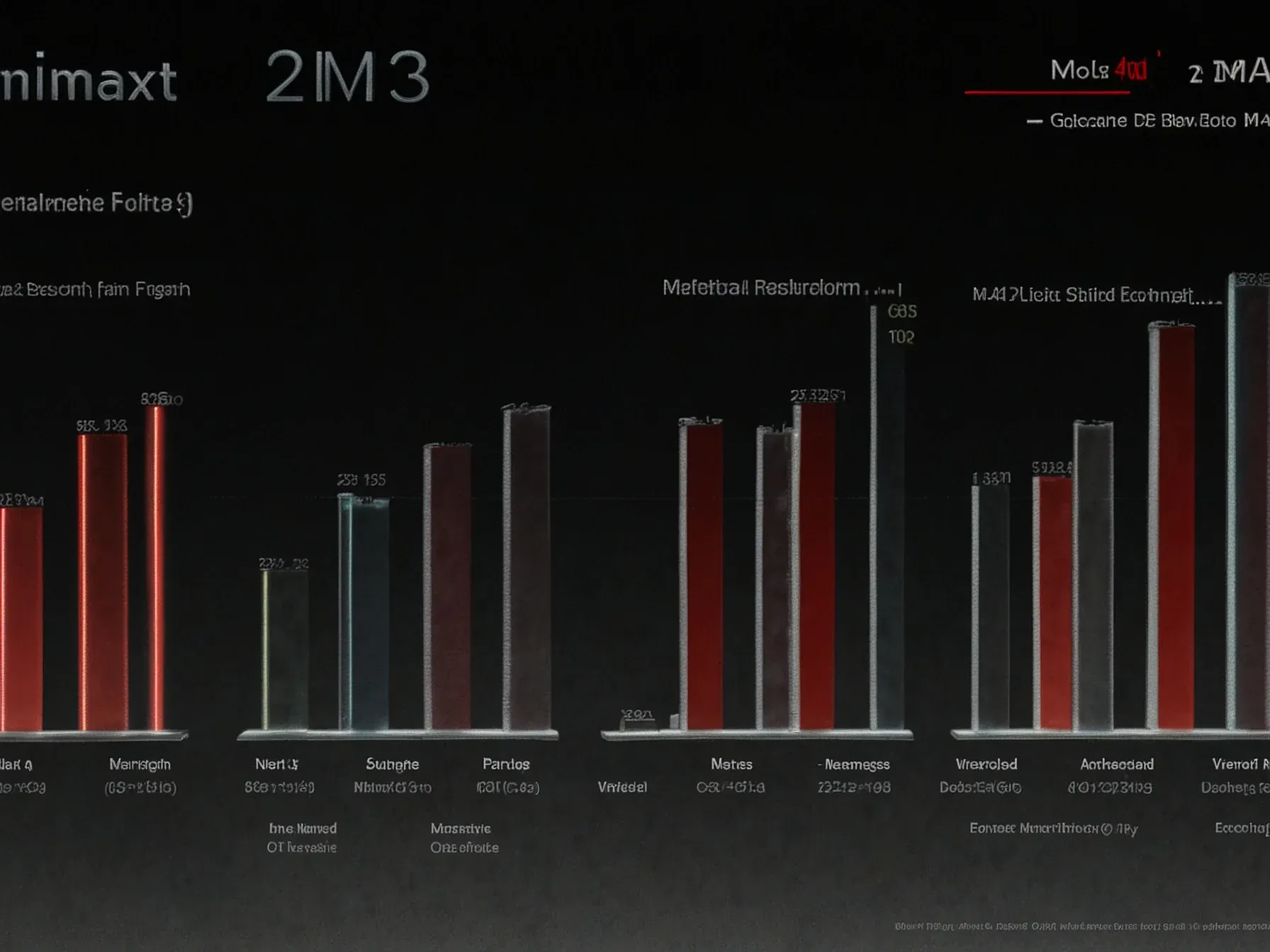
Editorial illustration for MiniMax-M2 Dominates Developer Benchmarks in Agentic Tool Performance
MiniMax-M2 Shatters Agentic AI Performance Benchmarks
MiniMax-M2 leads benchmarks in agentic tool calling and coding workflows
Everyone wants an AI model that can actually do things. Not just chat. Not just list ideas.
But actually write, test, and execute code. The latest benchmarks from MiniMax suggest they might have built one.
Their new M2 model leads on several key tests for what’s called “agentic” performance. That’s the jargon for an AI that can use tools, browse the web, and follow complex, multi-step instructions. It’s the difference between a clever parrot and a useful assistant.
MiniMax published the numbers. They are dry, technical, and specific. They show M2 competing with, and sometimes beating, much bigger names.
Benchmark Leadership Across Agentic and Coding Workflows MiniMax's benchmark suite highlights strong real-world performance across developer and agent environments. The figure below, released with the model, compares MiniMax-M2 (in red) with several leading proprietary and open models, including GPT-5 (thinking), Claude Sonnet 4.5, Gemini 2.5 Pro, and DeepSeek-V3.2. MiniMax-M2 achieves top or near-top performance in many categories: SWE-bench Verified: 69.4 -- close to GPT-5's 74.9 ArtifactsBench: 66.8 -- above Claude Sonnet 4.5 and DeepSeek-V3.2 τ²-Bench: 77.2 -- approaching GPT-5's 80.1 GAIA (text only): 75.7 -- surpassing DeepSeek-V3.2 BrowseComp: 44.0 -- notably stronger than other open models FinSearchComp-global: 65.5 -- best among tested open-weight systems These results show MiniMax-M2's capability in executing complex, tool-augmented tasks across multiple languages and environments--skills increasingly relevant for automated support, R&D, and data analysis inside enterprises.
The story here isn’t total domination. It’s consistency. M2 is nearly as good as OpenAI’s flagship at fixing real software bugs, according to the SWE-bench score.
It leads other open models on financial search and web browsing tasks. This pattern matters. It means a team could potentially swap in this model for specific, expensive workflows without losing much, if any, capability.
For developers, these benchmarks are a signal. The field is no longer just about who has the biggest model. It’s about who can build the most useful one for a given job. MiniMax seems to be aiming straight at the technical user who needs an AI that works, not one that just talks about working.
The real test comes next. Benchmarks are a controlled environment. Now people will try to break it, scale it, and see if it holds up when the instructions get messy and the tools are poorly documented. That’s where these models usually fail.
Related Reading
 LLMs & Generative AI
 ChatGPT's 'Nerdy' tweak rewards goblin metaphors in answers, study finds
 LLMs & Generative AI
 Google to End Free Access to Gemini AI for Non-Subscribers
 LLMs & Generative AI
 AI Engineers Face Rising Costs, Need New Strategies for Efficiency
 From Archives
 OpenAI says 0.07% of ChatGPT users show possible mania or psychosis signs weekly
 From Archives
 Fitbit's health coach preview gives timely updates at wake-up and after a workout
Common Questions Answered
How does MiniMax-M2 perform on the SWE-bench Verified benchmark compared to other AI models?
MiniMax-M2 achieves a remarkable 69.4 score on the SWE-bench Verified benchmark, coming very close to GPT-5's 74.9 performance. This indicates strong capabilities in software engineering tasks and positions the model as a competitive solution for developer-focused workflows.
What makes MiniMax-M2 stand out in the current AI development landscape?
MiniMax-M2 demonstrates exceptional performance across developer and agentic environments, particularly in coding workflows and tool calling benchmarks. The model's benchmark results show it can nearly match top-tier models like GPT-5, making it a compelling option for complex software development tasks.
Which other AI models did MiniMax-M2 compete against in its benchmark comparisons?
In its comprehensive benchmark suite, MiniMax-M2 was compared against several leading proprietary and open models, including GPT-5, Claude Sonnet 4.5, Gemini 2.5 Pro, and DeepSeek-V3.2. The comparison highlighted MiniMax-M2's competitive performance across multiple categories of AI capabilities.
Further Reading
- MiniMax Unveils M2: A Next-Gen AI Model Rivaling ChatGPT-5 at 8% of the Cost — iWeaver AI
- MiniMax Open-Source M2 Model: High-Performance AI Empowers Coding and Proxy, Cost is Only 8% of Competitors — AIbase
- MiniMax M2 vs GPT-4o vs Claude 3.5 Benchmark 2025 — Skywork.ai
- MiniMax M2 2025 Review & 2026 AI Insights — Skywork.ai
- MiniMax's new model beats Gemini, DeepSeek — Cybernews
