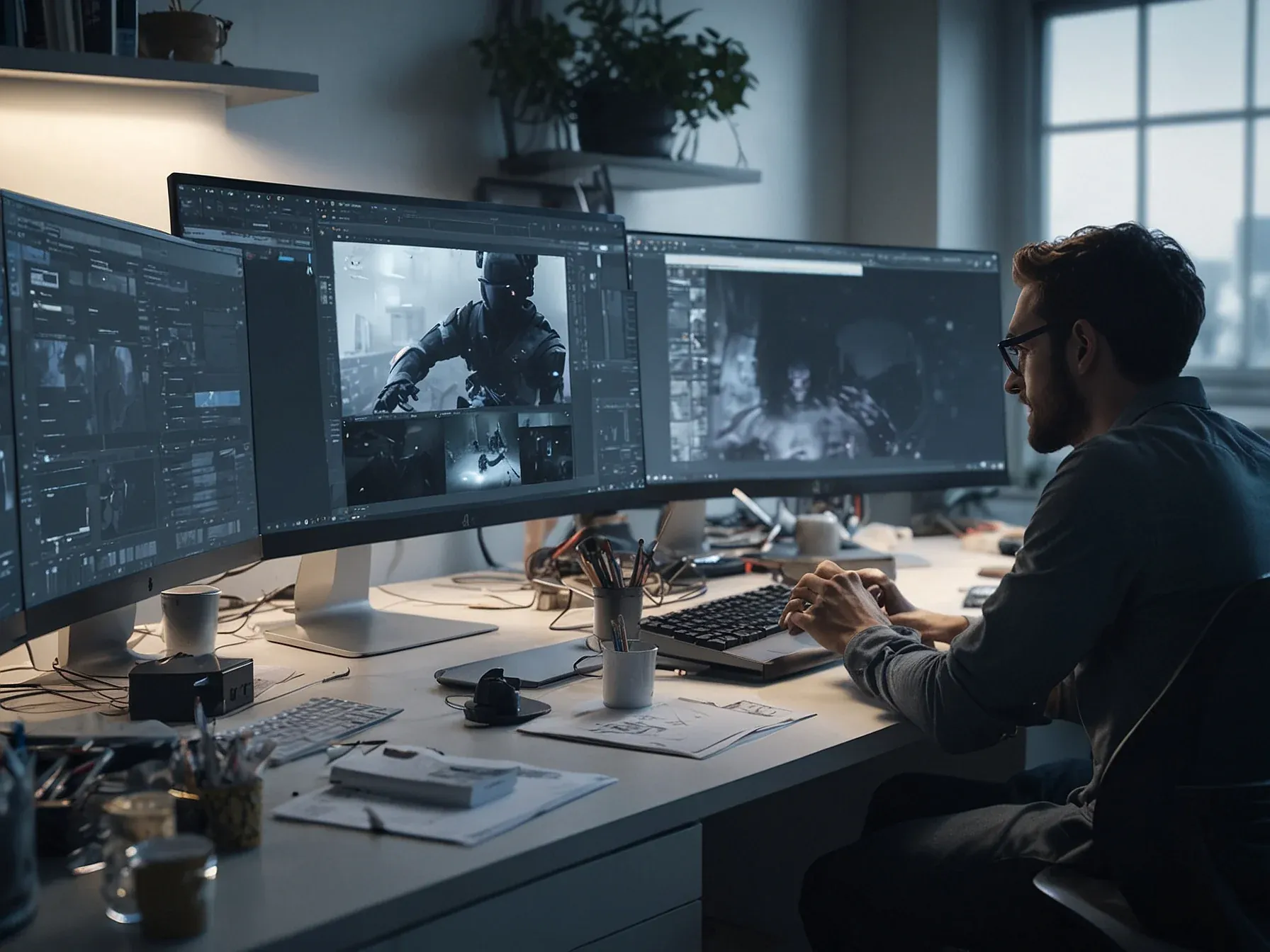
Editorial illustration for Indie Devs Draw Line in Sand: Games Marketed as Pure Human Creativity
Indie Devs Reject AI, Champion Pure Game Development
Indie developers market games as ‘AI-free,’ pledging quality without assistance
The gaming industry is hurtling toward an AI-driven future, with giants like EA, Microsoft, and Ubisoft betting big on generative tools to speed production and unlock new creative frontiers. But a quiet counter-movement is emerging from the indie sector, where a growing number of developers are pitching an entirely different value proposition: their games are built without any AI assistance at all. “We can produce results that meet our quality standards without its assistance,” they assert, a direct challenge to the prevailing narrative that artificial intelligence is an inevitable, even indispensable, part of modern game development.
"We can produce results that meet our quality standards without its assistance." Gen AI enthusiasts see the technology as a way to unlock hidden creative potential, and to many it's a tool to speed up the time-consuming and costly processes inherent to video game production. Some of the biggest companies are taking advantage of that; EA has announced a partnership with Stability AI, for instance, while Microsoft is using AI to generate gameplay. Ubisoft in particular has had a lot to say about gen AI, with CEO Yves Guillemot calling it "as big [of] a revolution for our industry as the shift to 3D" in a recent earnings call.
And so the debate sharpens: not between technology and tradition, but between two very different visions of creation. The indie developer’s “AI-free” pledge is more than a label. It is a quiet declaration of craft, a bet that human labor and small-team intuition can still yield something electric.
The giants chase scale and efficiency, wading into a revolution they insist is inevitable. Maybe they are right. But the indie’s claim is not a denial of progress.
It is a reminder that progress has a cost, and that some costs are not measured in hours or dollars. They are measured in care. In the deliberate, unassisted decisions that make a game feel like it was *made*, not generated.
This is not a war. It is a fork in the road. And the indies have chosen their path.
Now we get to see where it leads.
Related Reading
 Business & Startups
 Nordic pilot adds Gemini for Education, NotebookLM to boost AI literacy
 Business & Startups
 Kling launches Video O1, all-in-one model with MVL bridge using transformer
 Business & Startups
 DeepSeek Seeks More Capital Weeks After USD 7B Funding Round
 From Archives
 Avoid the AI-first trap as rivals tout 40% efficiency gains for your firm
 From Archives
 Jony Ive and Sam Altman unveil AI hardware prototype; OpenAI plans launch under two years
Common Questions Answered
How are indie game developers responding to the rise of generative AI in game production?
Indie developers are taking a strong stance against AI integration, positioning themselves as champions of pure human creativity. They are actively rejecting AI tools and emphasizing their ability to meet quality standards through traditional creative processes.
What major gaming companies are currently exploring AI integration in game development?
Companies like Electronic Arts (EA), Microsoft, and Ubisoft are actively exploring and implementing generative AI in their game production workflows. These corporations see AI as a potential tool to speed up development processes and unlock new creative possibilities.
Why are indie developers drawing a 'line in the sand' against AI in game creation?
Indie developers view their resistance to AI as both a technical and philosophical stance, asserting that human creativity remains fundamental to game design. They believe that maintaining pure human creative processes is essential to preserving the artistic integrity and unique vision of game development.
Further Reading
- Indie devs have begun adding a no generative AI stamp to their store pages — GamingOnLinux
- Artificial Intelligence and Market Entrant Game Developers — arXiv
- "I'm a Solo Developer but AI is My New Ill-Informed Co-Worker": Envisioning and Designing Generative AI to Support Indie Game Development — ACM Digital Library
