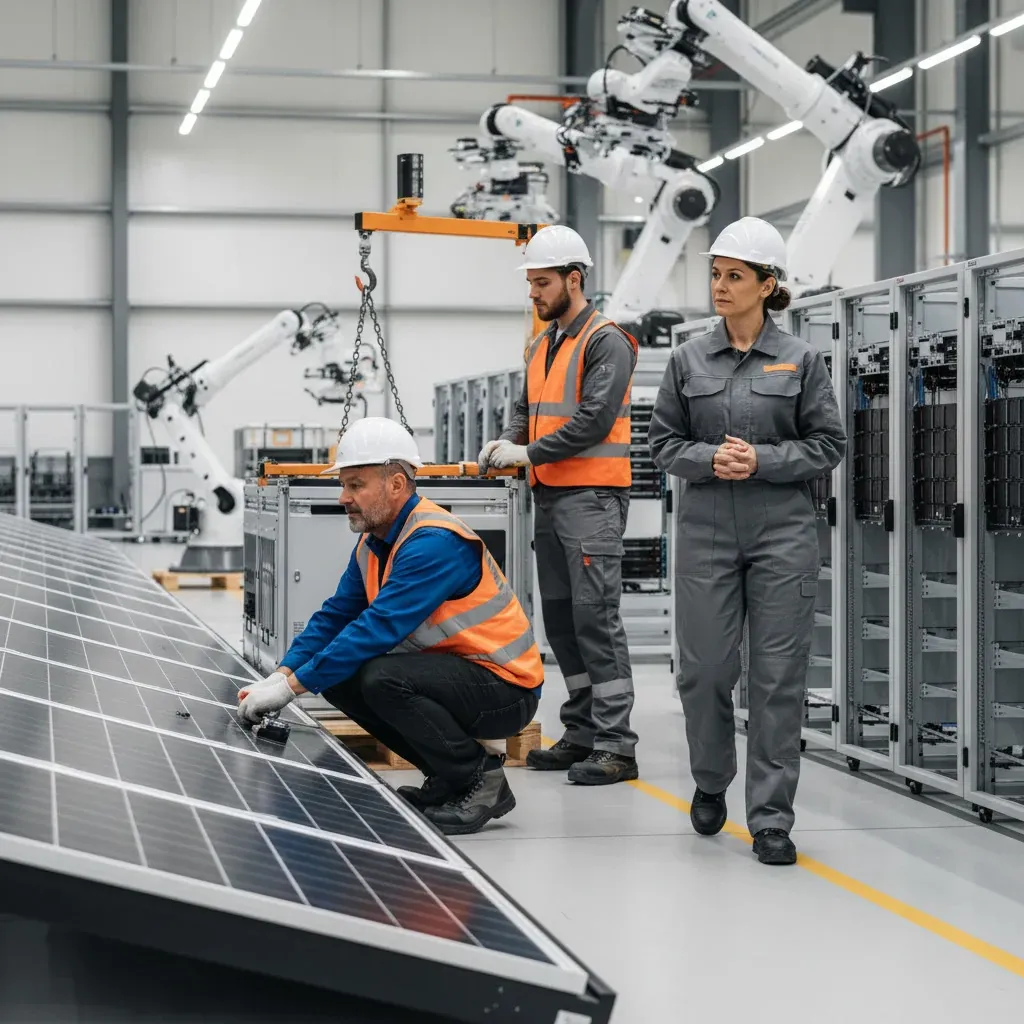
Editorial illustration for India's Data Centers Push Grid Limits as Renewable Energy Lags Behind
India's Data Centers Strain Grid, Renewable Challenge Looms
India’s Grid Strains Under Data Centre Power Demand, Renewable Gaps Remain
India's data centers are starting to break the national grid. This isn't speculative. As the country piles on server racks to fuel its digital economy, the sheer physical demand for electricity is exposing a brutal mismatch between clean energy promises and reliable power.
The problem is immediate and structural. These facilities cluster in areas already short on water, guzzling it for cooling. They need constant, flawless electricity.
India's grid, still propped up by coal, cannot always provide that. So data centers burn diesel. They turn to expensive, polluting backups.
Every new facility becomes a carbon liability wrapped in a digital promise.
India’s central grid has seen a significant increase in large renewable energy projects through solar parks, green energy corridors, and PLI schemes. As a result, data centres in states with low renewable energy levels, like Uttar Pradesh, Bihar, and West Bengal, may consider switching grids.
That sub-one percent electricity share is a tranquil past. It will multiply. The technical solutions exist on paper.
Hybrid solar models work. High-efficiency panels and smart management can cut grid reliance. But these models depend entirely on state policy, a notoriously inconsistent patchwork.
The real cost is delay. Every month of political hesitation locks in more fossil-dependent infrastructure. Data centers could force a faster build-out of renewables and storage.
Or they could simply become the reason India's climate goals were quietly abandoned. The pressure is not on some future grid. It is on today's.
Related Reading
 Open Source
 D&B rebuilds 642 million‑business database after AI agents hit limits
 Open Source
 Box CEO Aaron Levie Says AI Will Drive "Biggest Cybersecurity Upgrade
 Open Source
 Study: 6.7% of Deepfake Requests on Hugging Face Targeted Children
 From Archives
 OpenAI's Gumdrop hardware plans, codenamed 'i', raise smartphone concerns
 From Archives
 NousCoder-14B debut amid looming data shortage that may slow AI coding
Common Questions Answered
How are data centers impacting India's electrical grid infrastructure?
Data centers in major tech hubs like Bangalore and Mumbai are consuming unprecedented amounts of power, creating significant strain on the national electrical grid. The rapid digital infrastructure expansion is pushing the electrical system to its breaking point, challenging existing power distribution capabilities.
Why are renewable energy solutions challenging for India's data center expansion?
India faces complex energy challenges with renewable power, including expensive storage technologies and multi-day intermittency problems that cannot be solved by simple solar solutions. Energy analysts note that the country's renewable energy challenge extends beyond 24-hour power generation to more complex grid stability and consistent power supply issues.
What potential solutions are emerging for data center energy requirements in India?
Solar-hybrid configurations are becoming increasingly attractive, incorporating high-efficiency panels, advanced storage systems, and comprehensive support infrastructure. These hybrid models aim to address the current limitations in renewable energy deployment while meeting the growing computational power demands of expanding data centers.
Further Reading
- Will AI and Cloud Growth Push India’s Data Centres to the Edge of a Power Crisis? — Outlook Business
- India's power-hungry data centre sector at a crossroads — Institute for Energy Economics and Financial Analysis (IEEFA)
- Envisioning an AI Climate Strategy for India — Tech Policy Press
- India Data Center Power Market Size, Trends Report 2026-2034 — IMARC Group
- India Data Center Market to Grow at 14.60% During 2026-32, Driven by AI Integration, Hyperscale Expansion, and Digital Infrastructure Investments — PR Newswire / MarkNtel Advisors
