
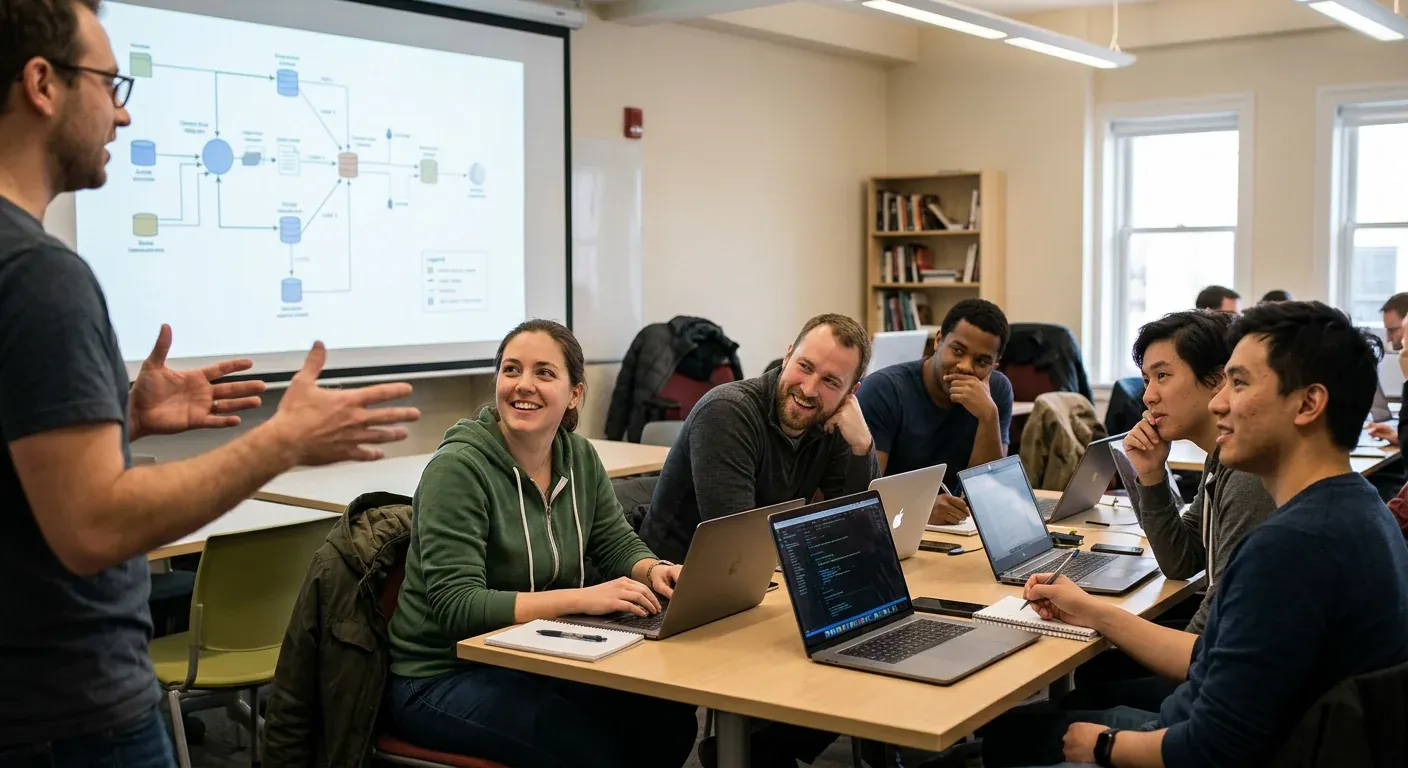
Editorial illustration for NousCoder-14B Launches as AI Coding Models Face Potential Data Bottleneck
NousCoder-14B Reveals Critical Challenge in AI Coding Models
NousCoder-14B debut amid looming data shortage that may slow AI coding
A new open-source coding model has arrived. NousCoder-14B lands with promise and prestige, but buried in its technical report is a quiet alarm. The training data, nearly every verifiable competitive programming problem available on the internet, has been consumed.
Twenty-four thousand problems. That’s it. The researchers aren’t just running low; they’re scraping the bottom of a finite well.
This debut, timed perfectly with the Claude Code moment, carries an uncomfortable truth: the era of infinite high-quality training data for code is ending. And the entire industry should be paying attention.
The model, called NousCoder-14B, is another entry in a crowded field of AI coding assistants, but arrives at a particularly charged moment: Claude Code, the agentic programming tool from rival Anthropic, has dominated social media discussion since New Year's Day, with developers posting breathless testimonials about its capabilities.
NousCoder-14B proves that open-source coding models can still punch above their weight. But its debut carries an uncomfortable truth etched into the fine print. The well of verifiable, high-quality coding problems is not bottomless.
This model drank deeply, and now the glass is nearly empty. The math is simple. Compute scales on a curve of diminishing cost.
Data does not. If the next leap in coding intelligence requires fresh, rigorous examples, the industry must confront an existential pivot. Synthetic data may fill the gap.
Or novel architectures might squeeze more from less. But the era of plucking low-hanging fruit from the internet’s curated garden is over. NousCoder-14B is a milestone, and a mirror.
It shows what we can build with everything we had. And it asks what we will build with what remains.
Related Reading
 Open Source
 D&B rebuilds 642 million‑business database after AI agents hit limits
 Open Source
 Box CEO Aaron Levie Says AI Will Drive "Biggest Cybersecurity Upgrade
 Open Source
 Study: 6.7% of Deepfake Requests on Hugging Face Targeted Children
 From Archives
 Cellular-enabled companion robot signals AI’s move beyond the home
 From Archives
 Ugreen AI NAS Pro adds touchscreen and OCuLink port for external GPU support
Common Questions Answered
What unique challenge does NousCoder-14B reveal about AI coding model development?
NousCoder-14B highlights a critical data bottleneck in AI coding model training, specifically demonstrating that researchers are approaching the limits of high-quality competitive programming datasets. The model's development suggests that finding verifiable and standardized training data is becoming increasingly challenging for future AI coding innovations.
How does NousCoder-14B's training dataset impact the future of AI coding models?
The researchers found that their training dataset encompasses a significant portion of all available, verifiable competitive programming problems in a standardized format. This comprehensive coverage indicates that the current pool of high-quality training data is being rapidly exhausted, potentially slowing down future AI coding model development.
What implications does the data bottleneck have for AI coding model progress?
The data bottleneck suggests that AI coding model development might face significant slowdowns as researchers struggle to find new, high-quality training datasets. This limitation could force researchers to develop more innovative approaches to data collection and model training, potentially reshaping the trajectory of AI coding assistance.
Further Reading
- Papers with Code - Latest NLP Research — Papers with Code
- Hugging Face Daily Papers — Hugging Face
- ArXiv CS.CL (Computation and Language) — ArXiv
