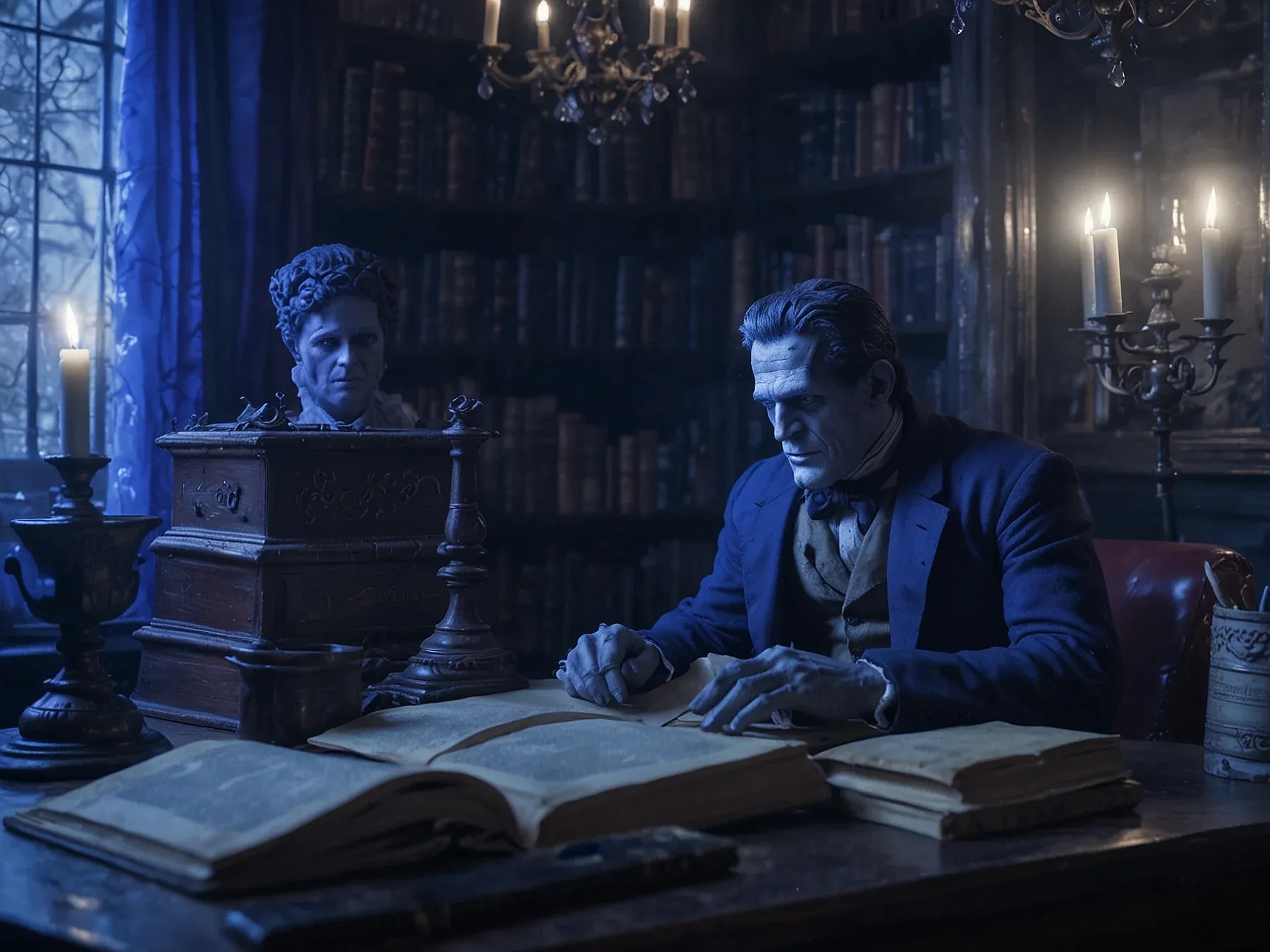
Editorial illustration for Guillermo del Toro Blasts AI Art: 'I'd Rather Die Than See This Go Mainstream
Del Toro Declares War on AI Art: 'I'd Rather Die'
Guillermo del Toro Says He’d Prefer Death Over AI Art Going Mainstream
Guillermo del Toro would rather be dead than see AI art normalized. He said so himself. This isn't a generic tech take from another celebrity; it's the logical end point of a philosophy he's been building for decades, one that sees Mary Shelley's "Frankenstein" not as a monster manual but as the essential text for our current moment.
The man makes monsters for a living. He understands creation, both its sacred spark and its potential for catastrophe. So when he looks at AI generators, he doesn't see a tool. He sees Victor Frankenstein in a hoodie, another arrogant creator who never stopped to ask if his invention wanted to exist, or what its purpose should be.
The Goodwin-Shelley household of Mary's youth was really pro-scientific. I think that Frankenstein is actually closer to Paradise Lost. It's man rising up to God and saying, "Why am I here when I didn't ask to be born?" Which is a very romantic--and by romantic, I mean the Romantic movement--question.
Victor is someone who believes very much in science, but he's also tragic. He almost doesn't ever confront what he's done. In fact, there is a big harangue Victor does in the book toward the sailors saying, You should follow your captain all the way.
Now, in my opinion, the arrogance of Victor is very common now: the tyrant that believes himself to be a victim. But that is true, or has been true since the beginning of time. Absolutely everyone from political figures to Silicon Valley tech bros.
The fact that we enthroned tyranny as a form of certainty, as if it was an attribute. I think the people I most admire are people that are riddled with doubts. When I think about playing God, I also think of AI.
Which is also perhaps something that never asked to be born. Do you see parallels between the makers of AI and, say, Victor? I was not interested in making any [in this film].
I understand [using] it in engineering and biochemistry and mathematics, because those are permutations. In art, I don't think anyone asked for it. Nobody raised their hand and said, "Could you invent this?" No one asked for Sora.
Look, the real threshold has not been crossed. It's not people making this, it's people consuming it--at a cost. I will gladly pay $4.99 for a song by the Beatles or Dylan, you name it, but who is going to pay $4.99 for something created with AI?
His objection is practical, too. Who pays for this? The core of his argument is economic and existential.
Art is a transaction of human experience. Paying for a machine's permutation voids the contract. Del Toro's position is extreme because the stakes are.
It's a defense of doubt, of the messy human question at the center of every real story, against the tyranny of synthetic certainty. He'd choose a finite life of that struggle over an infinite one watching it get priced out at $4.99 a pop.
Further Reading
Related Reading
 LLMs & Generative AI
 ChatGPT's 'Nerdy' tweak rewards goblin metaphors in answers, study finds
 LLMs & Generative AI
 Google to End Free Access to Gemini AI for Non-Subscribers
 LLMs & Generative AI
 AI Engineers Face Rising Costs, Need New Strategies for Efficiency
 From Archives
 AI Psychosis Highlights Mental Health Pros' Lack of ChatGPT Access
 From Archives
 Anthropic says language model checks its own activation states before responding
Common Questions Answered
How does del Toro connect AI art to the philosophical themes in Frankenstein?
Del Toro draws parallels between AI art and Frankenstein's narrative of technological creation, exploring the deeper philosophical questions about creation, agency, and the boundaries between human and artificial creativity. His perspective suggests that AI art, like Frankenstein's monster, raises profound questions about the nature of creation and the responsibilities of creators.
Why is Guillermo del Toro so strongly opposed to AI-generated art becoming mainstream?
Del Toro believes that AI art threatens artistic integrity and the fundamental essence of human creativity. His stance goes beyond simple technological resistance, representing a deeper concern about the potential loss of authentic artistic expression and the philosophical implications of machine-generated art.
How does del Toro's view of AI art relate to the Romantic movement's philosophical approach?
Drawing from the Romantic movement's philosophical traditions, del Toro sees AI art as a problematic form of creation that lacks the emotional depth and existential questioning inherent in human artistic expression. His perspective echoes the Romantic concern with individual creativity and the profound questions of existence that art traditionally explores.
Further Reading
- Guillermo del Toro has a 4-word response when asked about using AI in filmmaking—and it perfectly sums up his stance — PrimeTimer
- Guillermo Del Toro: “I'd Rather Die” Than Use AI in My Movies — World of Reel
- Papers with Code - Latest NLP Research — Papers with Code
- Hugging Face Daily Papers — Hugging Face
- ArXiv CS.CL (Computation and Language) — ArXiv
