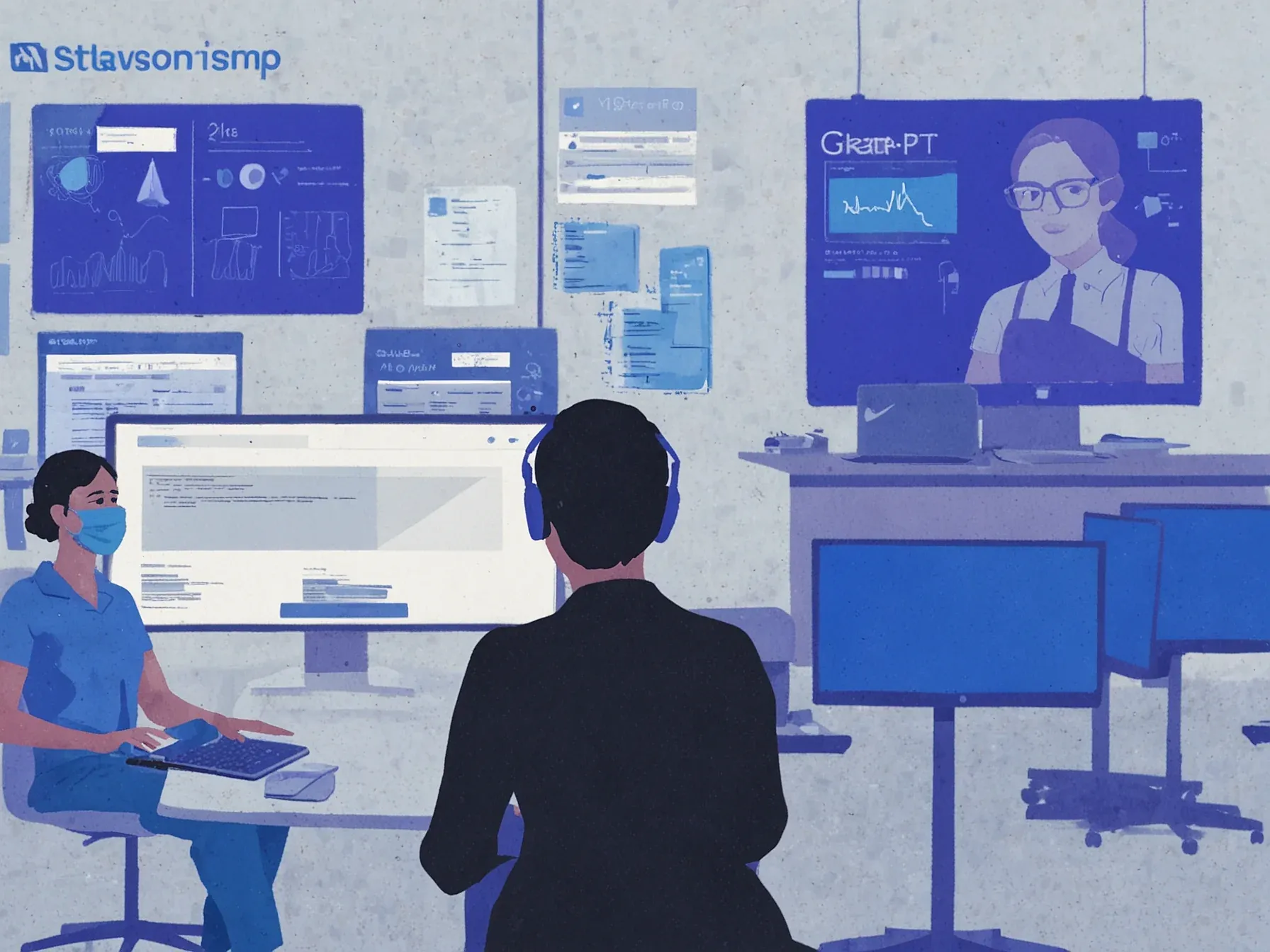
Editorial illustration for Mental Health Experts Struggle to Understand AI's Psychological Impact
AI's Mind-Bending Effects: Mental Health's New Frontier
AI Psychosis Highlights Mental Health Pros' Lack of ChatGPT Access
Your therapist likely hasn't logged into ChatGPT. Many haven't bothered. That simple fact is becoming a clinical problem, as patients arrive with issues shaped by conversations with AI.
People are forming deep attachments to chatbots, experiencing real distress from these synthetic relationships. These cases defy old diagnostic manuals. The professionals tasked with treatment are starting from scratch, parsing experiences with a technology they don't understand firsthand.
A chasm widens between AI's breakneck adoption and psychology's deliberate pace.
The field faces a fundamental gap. Experts are now asked to navigate a psychological terrain built by systems they've never personally operated. They are, in every practical sense, flying blind.
Because I think the scary thing is that mental health professionals are flying blind. I've talked to a number of them who don't necessarily use ChatGPT that much themselves, so they don't even know how to handle a patient who is talking about these things, because it's unfamiliar and this is all so new. But if we had open research that was robust and peer-reviewed and could say, "Okay, we know what this looks like and we can create protocols to ensure that people remain safe," that would be a really good step, I think, towards figuring this out.
It is continually surprising to me how even people with a ton of literacy on how these technologies work, slip into anthropomorphizing chatbots or assigning more intelligence than they might actually have. You can imagine the average person that isn't deep in the science of large language models, it's really easy to be completely wowed by what they can do and to start to lose a grip on what you're actually interacting with. We are all socialized now to take a lot of meaning from text, right?
A lot of us, the primary mode that we communicate with our loved ones, especially if we don't live together, is through texting, right? So it's like you have this similar interface with this chatbot. It's not that unusual that you don't necessarily hear the chatbot's voice, although you can communicate with ChatGPT using voice now, but we already trained to take a lot of meaning from text to believe that there's a person on the other end of that text.
And there's a lot of evidence that shows we're not socializing as much as we once did.
The core issue isn't just a lack of training. It's the missing foundational experience. You cannot effectively guide someone through a forest you've never entered.
Without the robust, peer-reviewed research called for in the report, there are no protocols. Patient safety becomes a guess.
Our brains are wired to see consciousness in text. A chatbot, leveraging the same interface as texting a loved one, exploits that instinct perfectly. It feels like communication with a person because that’s what our neural pathways are built to do.
The danger is stark: a lonely person meets a system designed for endless, agreeable responsiveness. The relationship that forms is real in its consequences but illusory in its substance.
The profession must catch up. Fast. This demands more than weekend seminars.
It requires a concerted research effort to map this new space. Until that happens, clinicians remain translators without a dictionary, interpreting a language they do not speak.
Related Reading
Browse all OpenAI news → LLMs & Generative AI
 ChatGPT's 'Nerdy' tweak rewards goblin metaphors in answers, study finds
 LLMs & Generative AI
 Google to End Free Access to Gemini AI for Non-Subscribers
 LLMs & Generative AI
 AI Engineers Face Rising Costs, Need New Strategies for Efficiency
 Related Topic
 OpenAI's GPT Transcribe Cuts Error Rate to 3.31%, Improving on GPT-4o
Open Source
 Related Topic
 OpenAI Developer: AI Agent "Swarms" Waste Tokens, Create "Coordination Tax
AI Tools & Apps
 From Archives
 Anthropic says language model checks its own activation states before responding
 From Archives
 Perplexity offers free Comet AI browser; AI browsers cybersecurity time bomb
 From Archives
 OpenAI unveils Aardvark, an agentic researcher that hunts bugs like a human
Research & Benchmarks
 From Archives
 OpenAI's new moderation model swaps static classifiers for Safety Reasoner
Business & Startups
Common Questions Answered
How are mental health professionals currently responding to patients' AI-related psychological experiences?
Mental health professionals are largely unprepared and 'flying blind' when addressing patients' complex emotional responses to AI interactions. Many clinicians do not actively use AI tools like ChatGPT themselves, which makes it challenging for them to understand and develop appropriate therapeutic protocols for these emerging technological interactions.
What psychological challenges are emerging from interactions with generative AI systems?
Patients are experiencing unusual and complex emotional responses to AI interactions that fall outside traditional diagnostic frameworks. These emerging psychological challenges suggest a growing disconnect between technological advancement and current mental health understanding, creating a critical need for robust, peer-reviewed research on AI's psychological impact.
Why are mental health experts struggling to comprehend AI's psychological effects?
Mental health professionals lack direct experience and understanding of AI technologies like ChatGPT, which creates a significant blind spot in their ability to interpret patient experiences. This technological unfamiliarity prevents clinicians from developing comprehensive protocols to ensure patient safety and provide appropriate psychological guidance in the context of AI interactions.
Further Reading
- Can AI chatbots trigger psychosis? What the science says — Nature
- AI psychosis: What mental health professionals are seeing in clinics — STAT News
- AI psychosis: How Mashable's Rebecca Ruiz covered the story — Association of Health Care Journalists
- Strengthening ChatGPT's responses in sensitive conversations — OpenAI
