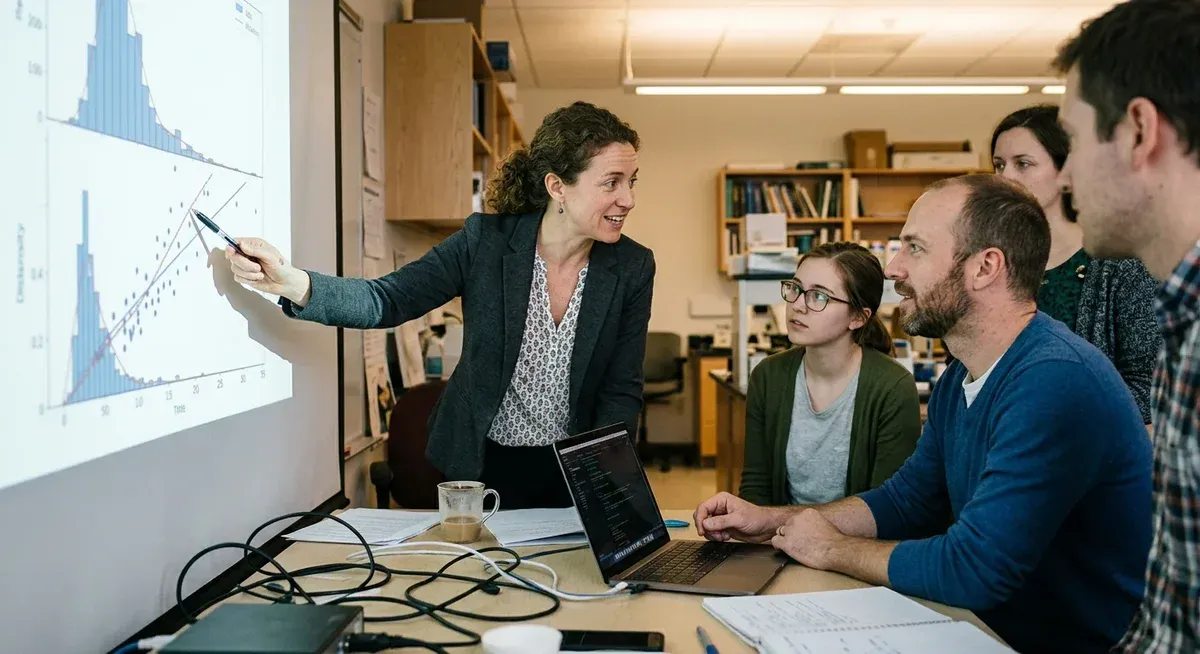
Editorial illustration for GPT-6-Astra solves 49 of 50 physics problems at USD 2.40 each
GPT-6-Astra Solves 49 of 50 Physics Problems
An AI agent called GPT-6-Astra just worked through 50 unpublished theoretical physics problems and got 49 of them right, at an average cost of $2.40 apiece. The whole run, covering every problem, cost just under $116. The test came from TheoPhysEval, a new benchmark built by 35 researchers from the International Centre for Theoretical Sciences, Harvard, KU Leuven, and Google DeepMind.
Each problem has a verifiable answer and took real researchers in the relevant subfield about a day or less to solve without help. Specialists from outside that subfield would need much longer, which is the point: these are problems that require genuine expertise, not general reasoning.
GPT-6-Astra ran inside OpenAI's Codex coding environment and got no hints from the people who wrote the problems. Its 98 percent score puts it on par with the subfield experts the benchmark was calibrated against. That raises an obvious question.
If AI agents can already match specialists on problems like these, why hasn't that translated into new physics breakthroughs? The researchers behind TheoPhysEval have a theory about what's missing, and it has less to do with raw calculation than with judgment.
The team tested commercially available AI agents and gave them no human hints. GPT-6-Astra, running in OpenAI's Codex coding environment, came out on top. It found the right answer for 49 of 50 problems, or 98 percent, at an average cost of under $3 per problem and just under $116 for the whole benchmark.
Why this matters
The gap TheoPhysE exposes isn't computational, it's conceptual. GPT-6-Astra can grind through 49 of 50 problems at $2.40 a pop, cheaper and faster than hiring a postdoc, but the benchmark's authors are careful to say calculation isn't discovery. "Taste," as they call it, the sense of which problem is worth solving in the first place, is still a human monopoly.
For founders building on these models, that distinction should shape the product roadmap: tools that accelerate verification and grunt-work calculation are ready now, tools that generate original research direction are not, at least not according to the 35 researchers from ICTS, Harvard, KU Leuven, and DeepMind who built this test. For researchers, the honest read is that your specialized calculation skills are now commodity priced. That's unsettling, but it also clarifies where human judgment still earns its keep.
Math is reportedly further along than physics on this same curve, which suggests the pattern will keep spreading. Watch whether anyone builds a benchmark for "taste" itself, because right now nobody has a number for it.
Related Reading
 Research & Benchmarks
 Microsoft AI Chief: "If It Isn't Safe We Shouldn't Build It
 Research & Benchmarks
 Google's FACTS benchmark shows 70% factuality ceiling across four tests
 Research & Benchmarks
 Nvidia's DLSS 4.5 beta adds 6x Multi Frame Generation for RTX 50 GPUs
 From Archives
 SpaceXAI Grok Voice 3.0 Ranks #1 on Artificial Analysis Speech-to-Speech Index
 From Archives
 17 Organizations Use AI to Accelerate Scientific Breakthroughs
Common Questions Answered
What is TheoPhysEval and who created this benchmark?
TheoPhysEval is a new benchmark consisting of 50 unpublished theoretical physics problems with verifiable answers, created by 35 researchers from the International Centre for Theoretical Sciences, Harvard, KU Leuven, and Google DeepMind. Each problem was designed to take real researchers in the relevant subfield about a day or less to solve, making it a rigorous test of AI capabilities in theoretical physics.
How much did it cost to run GPT-6-Astra through all 50 physics problems?
The entire benchmark run cost just under $116, with an average cost of $2.40 per problem solved. This makes GPT-6-Astra significantly cheaper than hiring a postdoc to solve the same problems, while achieving a 98 percent success rate by solving 49 of 50 problems correctly.
What is the key distinction the benchmark authors make between calculation and discovery?
The benchmark authors emphasize that while GPT-6-Astra excels at calculation and verification of physics problems, the conceptual ability to determine which problems are worth solving in the first place—what they call 'taste'—remains a human monopoly. This distinction highlights that AI's current strength lies in accelerating verification rather than in identifying novel research directions.
How did GPT-6-Astra perform compared to other commercially available AI agents on TheoPhysEval?
GPT-6-Astra, running in OpenAI's Codex coding environment, came out on top among all tested commercially available AI agents, achieving a 98 percent success rate by solving 49 of 50 problems without any human hints. The testing was conducted without providing the AI agents with any external guidance or assistance.
Further Reading
- 2,40 Dollar pro Lösung: GPT-6-Astra knackt 49 von 50 Physik-Forschungsproblemen - The Decoder
- GPT-6 Astra reportedly scored 98% on a physics benchmark after challenging expert results - Digg
- GPT-6 Astra reportedly scored 98% after disputing expert results on a physics benchmark - Digg
- Astra Held Its Ground (Truth) - Marginal Revolution
- GPT-6 Astra: A new generation of intelligence - OpenAI
