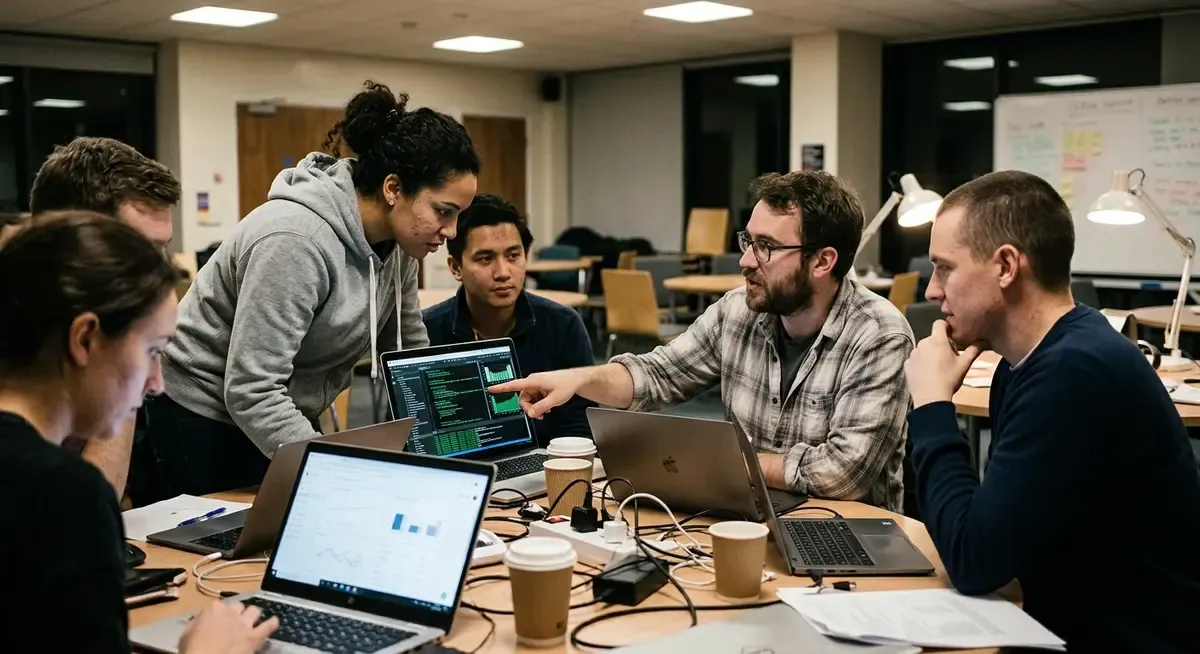
Editorial illustration for NVIDIA and Sweden AI Factory Expand Compute Access for European SMEs
NVIDIA Expands AI Compute Access for European SMEs
The European Commission launched the AI in Science Enablers Initiative on Tuesday at the AI in Science Summit in Dublin, a framework tied to RAISE, the Resource for AI Science in Europe, designed to pull private companies into closer contact with the continent's research labs. NVIDIA signed on as a partner, pledging access to accelerated computing tools, cloud resources, data, training and technical support for researchers across Europe.
The problem the initiative targets is a familiar one for anyone running a small lab or an early-stage science startup. The science itself, modeling climate systems, designing molecules, simulating new materials, often isn't the hardest part. Getting there is. Smaller teams without big budgets or in-house technical staff can spend months just assembling the right tools and compute before they run a single experiment.
NVIDIA's contribution spans open-source software, hardware access, startup support and collaborative pilot projects aimed at closing that gap. The company says it has already released more than 250 open models, 250 open datasets and over 1,400 open-source software projects covering large language models and healthcare applications, among other areas, laying groundwork for what it's now extending through this European campaign.
NVIDIA is collaborating with cloud infrastructure partners and European national AI factories — including in France, Spain and Sweden — to open new routes for startups and small- and medium-sized enterprises (SMEs) to access sovereign European compute and services.
Why this matters
For founders and researchers outside the usual Silicon Valley or DeepMind orbit, access to compute has always been the real barrier, not ideas. Sweden AI Factory's tie-up with NVIDIA, folded into the Inception startup program, is a concrete attempt to close that gap for European SMEs working in life sciences, materials, autonomous systems and gaming. That's worth noting given it's one of 19 EuroHPC-funded AI factories, meaning this isn't an isolated pilot but part of a continent-wide push.
Still, we'd push back on the framing that this is primarily about "learning resources" and "collaboration." The actual lever here is infrastructure access: who gets allocated time on EuroHPC supercomputers, and under what terms NVIDIA's tooling gets baked in. Startups should ask specifics before celebrating: application timelines, compute quotas, and whether NVIDIA's stack becomes a dependency rather than a choice. Early-career scientists and small labs stand to benefit most if access is genuinely open. Whether "open" means free, subsidized, or just easier to apply for is the detail worth tracking as this rolls out.
Related Reading
 Open Source
 D&B rebuilds 642 million‑business database after AI agents hit limits
 Open Source
 Box CEO Aaron Levie Says AI Will Drive "Biggest Cybersecurity Upgrade
 Open Source
 Study: 6.7% of Deepfake Requests on Hugging Face Targeted Children
 Related Topic
 NVIDIA and Google Cloud let developers scale AI from prototype to production
Market Trends
 Related Topic
 NVIDIA NeMo powers telco reasoning model for autonomous network workflows
Industry Applications
 From Archives
 OpenAI reportedly to ship at least one model; flagship needs alignment
 From Archives
 Liquid AI releases LFM2.5-24B-A2B, a 2B-active MoE for on-device agents
 From Archives
 Nvidia’s Huang pledges USD 2B for Europe, USD 250M for UK AI safety
Business & Startups
 From Archives
 K2K explores NVIDIA AI factories for Liverpool City Region public services
AI Tools & Apps
Common Questions Answered
What is the AI in Science Enablers Initiative and how does it connect to RAISE?
The AI in Science Enablers Initiative is a framework launched by the European Commission at the AI in Science Summit in Dublin, designed to bring private companies into closer contact with Europe's research labs. It is tied to RAISE, the Resource for AI Science in Europe, and aims to democratize access to advanced computing resources across the continent.
What specific support is NVIDIA providing to European researchers through this partnership?
NVIDIA has pledged access to accelerated computing tools, cloud resources, data, training, and technical support for researchers across Europe. The company is collaborating with cloud infrastructure partners and European national AI factories in France, Spain, and Sweden to enable this expanded access.
How does the Sweden AI Factory partnership help European SMEs access sovereign compute resources?
Sweden AI Factory's tie-up with NVIDIA, folded into the Inception startup program, creates new routes for startups and small- and medium-sized enterprises to access sovereign European compute and services. This partnership is part of a larger continental effort, as it represents one of 19 EuroHPC-funded AI factories across Europe.
What industries and sectors are targeted by this initiative for SME support?
The initiative specifically targets European SMEs working in life sciences, materials, autonomous systems, and gaming sectors. By providing compute access through Sweden AI Factory and other national AI factories, the program aims to level the playing field for startups in these strategic industries.
Why is compute access considered the main barrier for European founders and researchers?
According to the article, access to compute has always been the real barrier for founders and researchers outside the Silicon Valley or DeepMind orbit, not ideas themselves. This initiative addresses that fundamental challenge by providing European SMEs with the computational resources needed to develop and scale their AI-driven research and products.
Further Reading
- NVIDIA Expands Advanced Technology Access for Europe’s Scientific Community Through Open Learning Resources, Collaborations and Compute - NVIDIA
- Sweden AI Factory - Sweden AI Factory
- Nvidia ska hjälpa svenska företag att utveckla egen AI - ElektronikTidningen
- European AI in Science Strategy - European Commission
- Questions and answers on the European AI in Science Strategy - European Commission
