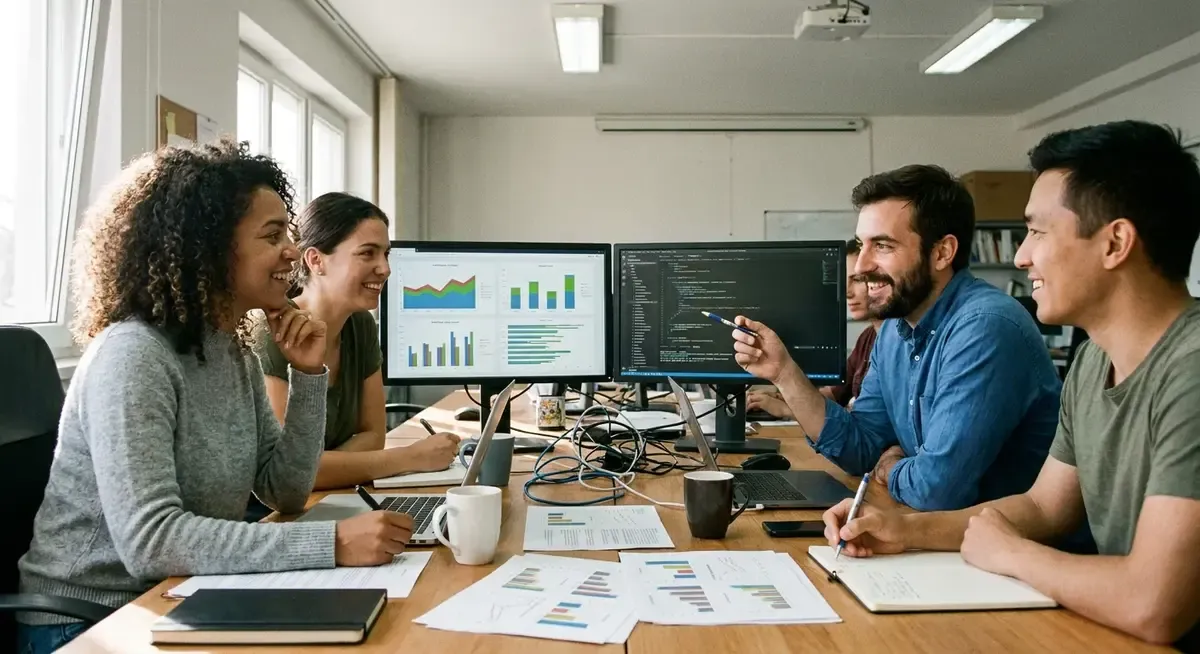
Editorial illustration for GPT-4o, Gemini, and Claude Vision Can Reason Over Visual Details
Vision AI Models Master Complex Visual Reasoning Tasks
GPT-4o, Gemini, and Claude Vision Can Reason Over Visual Details
Ask GPT-4o to look at a photo of a crowded whiteboard and it won't just tell you there's a whiteboard in the room. It will read the handwriting, follow the arrows between boxes, and explain what the diagram is actually arguing. That's the shift separating today's vision language models from the ones that came before. Google's Gemini, Anthropic's Claude Vision, and Alibaba's Qwen-VL all do versions of the same thing: take an image, a chart, a scanned PDF, or a screenshot, and reason over it the way a person would, rather than just labeling what's in frame.
The mechanics behind this are consistent across these systems. A vision component turns pixels into features a machine can work with, and a language model takes those features plus a written prompt to produce an answer. The result is software that can handle photos, documents, diagrams, and in some cases video, which makes it far more useful in classrooms, hospitals, warehouses, and accessibility tools than earlier image-only models ever were. Getting here took a specific line of research, starting with two models that proved images and text could share a common space at all.
Modern Vision Language Models are AI systems that can understand images and language together. They do not just detect objects in an image. They can also explain what is happening, answer questions, read visible text, understand layouts, compare details, and reason over visual information.
Why this matters
For developers, the practical shift is that a single API call to GPT-4o or Gemini can now replace what used to require a pipeline of OCR tools, chart-parsing scripts, and separate captioning models. That's a real cost and complexity reduction for teams building document-processing or accessibility tools. But we'd caution against treating "reasons over visual details" as a solved problem rather than a marketing line.
CLIP and BLIP could match images to text; the newer claim is that Claude Vision or Qwen-VL can follow instructions and hold a conversation about a screenshot or a chart. Founders building products on this should test that claim directly on their own messy, real-world images, not on the clean benchmark examples vendors show off. Researchers should ask what "reasoning" actually means here versus pattern-matching at a larger scale.
Healthcare and automation use cases raise the stakes further: a model that misreads a chart or a form field isn't a minor bug. Worth watching which of these four models actually holds up under adversarial or low-quality image inputs, not just curated demos.
Related Reading
Browse all Google news → LLMs & Generative AI
 ChatGPT's 'Nerdy' tweak rewards goblin metaphors in answers, study finds
 LLMs & Generative AI
 Google tests visual 'magazine-style' UI for Gemini 3 Pro users
 LLMs & Generative AI
 AI Engineers Face Rising Costs, Need New Strategies for Efficiency
 Related Topic
 NVIDIA and Google Cloud let developers scale AI from prototype to production
Market Trends
 Related Topic
 Google's FACTS benchmark shows 70% factuality ceiling across four tests
Research & Benchmarks
 From Archives
 AI Search Agents Struggle With Ambiguous Queries, Study Finds
 From Archives
 pxpipe hides text in PNGs to cut Claude token costs by up to 70%
 From Archives
 Gemini Update Adds Screen Reactions, AI Video Creation in June 2026
Industry Applications
 From Archives
 Google launches Nano Banana 2 Lite image model and Gemini Omni Flash video API
Business & Startups
Common Questions Answered
How do modern vision language models like GPT-4o differ from previous image recognition systems?
Modern VLMs such as GPT-4o, Gemini, and Claude Vision go beyond simple image identification to reason over visual details and understand context. Rather than just identifying what is in an image, they can read handwriting, follow diagrams, analyze charts, and explain what visual information means, transforming them from basic image-text models into multimodal assistants.
What specific visual tasks can GPT-4o and Gemini perform according to the article?
GPT-4o and Gemini can read handwriting on whiteboards, follow arrows and connections between boxes in diagrams, analyze charts and graphs, understand scanned PDFs and screenshots, and reason over the relationships between visual elements. These models can work with text, images, audio, and video to provide comprehensive multimodal analysis.
What practical benefits do vision language models provide for developers building document-processing tools?
A single API call to GPT-4o or Gemini can now replace what previously required multiple separate tools including OCR tools, chart-parsing scripts, and captioning models. This represents a significant cost and complexity reduction for teams developing document-processing and accessibility applications.
Which AI models are mentioned as examples of systems that can reason over visual details?
The article highlights Google's Gemini, Anthropic's Claude Vision, Alibaba's Qwen-VL, and OpenAI's GPT-4o as modern vision language models capable of reasoning over visual details. All of these models can take images, charts, scanned PDFs, or screenshots and analyze them to explain their meaning and content.
Further Reading
- Papers with Code - Latest NLP Research - Papers with Code
- Hugging Face Daily Papers - Hugging Face
- ArXiv CS.CL (Computation and Language) - ArXiv
