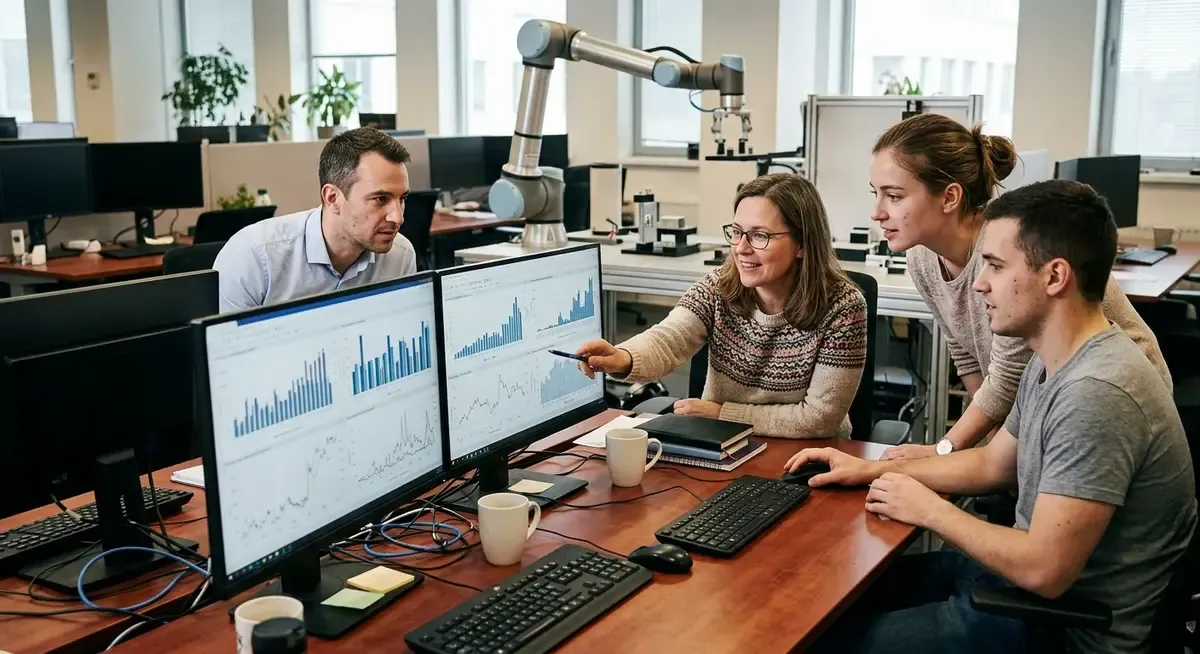
Editorial illustration for Stanford's Karen Liu on Generalist AI's Large-Scale Robot Data Collection
Stanford's Karen Liu on Robot Data Collection
A robot arm in Cambridge, Massachusetts, watched a short video of a person unzipping a purse and pulling out banknotes. Then it did the same thing to a different purse, one it had never seen. When its right gripper couldn't get a clean angle on the bills, it switched to its left and tried again.
"Ha," an engineer standing nearby said. "It never did that before."
That demo happened last week at Generalist AI, a startup working out of offices about 15 minutes from where I live. I went to watch robot arms stack cups, sort blocks, and sweep debris into a dustpan, tasks that sound mundane until you see a machine improvise its way through them. In one run, the robot's brush was pulled out of the scene mid-task, so it grabbed the dustpan itself and used it to flick a block into a bowl, no retraining required.
Pete Florence, Generalist's cofounder and CEO, has a name for why this feels different from past robotics demos. He points back to 2020, to the moment researchers realized a single language model could be prompted, not reprogrammed, into doing almost anything.
The arms mastered a range of tasks after ingesting a short, instructional video and, most impressively, no specific training for a given task. One of the most striking examples involved a robot that was instructed to sweep a block into a bowl using a dustpan and brush. When the brush was removed from the scene, the robot improvised by using the dustpan like a brush and flicking the block into the bowl.
Why this matters
Generalist AI's pitch is that robot data doesn't need to be locked to a single arm or gripper to be useful, and Karen Liu's comment gives that claim some outside credibility rather than just startup marketing. For developers and founders building on physical AI, the real question is whether "strongest results" hold up outside a demo in Cambridge with cups and blocks. Stacking cups is a long way from a warehouse floor or a kitchen with unpredictable lighting and clutter.
Liu's phrasing, "may be working," is a hedge worth noticing. Researchers should watch whether Generalist publishes benchmarks across different robot hardware, not just its own rig, since that's the actual test of a hardware-agnostic data strategy. If large-scale physical interaction data really transfers across robot bodies, it changes the economics of training embodied AI, cutting the need for bespoke data collection per platform.
If it doesn't generalize past curated demos, this is another case of a narrow trick dressed up as a breakthrough. The next thing to watch: independent replication on robots Generalist didn't build.
Related Reading
 Market Trends
 AI drives three initiatives to accelerate global action for planet protection
 Market Trends
 Akamai data shows AI training bots and content‑fetching bots rise since July
 Market Trends
 NVIDIA and Google Cloud let developers scale AI from prototype to production
 From Archives
 DeepSeek's V4 Flash Agent Tasks Falter Amid Price Restructuring
 From Archives
 Writer says its new AI model cuts costs by 52% amid token spending surge
Common Questions Answered
How did the robot arm at Generalist AI demonstrate generalization when handling different purses?
The robot arm watched a short instructional video of a person unzipping a purse and removing banknotes, then successfully replicated this task on a different purse it had never seen before. When its right gripper couldn't get a clean angle on the bills, the robot improvised by switching to its left gripper and trying again, demonstrating adaptive problem-solving without specific training for that particular purse.
What is notable about how Generalist AI's robots learn tasks without explicit training?
The robot arms can master a range of tasks after ingesting only a short instructional video, without requiring specific training for each individual task. This capability allows robots to generalize from visual demonstrations and apply learned behaviors to novel situations and objects they haven't encountered before.
How did the robot improvise when the dustpan and brush task became impossible?
When instructed to sweep a block into a bowl using a dustpan and brush, the robot successfully completed the task even after the brush was removed from the scene. Instead of failing, the robot improvised by using the dustpan itself like a brush and flicking the block into the bowl, demonstrating creative problem-solving capabilities.
What is Generalist AI's core claim about robot data utility according to Karen Liu?
Generalist AI claims that robot training data doesn't need to be locked to a single arm or gripper configuration to be useful across different robotic systems. Karen Liu's endorsement of this claim provides outside credibility beyond just startup marketing, suggesting that generalized robot data can transfer across different hardware platforms.
What real-world challenges remain for Generalist AI's robot demonstrations?
While the robots show strong results in controlled demo environments like Cambridge with cups and blocks, the key question is whether these capabilities will hold up in unpredictable real-world settings like warehouse floors or kitchens with variable lighting and clutter. The gap between stacking cups in a demo and handling complex, messy environments represents a significant challenge for practical deployment of this physical AI technology.
Further Reading
- Karen Liu & Her Research in Embodied Intelligence is Featured in Stanford Research - Stanford Research
- Keynotes and Early Career Spotlights · Robotics - RSS 2026 - Robotics: Science and Systems
- ARCap: Collecting High-quality Human Demonstrations for Robot Learning with Augmented Reality Feedback - Stanford The Movement Lab
- DexCap: Scalable and Portable Mocap Data Collection System for Dexterous Manipulation - Stanford PAIR Publications
- How AI Advances Are Improving Humanoid Robots - Science Friday
