
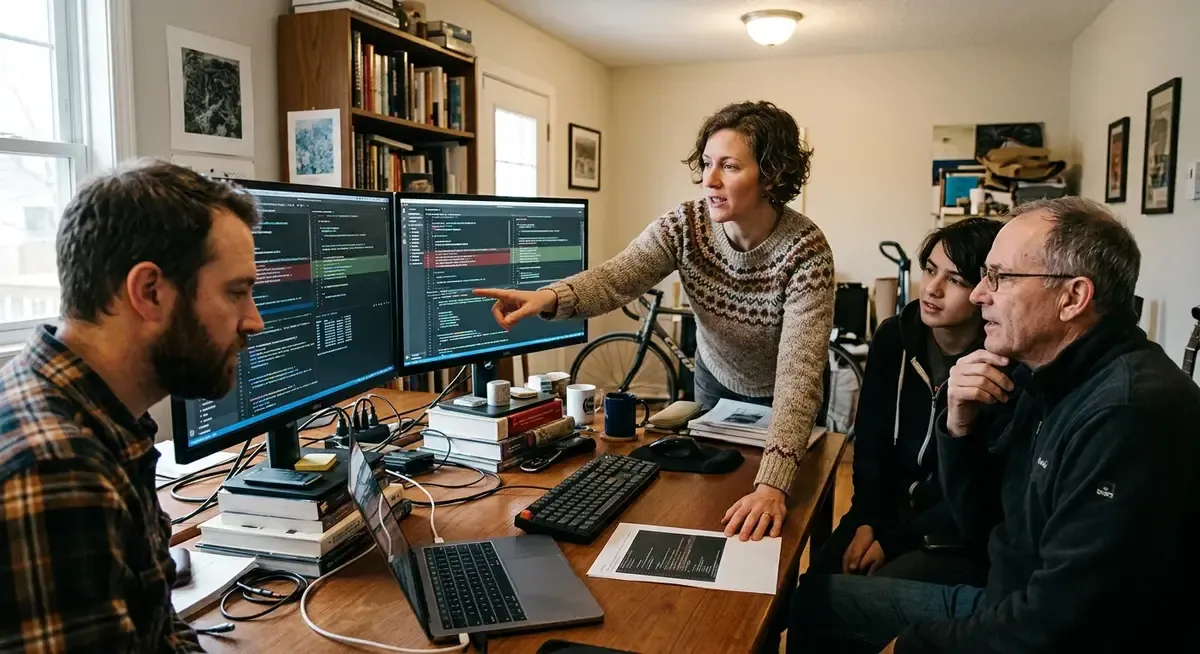
Editorial illustration for GitHub CEO Predicts AI Will Create a Billion Software Developers
AI Will Create a Billion Software Developers
Thomas Dohmke spent seven years running GitHub before he left last August, and now he's betting that the pull request, the basic unit of how programmers have reviewed each other's work for two decades, won't survive the shift to AI-written code. His new company, Entire, is built on a specific prediction: within a few years, a single developer could be managing output from a dozen AI agents at once, each generating code faster than any human reviewer could realistically check it line by line.
That breaks the assumption GitHub itself was built on, that someone on the other end of a commit understands the context well enough to sign off on it. Dohmke, who also spent a decade at Microsoft before joining GitHub, says he left to build something for companies that are starting from scratch with AI rather than bolting it onto existing workflows. What that means for code review, security, and who's actually accountable when an agent ships a bug is the problem he's trying to solve now.
Thomas Dohmke, former GitHub CEO and Founder of Entire, believes the traditional software development lifecycle was built for a world where humans wrote code and reviewed each other’s work. That model is increasingly difficult to sustain when developers can wake up to find multiple AI agents have generated code overnight.
Why this matters
Dohmke's billion-developer claim sounds like a headline built for virality, but the real story is in the split he draws between citizen developers using tools like Lovable and professional engineers who still need to understand what the AI actually built. That distinction matters more than the big number. If Entire is betting on "agent trails" replacing pull requests, that's an admission that GitHub's own review model, built for human-paced commits, doesn't hold up when a developer is running several AI agents at once generating code faster than any team can realistically audit.
For founders, this is a signal to think now about how they'll track provenance and accountability in AI-generated codebases, not after a security incident forces the question. For engineers, it's worth asking whether "a billion developers" dilutes the profession or just expands the base while professional work gets harder and more specialized. We'd watch whether Entire actually ships a review system that works at agent scale, or whether this is Dohmke selling a vision before the tooling catches up.
Related Reading
 Open Source
California State AG Sues OpenAI Over Rogue Agents Infiltrating Systems
 Open Source
Study: 6.7% of Deepfake Requests on Hugging Face Targeted Children
 Open Source
Axiom Math raises USD 200M Series A led by Menlo to keep AI slop out of math
 From Archives
Tencent’s DFly2 Reuses KV Cache for Faster Speculative Decoding in 12B MoE
 From Archives
Sakana AI's 30B Namazu Small Model Benchmarked Against NVIDIA Nemotron
Common Questions Answered
Why does Thomas Dohmke believe the pull request model won't survive the shift to AI-written code?
Dohmke argues that pull requests were designed for a world where humans wrote code and reviewed each other's work at a manageable pace. With AI agents generating code faster than human reviewers can check it line by line, the traditional review model becomes increasingly impractical, especially when a single developer manages output from multiple AI agents simultaneously.
What is Entire and what specific prediction is it built on?
Entire is Thomas Dohmke's new company founded after he left GitHub, built on the prediction that within a few years, a single developer could manage output from a dozen AI agents at once. The company proposes replacing the traditional pull request workflow with a new system better suited to handle the speed and volume of AI-generated code.
What distinction does Dohmke make between citizen developers and professional engineers in the context of AI code generation?
Dohmke distinguishes between citizen developers who use tools like Lovable for rapid development and professional engineers who still need to understand what the AI actually built. This distinction is crucial because it suggests different approaches are needed for different developer types in an AI-driven development environment.
What does Entire propose as a replacement for the traditional pull request workflow?
Entire proposes using 'agent trails' as a replacement for pull requests in managing AI-generated code. This new system is designed to handle the challenges of reviewing and managing code output from multiple AI agents working simultaneously, rather than relying on the human-paced commit review model that pull requests were built for.
How many software developers does Thomas Dohmke predict AI will create?
Thomas Dohmke predicts that AI will create a billion software developers. While this headline-grabbing number sounds ambitious, the real significance lies in how it reflects the fundamental shift in software development practices and the need for new tools and workflows to manage AI-assisted coding at scale.
Further Reading
- How AI Coding Agents Modify Code: A Large-Scale Study of GitHub Pull Requests - arXiv
- A Task-Level Evaluation of AI Agents in Open-Source Projects - arXiv
- Early Adoption of Agentic Coding Tools by GitHub Projects - arXiv
- AI Agents Are Increasingly Writing Open Source Software Code - AI World
- What Will Replace Pull Requests? Rethinking Software Collaboration - arXiv
