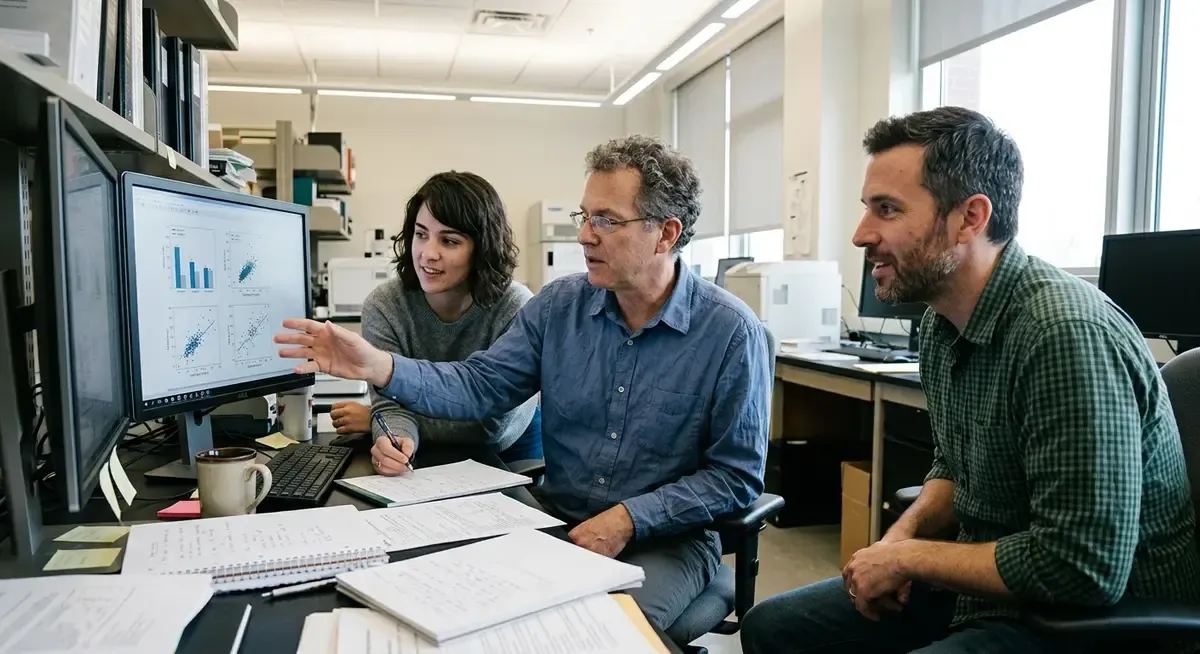
Editorial illustration for Ex-OpenAI Researcher: AI's Riemann Proof Process Matters More Than Result
AI's Riemann Proof Process Matters More Than Result
Scott Aaronson spent years studying what computers can and can't do before anyone needed him to say it about AI. Now he's saying it anyway. In a blog post, the complexity theorist and former OpenAI researcher takes up two recent results: an AI system's work on the Riemann hypothesis and a separate OpenAI result on the Fourier transform, a tool that underlies audio, image, and signal processing. In the Fourier case, the system found a faster computation method and proved a limit on how much faster any method could go.
Aaronson, who teaches at the University of Texas at Austin, argues most people are asking the wrong question when they ask whether the Riemann proof itself matters. He doesn't think it will touch daily life directly. What he thinks matters is that a machine produced work like this at all, and what that says about the kind of mathematical terrain still waiting to be mapped. His post lays out why he's updated his thinking on one of the oldest debates in his field, and why he reaches for language about economic upheaval and existential risk to describe it.
Aaronson, a professor at the University of Texas at Austin, argues the far bigger deal is that AI can do this kind of work at all. In his view, that could have "staggering implications for everyday life," from reshaping the global economy to threatening all life on Earth.
Why this matters
Aaronson's point cuts against how most of us have been talking about AI math results. The instinct is to ask "what's the proof good for," as if a Riemann hypothesis breakthrough needs a product roadmap attached. Aaronson's "caveman act" line is a jab at exactly that reflex, and it's a fair one.
For developers and researchers watching these systems, the signal isn't in the specific theorem, it's in whether a model can generate a proof that a complexity theorist takes seriously enough to walk through line by line. That's a capability claim, not an applications claim, and the two get conflated constantly in AI coverage. Founders pitching math-capable models should take note: the Riemann result and the matrix multiplication proof are evidence about reasoning depth, something investors and engineers can actually evaluate, separate from whatever downstream uses get bolted on later for a press release.
We'd rather see more of this framing. Watch whether other researchers start grading AI proofs on rigor instead of marketing them as solved mysteries.
Related Reading
Browse all OpenAI news → Research & Benchmarks
Microsoft AI Chief: "If It Isn't Safe We Shouldn't Build It
 Research & Benchmarks
Google's FACTS benchmark shows 70% factuality ceiling across four tests
 Research & Benchmarks
Nvidia's DLSS 4.5 beta adds 6x Multi Frame Generation for RTX 50 GPUs
 Related Topic
California State AG Sues OpenAI Over Rogue Agents Infiltrating Systems
Open Source
 Related Topic
OpenAI researcher quits, citing distrust over ad‑driven engagement metrics
LLMs & Generative AI
 From Archives
Z.AI's GLM-5.5 Model Delayed to 2027 Amid Data Access Shift
 From Archives
MOZAIC Deepfake Benchmark Tests 137,745 Audio-Video Clips
 From Archives
OpenAI fixes GPT-6.2 Astra pricing error, quota now depletes 40% faster
LLMs & Generative AI
 From Archives
OpenAI and Cisco Release Shirudo: Open-Source Linux Runtime for Live System Defense
Open Source
Common Questions Answered
Why does Scott Aaronson argue that AI's ability to work on the Riemann hypothesis matters more than the actual result?
Aaronson contends that the significance lies not in whether AI solves the Riemann hypothesis itself, but in demonstrating that AI systems can produce mathematical proofs that complexity theorists take seriously. He believes this capability could have staggering implications for everyday life, from reshaping the global economy to potentially threatening all life on Earth, making the process more important than any single result.
What were the two recent AI mathematical results that Scott Aaronson analyzed in his blog post?
Aaronson examined an AI system's work on the Riemann hypothesis and a separate OpenAI result on the Fourier transform. The Fourier transform case involved an AI system finding a faster computation method while also proving a limit on how much faster it could be, demonstrating the system's capability in mathematical optimization and proof generation.
How does Aaronson's perspective challenge the typical way people discuss AI mathematical breakthroughs?
Most discussions focus on asking what a specific proof is good for, treating mathematical breakthroughs as if they need practical product applications attached. Aaronson argues this approach misses the real signal, which is whether AI models can generate rigorous proofs at all, rather than whether those proofs solve specific theorems or have immediate commercial value.
What is Aaronson's background and current position that informs his perspective on AI capabilities?
Scott Aaronson is a complexity theorist and professor at the University of Texas at Austin who previously worked as a researcher at OpenAI. His years of studying what computers can and cannot do theoretically provide him with deep expertise to evaluate whether AI systems are genuinely performing novel mathematical work or simply pattern matching.
Further Reading
- Artificial Intelligence for Mathematical Reasoning - arXiv
- A Benchmark Suite for Advanced Mathematical Proof Generation and Verification - arXiv
- Mathematical Reasoning in Large Language Models: Benchmarks, Architectures, Evaluation, and Open Challenges - arXiv
- Mathematicians are amazed by 'holy grail' proof of Riemann hypothesis - New Scientist
- IMProofBench: Benchmarking AI on Research-Level Mathematical Proof Generation - arXiv
