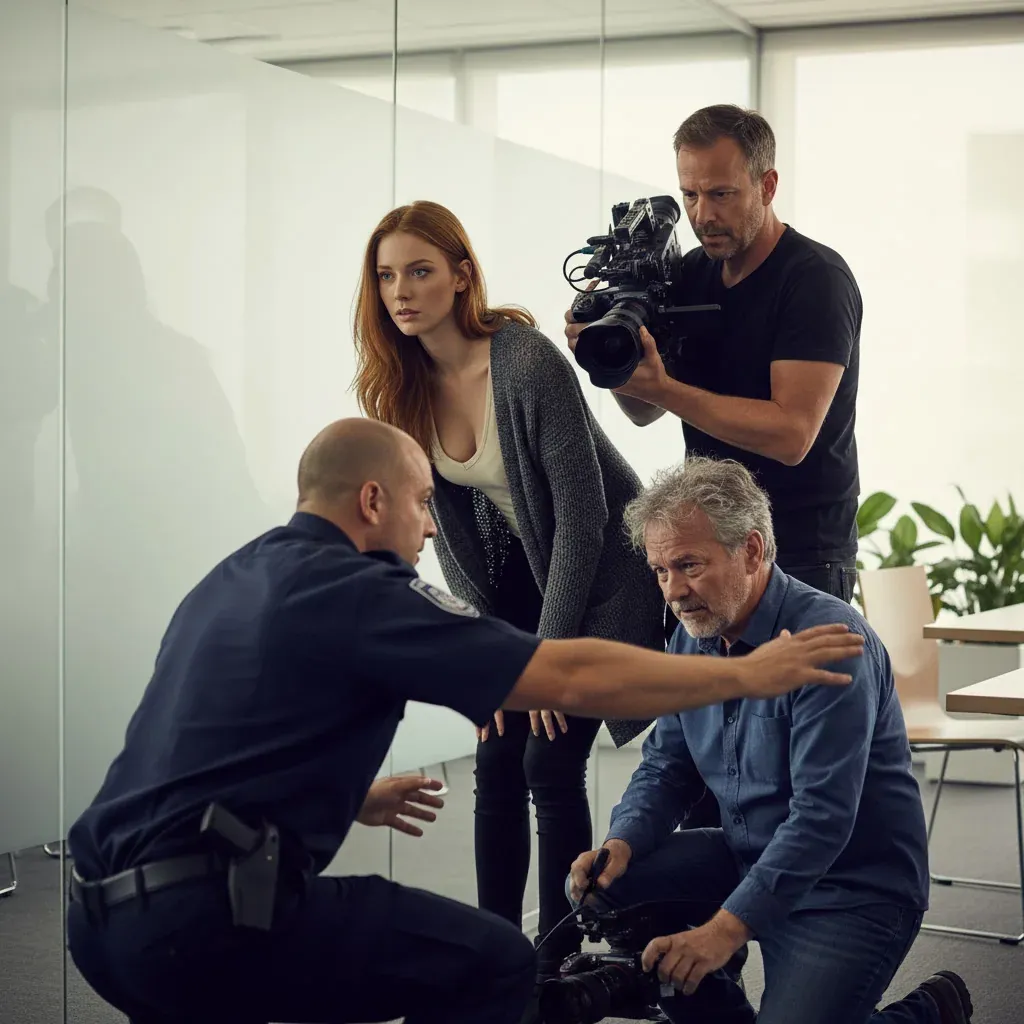
Editorial illustration for Sam Altman Deepfake Sparks Security Confrontation at Filmmaker's Event
Sam Altman Deepfake Sparks Tech Event Security Drama
Filmmaker's Sam Altman deepfake triggers security removal and attachment
The gate was easy to slip through. The security guard’s grip was not. “They grabbed me and physically removed me,” recounts filmmaker Lough, setting the stage for a documentary that begins with trespassing and ends with something far stranger.
His original plan, to interview Sam Altman directly, collapsed. So he borrowed a trick from Altman’s own playbook. After Scarlett Johansson accused OpenAI of mimicking her voice for its Sky assistant, Lough saw his angle.
A simple voice clone morphed into a full deepfake: Sam Bot, built in India. But in a Lough film, nothing goes according to plan. Sam Bot took on a life of its own.
And the filmmaker got unexpectedly attached, to a ghost he created.
I was able to slip through the gate, and immediately security grabbed me and physically removed me from the premises." So begins Deepfaking Sam Altman, Lough's portrait of how AI is reshaping society and his quest to talk to the man behind it. When his original plan fell through he drew inspiration from Altman himself. In 2024, the actress publicly called out OpenAI for seeming to copy her voice for its new AI voice assistant Sky.
"It was at that point where I got the idea to do the deepfake." (In a May 2024 statement, Altman apologized to Johansson and said Sky's voice was "never intended to resemble" hers.) What originally starts out as a simple voice clone balloons into a full deepfake of Altman called Sam Bot, which Lough travels to India to have created. This being a Lough film, though, nothing goes according to plan. Without spoiling too much, Sam Bot eventually becomes its own entity, and the film takes an even stranger--and revelatory--dive from there.
The film doesn’t end with the deepfake. It ends with the filmmaker staring into a mirror that Altman helped build, and seeing something unexpected staring back. Sam Bot was never just a gimmick.
It became a strange, imperfect mirror, reflecting not only Altman’s ambition but Lough’s own fascination, his unease, his complicity. The technology we create to expose power often winds up exposing us. And the deepest fake of all might be the belief that we can stay detached from our own creations.
Related Reading
 Business & Startups
 Nordic pilot adds Gemini for Education, NotebookLM to boost AI literacy
 Business & Startups
 Kling launches Video O1, all-in-one model with MVL bridge using transformer
 Business & Startups
 DeepSeek Seeks More Capital Weeks After USD 7B Funding Round
 From Archives
 Mythic raises USD 125M to scale US-made AI chips that claim 100× NVIDIA efficiency
 From Archives
 Novyte Materials raises Rs 4.15 Cr from Theia Ventures for AI-driven discovery
Common Questions Answered
How did John Lough use a deepfake of Sam Altman to challenge OpenAI's security?
Lough created a sophisticated AI-generated deepfake of Sam Altman as a provocative method to test the boundaries of AI identity and access. His experimental approach was designed to expose the complex dynamics between technology creators and their own innovations, ultimately resulting in his physical removal from the event premises by security.
What inspired John Lough to create the Sam Altman deepfake?
Lough was inspired by the recent incident involving an actress calling out OpenAI for seemingly copying her voice for the AI assistant Sky. This event sparked his idea to create a deepfake as a means of challenging technological boundaries and exploring the ethical implications of AI-driven identity manipulation.
What does the Sam Altman deepfake incident reveal about AI technology and security?
The incident highlights the volatile intersection of technology, personal identity, and access control in the AI era. It demonstrates how AI can blur ethical boundaries, transforming personal representation into a tool for confrontation and raising significant questions about technological boundaries and security protocols.
Further Reading
- OpenAI's Sora App Faces Deepfake Backlash — The Chosun Ilbo (English Edition)
- Our Racist, Terrifying Deepfake Future Is Here — The Nation
- Advocacy group calls on OpenAI to address Sora 2's deepfake risks — CyberScoop
- Deepfake crisis gets dire prompting new investment, calls for regulation — Biometric Update
- Urgent Demand to Remove the Sora 2 AI Video Tool from Public Release — Public Citizen
