
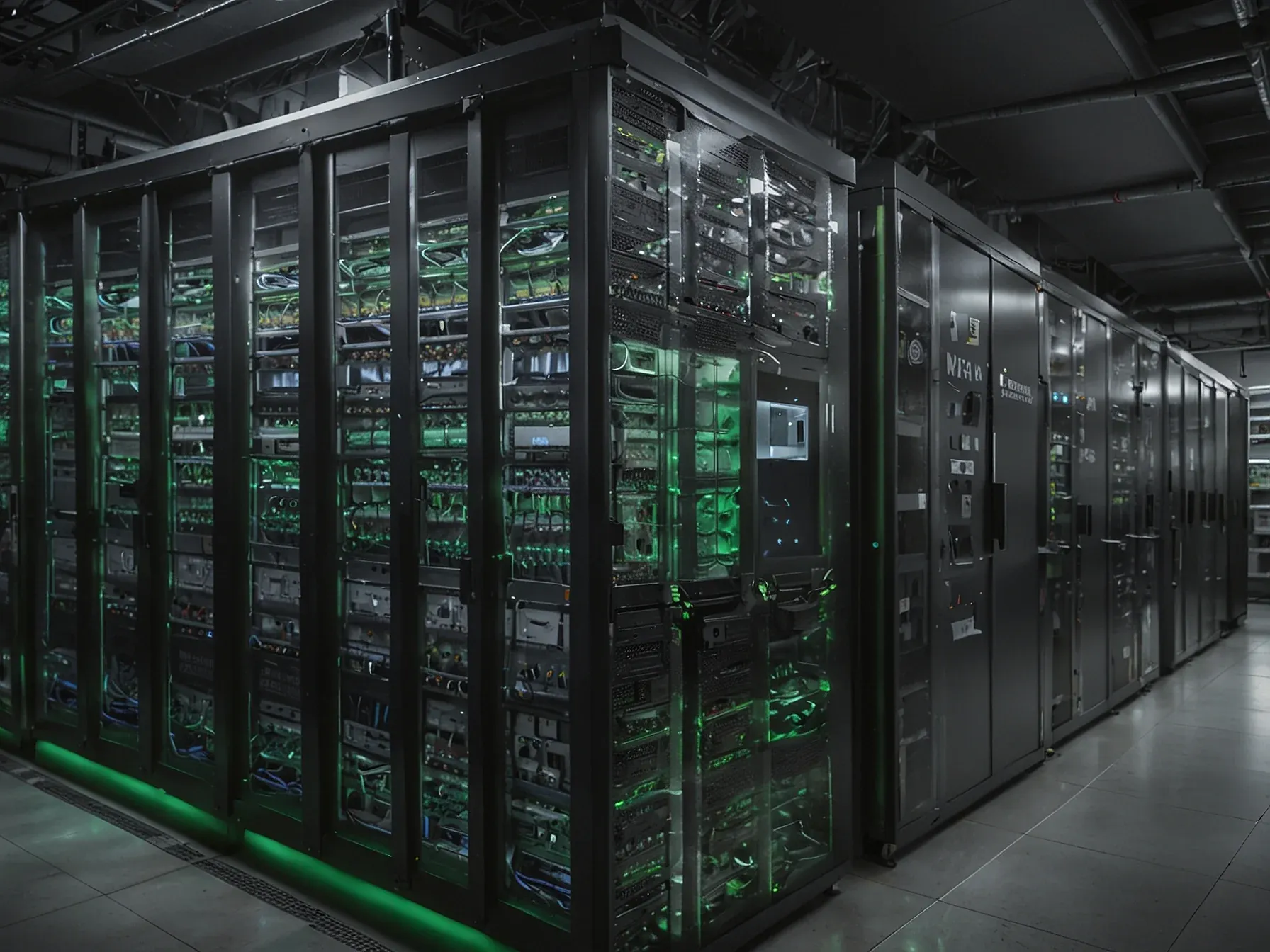
Editorial illustration for DFlash speculative decoding boosts NVIDIA Blackwell inference up to 15×
DFlash speculative decoding boosts NVIDIA Blackwell...
NVIDIA Blackwell delivers 15 petaflops of dense NVFP4 compute, a staggering amount of raw power. But raw power means nothing if the pipeline can’t feed it. That’s where DFlash comes in.
This new speculative decoding technique, developed by researchers at UC San Diego, aligns perfectly with Blackwell’s architecture. It exposes more parallel work, enabling up to 15× more concurrent users at the same interactivity rate. Across datasets, DFlash outperforms EAGLE-3.
On smaller models like Llama 3.1 8B, it nearly doubles performance. The NVIDIA ecosystem integrates DFlash without any application refactoring. Inference just got a massive upgrade.
DFlash doesn’t just optimize inference, it rewrites the arithmetic of what’s possible on Blackwell. By aligning block diffusion with the architecture’s raw 15 PFLOPS, it turns speculative decoding from a narrow trick into a broad multiplier. Fifteen times more users, same interactivity.
That’s not a marginal gain; it’s a fundamental shift in deployment economics. The speedups over EAGLE-3 hold across datasets, and even 8B models nearly double in throughput. NVIDIA has woven this into the developer stack without a single refactor.
The paper from UC San Diego is a research milestone, but the real milestone is what happens next: applications that were gated by latency become unshackled. Inference isn’t the bottleneck anymore. DFlash proves that the right algorithmic fit can unlock hardware you already own.
Related Reading
 Research & Benchmarks
 Microsoft AI Chief: "If It Isn't Safe We Shouldn't Build It
 Research & Benchmarks
 Google's FACTS benchmark shows 70% factuality ceiling across four tests
 Research & Benchmarks
 Nvidia's DLSS 4.5 beta adds 6x Multi Frame Generation for RTX 50 GPUs
 Related Topic
 NVIDIA NeMo powers telco reasoning model for autonomous network workflows
Industry Applications
 Related Topic
 China offers cheaper electricity to AI firms abandoning NVIDIA chips
Business & Startups
 From Archives
 NVIDIA BioNeMo Toolkit Enables AI Scientist to Align, Fold, and Dock Molecules
 From Archives
 Data2Story converts CSVs to articles with 7 AI; 53 readers prefer them to human
 From Archives
 NVIDIA architectures boost AI per‑watt efficiency with full‑stack optimizations
Industry Applications
 From Archives
 NVIDIA OpenShell Secures Agentic AI in Telco Autonomous Networks
AI Tools & Apps
Common Questions Answered
What is DFlash speculative decoding and how does it improve NVIDIA Blackwell inference?
DFlash is a new speculative decoding technique developed by UC San Diego researchers that aligns with NVIDIA Blackwell's architecture to expose more parallel work during inference. By optimizing how the inference pipeline utilizes Blackwell's 15 petaflops of dense NVFP4 compute, DFlash enables up to 15× more concurrent users while maintaining the same interactivity rate, fundamentally transforming deployment economics.
How does DFlash compare to EAGLE-3 in terms of performance?
DFlash outperforms EAGLE-3 across multiple datasets and model sizes, delivering superior throughput improvements. Even on smaller models like Llama 3, DFlash demonstrates significant speedups, with 8B models nearly doubling their throughput compared to the previous speculative decoding approach.
Why is aligning speculative decoding with Blackwell's architecture important?
NVIDIA Blackwell's raw 15 petaflops of compute power is only useful if the inference pipeline can efficiently feed it with work. DFlash's alignment with Blackwell's architecture exposes more parallel work opportunities, turning speculative decoding from a narrow optimization trick into a broad performance multiplier that maximizes hardware utilization.
What is the practical impact of DFlash's 15× throughput improvement on deployment?
The 15× improvement in concurrent users at the same interactivity rate represents a fundamental shift in deployment economics for large language models on Blackwell. This means organizations can serve significantly more users simultaneously without degrading response quality, making inference workloads substantially more cost-effective and scalable.
Further Reading
- Boost Inference Performance up to 15x on NVIDIA Blackwell Using DFlash Speculative Decoding — NVIDIA Developer Forums
- DFlash: Block Diffusion for Flash Speculative Decoding — arXiv
- DFlash on GPU Cloud: 6x Faster LLM Inference with Block Diffusion — Spheron Network
- DFlash: 3x faster LLM inference — Baseten
- Supercharging LLM inference on Google TPUs: Achieving 3X speedups with diffusion-style speculative decoding — Google Developers Blog
