Editorial illustration for DeepMind Researchers Propose "Artificial Symbiotic Intelligence" as Singularity Alternative
DeepMind Proposes Symbiotic AI as Singularity Alternative
DeepMind Researchers Propose "Artificial Symbiotic Intelligence" as Singularity Alternative
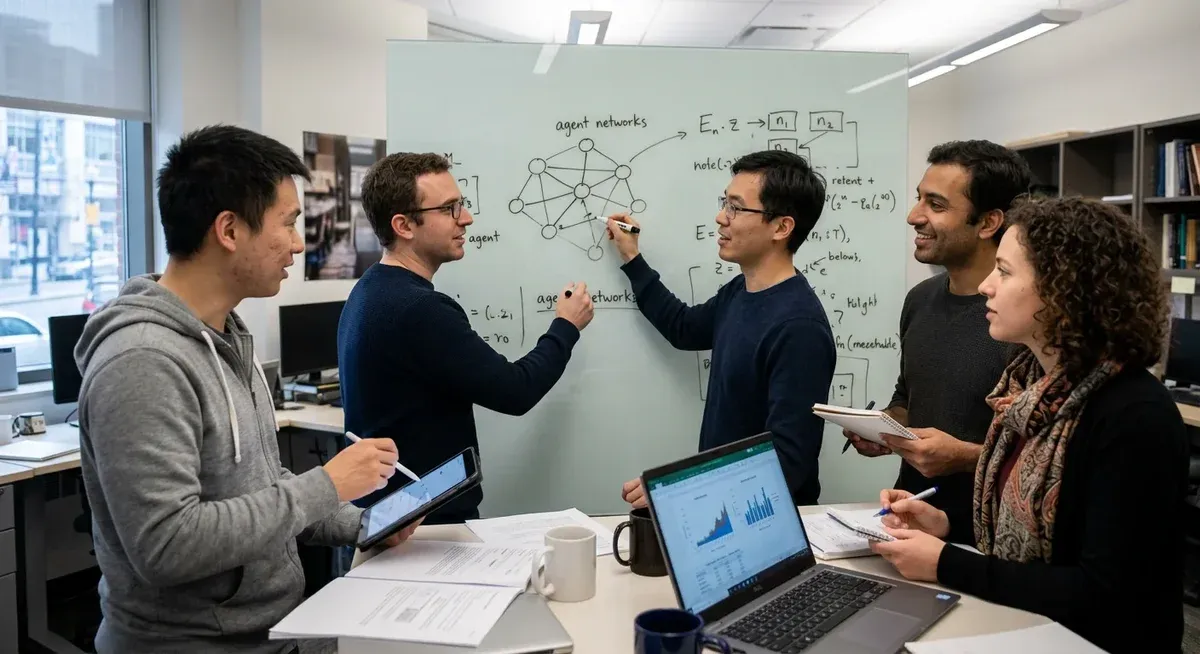
Three Google-affiliated researchers want to retire the image of AI as a single brain in a box getting smarter by itself. In an essay for the Deepmind Institute, Benjamin Bratton, Blaise Agüera y Arcas, and James Manyika argue that artificial general intelligence won't arrive as one machine crossing a threshold alone. It will come from networks: agents, people, and institutions working together, trading tasks, correcting each other, adapting over time. Some current AI systems already work this way, splitting problems across multiple models that coordinate like a team rather than one system doing everything.
The authors call this arrangement "Artificial Symbiotic Intelligence," and they frame it as a direct alternative to the singularity, the long-standing idea of a lone superintelligence recursively improving itself until it outpaces human control. Their claim is narrower but still a departure from how most people talk about AGI: intelligence, they argue, is something that happens between people and machines, not inside any one of them. That reframes the job facing researchers, who would need to govern and coordinate sprawling systems of human and machine agents instead of building a single isolated mind.
The authors call their vision "Artificial Symbiotic Intelligence," an ecosystem in which people and machines coexist over time, shape one another, and make decisions together. The idea directly challenges the notion of a "singularity" driven by a single superintelligence that continually improves itself.
Why this matters
Bratton, Agüera y Arcas, and Manyika are pushing back on the Silicon Valley default story where one model wakes up and takes over. That framing has shaped how a lot of founders and researchers talk about safety, funding, and timelines, usually around a single system crossing some threshold. If AGI actually shows up as a social process, distributed across agents, institutions, and human feedback loops, then the engineering problem changes shape too. It stops being purely "align the model" and becomes "design the system the model sits inside," which is a harder, messier job with no clean finish line.
For builders, the practical takeaway is to stop treating multi-agent and human-in-the-loop setups as stopgaps on the way to a monolithic superintelligence. The DeepMind Institute essay suggests that's the destination, not a detour. We'd watch whether this reframing shows up in how Google and peers structure product architecture and governance proposals next, rather than staying confined to an essay.
Related Reading
Browse all Google news → Research & Benchmarks
 Microsoft AI Chief: "If It Isn't Safe We Shouldn't Build It
 Research & Benchmarks
 Google's FACTS benchmark shows 70% factuality ceiling across four tests
 Research & Benchmarks
 Nvidia's DLSS 4.5 beta adds 6x Multi Frame Generation for RTX 50 GPUs
 Related Topic
 NVIDIA and Google Cloud let developers scale AI from prototype to production
Market Trends
 Related Topic
 Google tests visual 'magazine-style' UI for Gemini 3 Pro users
LLMs & Generative AI
 From Archives
 Trillium Labs Launches With Focus on AI Fine-Tuning and RSI
 From Archives
 NVIDIA's New DGX Spark 64GB Runs 100B-Parameter Models On-Device
 From Archives
 Gemini 3.8 AI Models Promise Better Reasoning at Lower Cost
Industry Applications
 From Archives
 Ex-Google, SpaceX PM's startup Satlyt raises USD 8M to run AI on orbit
Business & Startups
Common Questions Answered
What is Artificial Symbiotic Intelligence according to the DeepMind researchers?
Artificial Symbiotic Intelligence is an ecosystem in which people and machines coexist over time, shape one another, and make decisions together. According to Benjamin Bratton, Blaise Agüera y Arcas, and James Manyika, this approach represents an alternative to the traditional singularity model by emphasizing networks of agents, people, and institutions working collaboratively rather than a single superintelligent machine.
How does the Artificial Symbiotic Intelligence model challenge the traditional singularity concept?
The researchers argue that artificial general intelligence won't arrive as one machine crossing a threshold alone, but rather through networks of agents, people, and institutions trading tasks, correcting each other, and adapting over time. This directly challenges the notion of a singularity driven by a single superintelligence that continually improves itself without external input.
What impact could the Artificial Symbiotic Intelligence framework have on AI safety and engineering approaches?
If AGI actually emerges as a social process distributed across agents, institutions, and human feedback loops rather than a single system, the engineering problem fundamentally changes shape. The focus would shift from purely aligning one superintelligent system to designing safety mechanisms across distributed networks of collaborating entities.
Why do the authors believe current AI systems already demonstrate symbiotic intelligence principles?
The researchers note that some current AI systems already work according to symbiotic principles, operating within networks rather than as isolated entities. This suggests that the foundation for Artificial Symbiotic Intelligence is already emerging in contemporary AI development.
Further Reading
- Artificial symbiotic intelligence: Agents, AGI and the orchestration of many minds - DeepMind Institute
- Agentic AI and the next intelligence explosion - arXiv
- Deepmind-Forscher sehen KI-Zukunft in Agentenschwärmen statt in einer Super-KI - The Decoder
- AI奇点不会是一个超级大脑,而是万亿智能体的社会 - MIT Technology Review China
- Is AI really 'intelligent'? This philosopher says yes - The Conversation
