
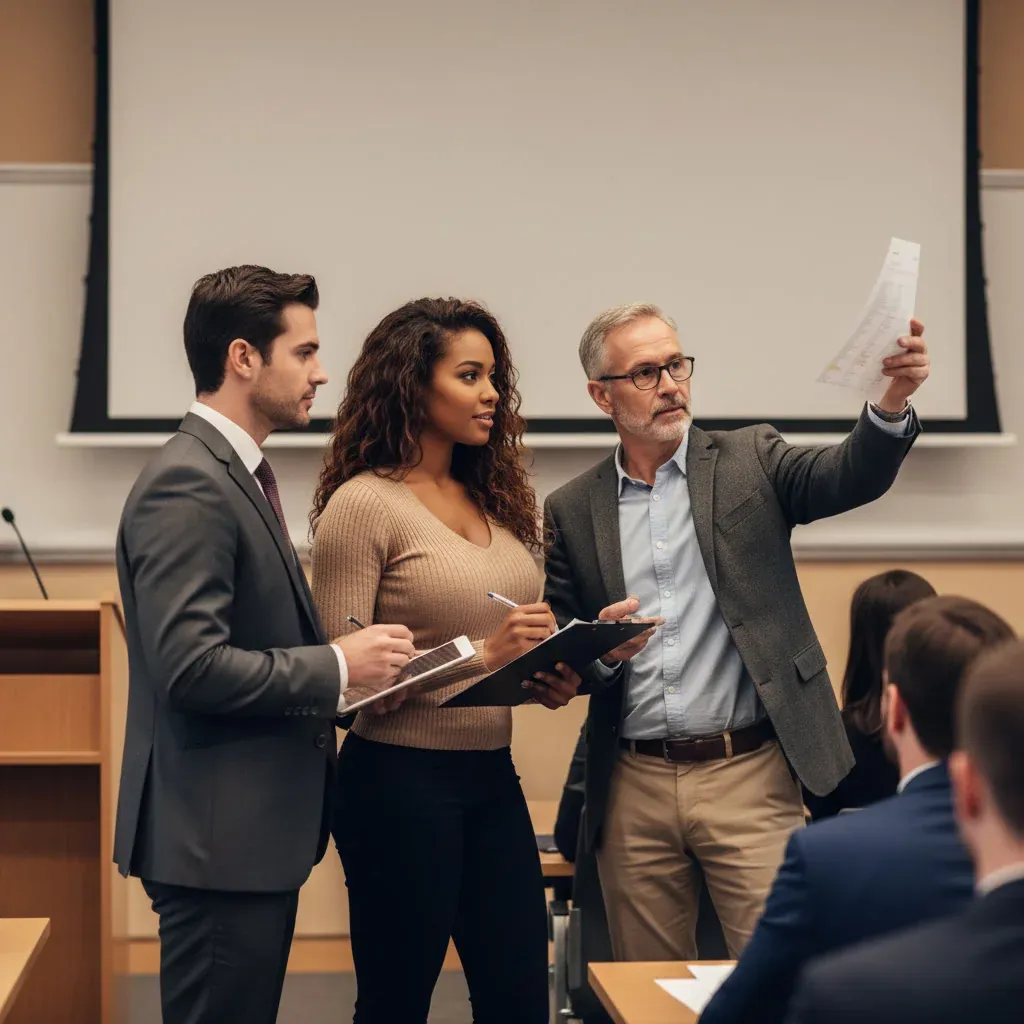
Editorial illustration for AI Writing Tools Standardize Workplace Communication, Except for Women
AI Writing Tools Bias Against Women's Communication
AI Writing Tools Standardize Workplace Communication, Except for Women
Type "maybe we should move the deadline" into an AI writing assistant and you'll get a different email back than if you'd typed "the deadline should move." That gap is the subject of a new study out of Johns Hopkins University, which tested how four large language models, Meta's Llama 3.1 3B Instruct, Mistral 7B Instruct, Gemma 2 27B, and GPT-4, handle prompts written in styles researchers associate with men versus women. Hedging words like "maybe" and "I think," along with collective pronouns like "we" and "our," pushed the models toward replies that were less sophisticated, more readable, and less formal. The pattern held across emails, job applications, and resignation letters, though it showed up most strongly in the first two.
None of this proves AI assistants are shaping who gets hired or promoted. The researchers stopped short of that claim. But as more people lean on these tools to draft everything from cover letters to performance reviews, the question of whether phrasing habits get quietly rewritten, and in whose favor, is starting to matter to the people managing workplace communication day to day.
A study by researchers at Johns Hopkins University examined how different communication styles influence AI-generated professional writing. It found that prompts containing features more commonly associated with women, including hedging phrases such as “maybe” and “I think” and collective references such as “we” and “our”, generally produced responses that were less sophisticated, more readable, and less formal.
Why this matters If an AI assistant treats a hedge like "I think" or "just checking" as a style flaw to erase, it isn't neutralizing tone. It's imposing one. The Johns Hopkins findings point to a bias problem hiding inside a tool that developers pitch as a leveler.
For builders, this is a prompt-engineering and training-data question worth answering before launch, not after a customer complaint. For founders selling these products into HR or communications teams, the liability is real: a tool that rewrites women's drafts more aggressively than men's is a tool that can get a company sued or embarrassed. For researchers, the open question in the article, whether this pattern holds across tools and industries, deserves more than one study.
We'd push back on any vendor claiming their assistant is "objective" about tone. Objective according to whom, trained on whose writing? Workplace AI tools are shaping how millions of people sound at work right now.
Worth asking who that voice was modeled on before it becomes the default.
Related Reading
 Research & Benchmarks
Microsoft AI Chief: "If It Isn't Safe We Shouldn't Build It
 Research & Benchmarks
Google's FACTS benchmark shows 70% factuality ceiling across four tests
 Research & Benchmarks
Nvidia's DLSS 4.5 beta adds 6x Multi Frame Generation for RTX 50 GPUs
 From Archives
NVIDIA HPC SDK Playbook Brings GPU-Accelerated Compilers to DGX Spark
 From Archives
Moonshot AI Pivots Kimi to Science as DP Technology Analyzes Gene Data
Common Questions Answered
What did the Johns Hopkins University study find about how AI writing assistants handle gendered communication styles?
The study tested four large language models including GPT-4, Llama 3.1, Mistral, and Gemma and discovered that prompts containing features associated with women's communication styles—such as hedging phrases like "maybe" and "I think" and collective pronouns like "we" and "our"—produced responses that were less sophisticated, more readable, and less formal. This indicates that AI writing assistants may be systematically altering communication patterns based on gendered linguistic features rather than remaining neutral.
How do hedging words and collective pronouns affect AI-generated professional emails according to the research?
When prompts include hedging language like "maybe we should move the deadline" versus direct statements like "the deadline should move," AI writing assistants generate notably different outputs. The study found that these gendered communication patterns influence the sophistication level and formality of the AI-generated responses, suggesting the tools are not truly neutral in how they process different writing styles.
What are the potential liability concerns for companies selling AI writing tools to HR and communications teams?
If AI writing assistants systematically remove or alter communication features associated with women's writing styles, they may be imposing a particular communication standard rather than neutralizing tone. This creates real liability risks for organizations using these tools, as they could inadvertently disadvantage employees whose natural communication patterns are being altered by the AI system before professional use.
Why is this AI bias problem considered a prompt-engineering and training-data issue according to the article?
The Johns Hopkins findings suggest that the bias toward certain communication styles is embedded in how these AI models are trained and how they process prompts. Rather than addressing complaints after customers discover the bias, developers should examine their training data and prompt-engineering practices before launching AI writing assistants to ensure they don't systematically disadvantage users based on gendered communication patterns.
Further Reading
- AI might be making women sound bad at work - Johns Hopkins University Department of Computer Science
- AI tools may make women sound less sophisticated at work - HC Magazine
- AI may be making women's emails and job applications sound less professional - Business Insider
- When 'I think' costs you: AI's subtle communication gap - Canadian HR Reporter
- Writing with AI Can Reduce Gender Bias in Hiring Evaluations - ACM
