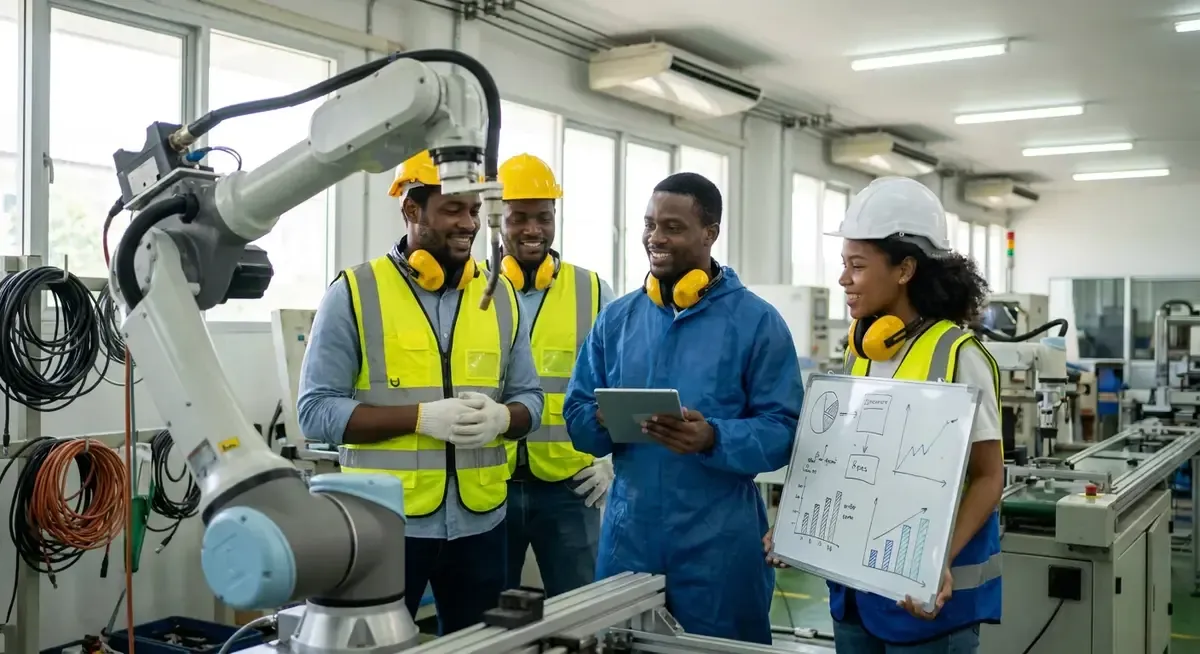
Editorial illustration for Daniela Rus Wins Bavarian High-Tech Prize for Autonomous Robot Systems
Daniela Rus Wins Bavarian Prize for Robot AI
Daniela Rus picked up Germany's richest technology prize on July 23, accepting the 2026 High-Tech Prize of the Bavarian Minister-President at the Herkulessaal in the Munich Residence. The award, given jointly by the Bavarian State Government and the Bavarian Academy of Sciences and Humanities, recognizes her work at MIT's Computer Science and Artificial Intelligence Laboratory, where she serves as director and holds the title of Panasonic Professor of Computer Science.
The selection committee pointed to four areas of her research: self-organizing robot collectives, soft robotics, autonomous mobility, and brain-inspired artificial intelligence. Those four threads trace back roughly 30 years, all aimed at the same problem: getting machines to function reliably outside a lab, in situations nobody programmed for in advance.
The timing matters. Physical AI, robots that operate in unscripted physical environments rather than purely digital ones, has become a central concern for both companies and governments. Most public conversation about human-robot collaboration stays narrow, fixated on warehouse floors or household chores. Rus has pushed her work into far more varied terrain, spanning transportation, agriculture, medicine, and environmental monitoring, with soft robotics as one of her signature contributions to the field.
The selection committee cited four strands of her work: self-organizing robot collectives, soft robotics, autonomous mobility, and brain-inspired artificial intelligence. Together they describe a 30-year effort to build machines that hold up outside the lab, in conditions no one scripted in advance.
Why this matters
Rus's win is a reminder that the most durable AI work right now isn't chatbots, it's physical systems that have to survive contact with the real world. Soft robotics and multi-domain autonomy (transportation, agriculture, medicine, home use, environmental monitoring) demand a different kind of rigor than language models: you can't patch a bug in a robot arm with a prompt tweak. For researchers and founders building in robotics, the Bavarian prize, backed by a state government and its academy of sciences rather than a tech conference, signals that European institutions are willing to put serious money behind hardware-adjacent AI, not just software.
That matters for anyone weighing where to seek funding or partnerships outside the usual Silicon Valley channels. It's also a useful check on the industry's current obsession with scale and generality. Rus's career argues that narrower, embodied problems, a safer gripper, a more adaptive drone, a better crop sensor, can be just as consequential as another large model.
Worth watching whether this prize nudges more capital toward that kind of unglamorous, physical-world engineering.
Related Reading
 Industry Applications
 Westinghouse teams with Google Cloud to build AI platform for nuclear power
 Industry Applications
 NVIDIA NeMo powers telco reasoning model for autonomous network workflows
 Industry Applications
 Month-1 Agent Adds Holistic Observability with Trace IDs and Token Tracking
 From Archives
 AMD Releases Hyperloom v1.0.0a1 for GPU Inference Optimization
 From Archives
 NVIDIA's Sixth-Gen NVLink Powers Millions of AI Chips
Common Questions Answered
What are the four main research areas that Daniela Rus was recognized for in winning the Bavarian High-Tech Prize?
The selection committee cited four strands of her work: self-organizing robot collectives, soft robotics, autonomous mobility, and brain-inspired artificial intelligence. Together, these research areas represent a 30-year effort to build machines that can operate effectively outside laboratory conditions in unpredictable real-world environments.
What is Daniela Rus's current position at MIT?
Daniela Rus serves as the director of MIT's Computer Science and Artificial Intelligence Laboratory (CSAIL) and holds the title of Panasonic Professor of Computer Science. She was awarded the 2026 High-Tech Prize of the Bavarian Minister-President on July 23 at the Herkulessaal in the Munich Residence.
Why does the article argue that physical robotics systems require different rigor than language models?
Unlike chatbots and language models where bugs can be fixed with software updates or prompt adjustments, physical systems like robot arms operating in the real world cannot be patched with simple tweaks. Soft robotics and multi-domain autonomy applications in transportation, agriculture, medicine, and environmental monitoring demand a fundamentally different engineering approach to ensure reliability and safety in unpredictable conditions.
Who jointly awards the Bavarian High-Tech Prize that Daniela Rus received?
The award is given jointly by the Bavarian State Government and the Bavarian Academy of Sciences and Humanities. It is one of Germany's richest technology prizes and recognizes exceptional contributions to technological advancement.
Further Reading
- Daniela Rus receives Bavarian Minister-President’s High-Tech Prize - MIT EECS
- Verleihung der Hightech-Preise Bayern: „ein Hauch von ...“ - Bayerisches Staatsministerium für Wissenschaft und Kunst
- Hightech-Preis Bayern 2026: Robotik-Pionierin Daniela Rus geehrt - BR
- Bayerischer Hightech-Preis geht an Roboter-Forscherin - n-tv
- High-Tech-Award-2026-Daniela-Rus-Rationale - Bavarian High-Tech Prize
