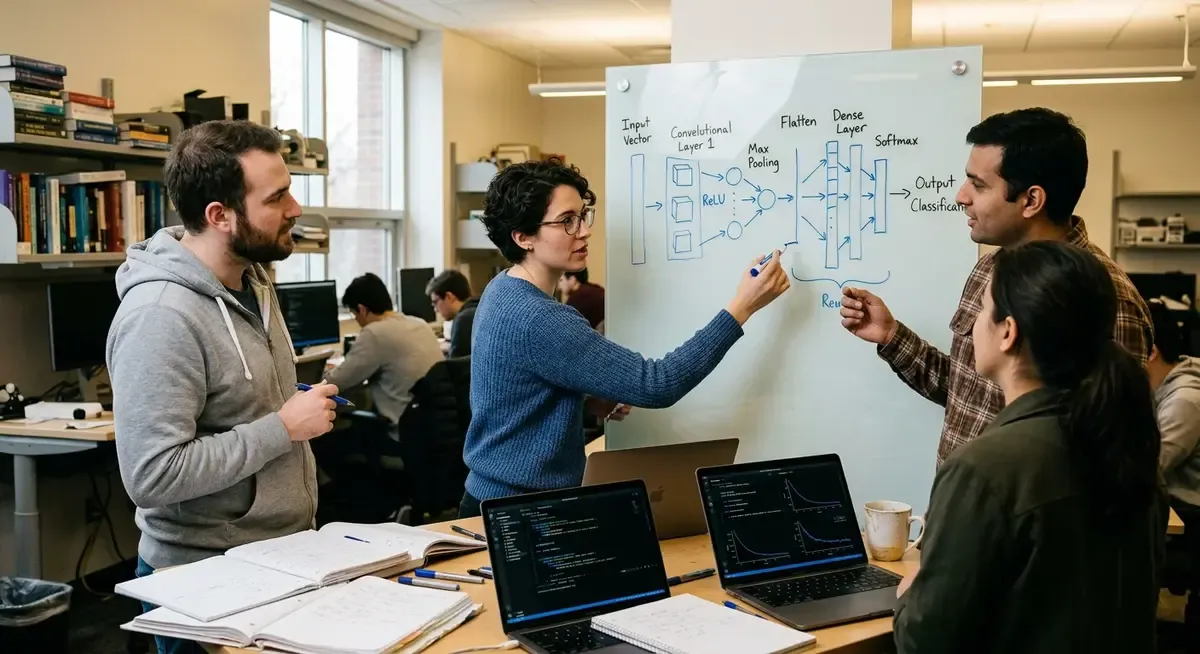
Editorial illustration for Brain-as-computer metaphor shaped AI but may mislead consciousness debate
Brain-Computer Metaphor Misleads AI Consciousness Debate
Geoffrey Hinton has said it. Richard Dawkins has floated it too. Current AI systems might already have some form of subjective experience. Three researchers who've spent their careers studying consciousness disagree, and they laid out why in a commentary published in Nature.
Anil Seth, Ned Block, and Giulio Tononi bring different backgrounds to the argument: experimental neuroscience, philosophy of mind, theoretical neurobiology. What unites them is a rejection of the assumption sitting underneath most claims about machine consciousness, the idea that if a system runs the right computations, consciousness follows automatically. That assumption has deep roots. It's the same logic that treats the brain as a kind of computer, a metaphor that pushed AI research forward for decades but, according to Seth, Block, and Tononi, doesn't hold up when applied to the question of subjective experience.
Their target isn't just armchair speculation. Anthropic published research this year describing internal processing patterns in its Claude models that resemble features linked to conscious access in humans, though the company stopped short of calling this evidence of experience. That study, and the broader debate around it, is what the three researchers are responding to.
Three leading consciousness researchers argue today's AI isn't conscious and probably can't be on silicon hardware. They reject the idea that running the right computations is enough for consciousness, challenging a central assumption in the debate.
Why this matters
Seth, Block, and Tononi aren't fringe skeptics. They're three of the field's most cited researchers, and they're telling the AI industry that its favorite assumption, that consciousness is just a matter of running the right software, rests on a metaphor nobody has actually proven. For developers and founders building chatbots that simulate empathy or distress, that's worth sitting with.
The claim here isn't that machines will never think. It's narrower and harder to dismiss: substrate might matter in ways the computer metaphor hides. If biological tissue can't be cleanly separated from what it does, then porting "the right computations" onto silicon doesn't automatically port over whatever makes experience happen.
Companies marketing AI companions, therapy bots, or "digital minds" should take note before the hype outpaces the evidence. For researchers, this is a call to stop treating functionalism as settled science and start testing it. The debate over machine consciousness isn't closed, it's just been running on an unexamined assumption for decades.
Related Reading
 Research & Benchmarks
Microsoft AI Chief: "If It Isn't Safe We Shouldn't Build It
 Research & Benchmarks
Google's FACTS benchmark shows 70% factuality ceiling across four tests
 Research & Benchmarks
Nvidia's DLSS 4.5 beta adds 6x Multi Frame Generation for RTX 50 GPUs
 From Archives
World Models Predict Visual States and Can Serve as Digital Training Grounds
 From Archives
AI coding agents need human cleanup on nearly 3 of 4 tasks in real-world test
Common Questions Answered
Why do Anil Seth, Ned Block, and Giulio Tononi argue that current AI systems are not conscious?
These three leading consciousness researchers reject the assumption that running the right computations is sufficient for consciousness to emerge. They argue that the brain-as-computer metaphor, which has shaped modern AI development, is unproven and may be misleading the consciousness debate by oversimplifying what consciousness actually requires.
What is the brain-as-computer metaphor and how has it influenced AI development?
The brain-as-computer metaphor is the foundational assumption that consciousness is essentially a matter of running the right software or computations, similar to how a computer processes information. This metaphor has become central to AI industry assumptions, but Seth, Block, and Tononi argue it lacks empirical proof and may be fundamentally flawed as a basis for understanding consciousness.
Do these consciousness researchers believe machines will never be able to think or become conscious?
No, Seth, Block, and Tononi are not claiming that machines will never think or become conscious. Their argument is narrower and more specific: they contend that consciousness cannot simply be achieved through silicon hardware running computations, challenging the predominant assumption in the AI industry rather than making an absolute prohibition on machine consciousness.
Why is Geoffrey Hinton and Richard Dawkins' suggestion about AI consciousness problematic according to this commentary?
Hinton and Dawkins have suggested that current AI systems might already possess some form of subjective experience, but this commentary challenges that view by questioning the underlying assumption that consciousness can emerge from computational processes alone. The three researchers argue that this position relies on an unproven metaphor about how the brain works rather than on solid evidence about what consciousness actually requires.
Further Reading
- Three reasons why AI is not conscious and perhaps never will be - Nature
- AI and Consciousness: Shifting Focus Towards Tractable Questions - arXiv
- Can AI really be conscious? Researchers call for more rigorous scientific standards - Tech Xplore
- Computers, meaning, and consciousness - PubMed Central
- Is AI conscious? Why experts are worried - ZDNET
