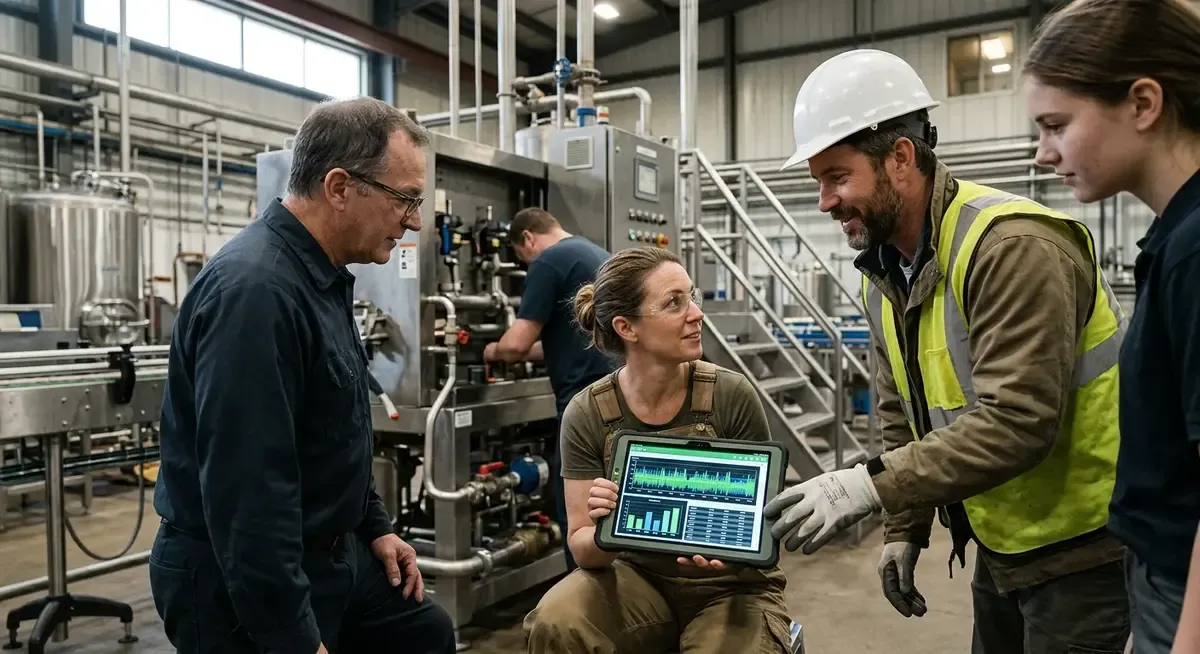
Editorial illustration for Bayesian Flow Matching State Estimation Avoids Power Flow Approximation
Bayesian Flow Matching Improves Grid State Estimation
Bayesian Flow Matching State Estimation Avoids Power Flow Approximation
Grid operators monitoring medium-voltage feeders face a basic problem: they can't see most of what's happening on the line. Real-time measurements are sparse, so distribution system state estimation has long leaned on pseudo-measurements, educated guesses about what secondary substations are drawing, to fill the gap. Weighted least squares handles the physics of power flow precisely but flattens those guesses into a mean and a variance, throwing away the shape of the uncertainty.
Supervised deep learning models try to do better by learning the power flow directly from data, but that ties them to whatever measurement configuration they were trained on. Change the sensors, change the topology, and the model needs retraining.
A team proposes PoSE, short for posterior sampling for state estimation, as a way around this trade-off. The method keeps the exact physics of the Bayesian approach but replaces the crude Gaussian prior with something learned: a neural network trained with flow matching on historical substation injection data. Tested on a 240-bus unbalanced three-phase model of an Iowa feeder, the approach claims the lowest errors across injection, voltage, and branch-current estimates among the methods compared.
On the IEEE 33-bus feeder, PoSE lowers the probabilistic injection error (CRPS) by 6.7-7.5% against a full-covariance Gaussian prior in all 12 tested settings. It provides reliable uncertainty: the 90% intervals contain the true injection almost exactly as often as exact posterior samples would, whereas those of supervised estimators contain it in only 37-78% of cases.
Why this matters
PoSE splits the job in a way that should appeal to anyone tired of retraining models every time grid conditions shift. The neural network only learns the prior, the distribution of plausible loads at secondary substations, and leaves power flow and topology to do their work at sampling time through a Kalman-type correction. That separation matters because it means one trained prior can serve different measurement configurations without the usual retraining cycle supervised estimators demand.
For researchers building state estimation tools, this is a concrete argument for decoupling what you learn from what you compute exactly. It also raises a fair question worth watching: how well does a prior trained on one feeder's load patterns generalize to a feeder with different substation counts or topology quirks? The paper's claim rests on physical consistency at sampling, not on the network mimicking power flow, which is a cleaner division of labor than most DSSE approaches offer.
Whether utilities adopt this over weighted least squares will depend on how it handles sparse, noisy measurements in practice, not just in benchmark conditions.
Related Reading
 Industry Applications
Westinghouse teams with Google Cloud to build AI platform for nuclear power
 Industry Applications
NVIDIA NeMo powers telco reasoning model for autonomous network workflows
 Industry Applications
Month-1 Agent Adds Holistic Observability with Trace IDs and Token Tracking
 From Archives
Accenture employee gave personal AI agent access to secure Pentagon system
 From Archives
Coforge Launches Autonomous Software Factory for AI Agents
Common Questions Answered
What is the main limitation of pseudo-measurements in traditional distribution system state estimation?
Pseudo-measurements are educated guesses used to fill gaps where real-time measurements are sparse on medium-voltage feeders. While weighted least squares can handle power flow physics precisely, it flattens these guesses into just a mean and variance, discarding important information about the actual shape of uncertainty in the data.
How does PoSE (Probabilistic State Estimation) improve upon supervised deep learning estimators for grid monitoring?
PoSE achieves 6.7-7.5% lower probabilistic injection error compared to full-covariance Gaussian priors on the IEEE 33-bus feeder. More importantly, its 90% confidence intervals contain true injection values almost exactly as often as exact posterior samples would, whereas supervised estimators only achieve this accuracy 37-78% of the time.
Why does separating the neural network prior from power flow physics reduce retraining requirements in PoSE?
PoSE's architecture splits the estimation task so the neural network only learns the prior distribution of plausible loads at secondary substations, while power flow equations and grid topology apply corrections at sampling time through a Kalman-type mechanism. This separation means a single trained prior can serve different measurement configurations without requiring the continuous retraining cycle that supervised estimators demand.
What does Bayesian Flow Matching enable that traditional state estimation methods cannot achieve?
Bayesian Flow Matching allows PoSE to preserve the full shape of uncertainty distributions rather than collapsing them to simple mean and variance parameters. This capability enables more reliable uncertainty quantification for grid operators, providing confidence intervals that accurately reflect the true probability of injection values across different measurement scenarios.
Further Reading
- Bayesian Distribution System State Estimation with Flow Matching - arXiv
- Flow Matching-Based Generative Modeling for Efficient and Scalable Data Assimilation - arXiv
- ACCELERATED SEQUENTIAL FLOW MATCHING: A BAYESIAN APPROACH TO STREAMING PREDICTION - OpenReview
- Error propagation in the state estimation and prediction of distribution grids with a limited database - CIGRE
- An ML-Ready Synthetic Medium-Voltage Grid Dataset - IEEE DataPort
