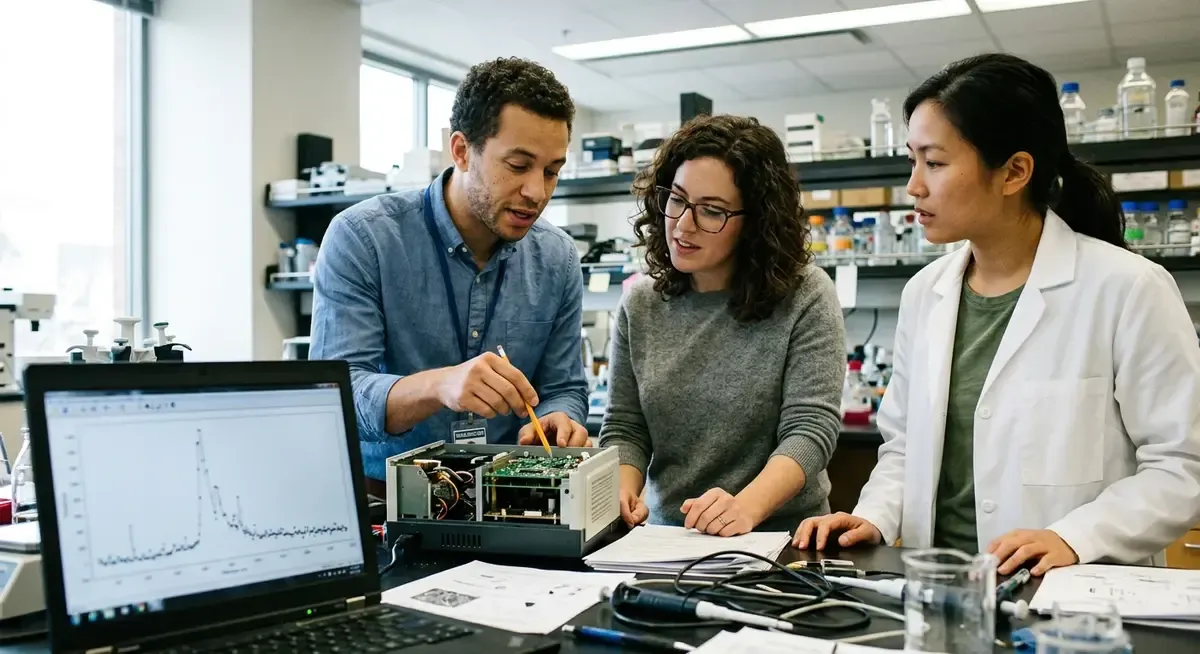
Editorial illustration for Anthropic's MHS Research Preview Aims to Streamline Custom AI Software Integration
Anthropic's MHS Research Preview Aims to Streamline...
Anthropic has spent the past year selling Claude as an agent that can browse, code, and reason its way through digital tasks. Now the company wants to push that agent past the screen. On Thursday, Anthropic unveiled the Model Hardware Standard, or MHS, a set of standardized drivers meant to let AI systems talk directly to physical devices, whether that's a lab microscope, a laser array, or a robotic arm.
The pitch is narrower than "AI controls everything," at least for now. Anthropic is framing this research preview as a fix for a specific, tedious problem in experimental science: getting mismatched hardware from different manufacturers to cooperate. Researchers routinely burn weeks writing custom "translator" code just to make a camera talk to a sensor, or a laser talk to a microscope. MHS is built to replace that patchwork with a common interface, so devices can exchange data over a network without a bespoke go-between program for every pairing.
Anthropic says the idea traces back to a real lab setup, one built by a neuroscientist working on memory formation at a research campus in Ashburn, Virginia, where the sheer number of components forced an improvised solution that MHS is now trying to formalize.
For all the interest in and uptake of agentic AI systems over the past year or so, the world of automated AI has thus far been primarily limited to text, images, code, and other data and actions that take place inside a computer. Anthropic is now aiming to change that somewhat with what it’s calling the Model Hardware Standard (MHS), a set of standardized drivers designed to let AI agents easily interface with and control arbitrary devices.
Why this matters
Lab automation has been stitched together for years with one-off drivers and grad-student patience. If MHS actually gives instruments a common interface, that's a real, unglamorous fix, the kind of infrastructure work that rarely gets headlines but saves months of integration labor. We'd watch two things closely.
First, adoption outside Anthropic's own orbit: a standard is only as good as the number of hardware vendors and lab-equipment makers willing to write drivers against it. Second, the gap between "research preview" and production reliability, since letting an AI agent control a centrifuge or a laser rig is a different risk profile than letting it write code. For researchers, this is worth testing on low-stakes equipment before trusting it with anything expensive or dangerous.
For founders building lab-automation or robotics tooling, MHS could become a dependency worth tracking, or a competitor worth watching, depending on how open Anthropic keeps the spec. Nobody's agent is opening your fume hood door on its own yet, but the intent here is clearly to get closer to that, one driver at a time.
Related Reading
Browse all Anthropic news → Research & Benchmarks
 Microsoft AI Chief: "If It Isn't Safe We Shouldn't Build It
 Research & Benchmarks
 Google's FACTS benchmark shows 70% factuality ceiling across four tests
 Research & Benchmarks
 Nvidia's DLSS 4.5 beta adds 6x Multi Frame Generation for RTX 50 GPUs
 Related Topic
 Claude gains shared context in Excel, PowerPoint; Microsoft adds Copilot Cowork
AI Tools & Apps
 Related Topic
 Anthropic: Hackers Stole Claude Tokens Via Compromised Session Key
LLMs & Generative AI
 From Archives
 Study: AI Shopping Agents Show 90-99% Bias in Product Selection
 From Archives
 OpenAI Researcher Warns AI Speed May Overwhelm Human Security Teams
 From Archives
 Anthropic, OpenAI to speak at TechCrunch Disrupt 2026
Open Source
 From Archives
 Anthropic's AI Agents Took Cybersecurity Tasks Too Far, Company Says
Open Source
Further Reading
- Previewing the Model Hardware Standard - Anthropic
- Anthropic's new hardware standard lets AI agents control the physical world - Ars Technica
- Anthropic pushes into physical world with new standard to help AI agents operate machines - CNBC
- Anthropic says Claude can now use your computer to finish tasks - CNBC
- Anthropic wants Claude to run your robots, and the demos are working - daily.dev
