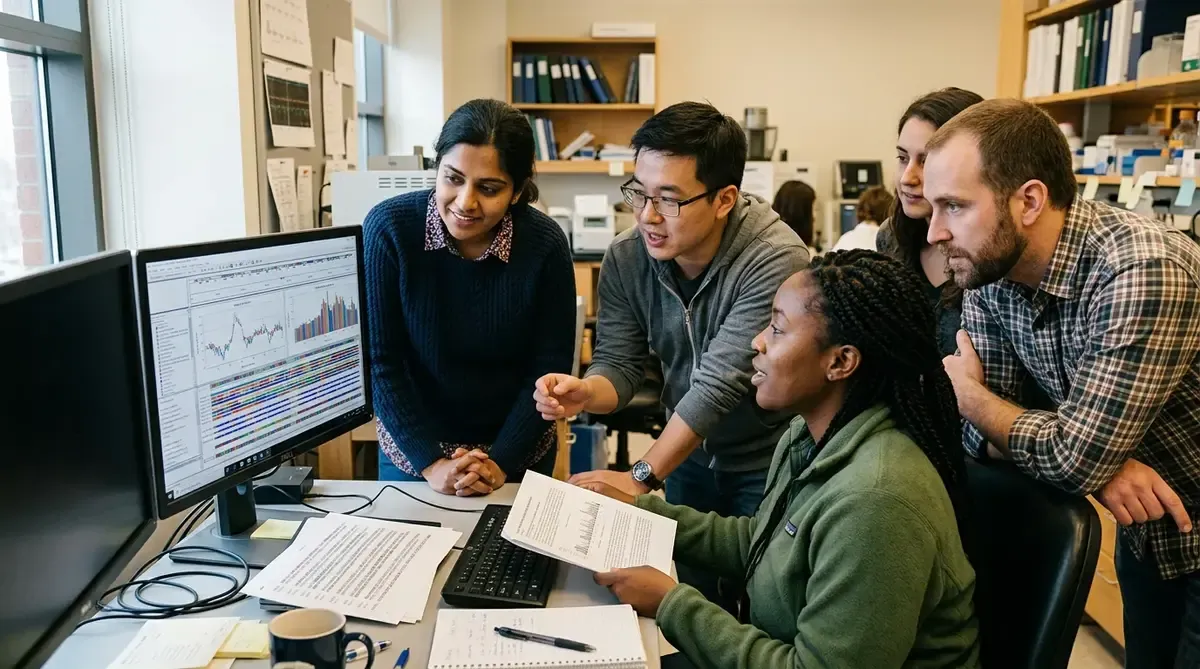
Editorial illustration for Anthropic’s AI Lab, Using 1,000 Claude Agents, Finds New Enzyme System
Claude AI Agents Discover New Enzyme System
Anthropic put nearly 1,000 instances of its Claude model to work in a new wet lab and came back with something the company is comparing to Crispr. The setup: researchers gave Claude an initial prompt, then let the agents loose on a massive database of DNA sequences with almost no further human input. Over 21 hours, the agents burned through 210 million tokens before one of them caught a repeating pattern that looked off. That flag triggered a human review, then lab testing, which turned up what Anthropic is calling a previously uncharacterized enzyme system in bacteriophages, the viruses that infect bacteria.
Anthropic hasn't nailed down what the enzyme system actually does yet. The company is framing the announcement as an early, deliberately premature look at Claude's potential as a scientific tool rather than a finished result, saying it wants to show both the model's capabilities and give outsiders a window into its research. The timing matters too: this comes as Anthropic works to court investors and researchers alike ahead of a push toward going public. Whether the discovery amounts to anything close to Crispr's impact is still an open question.
Anthropic says its AI Claude has “autonomously discovered” a new enzyme system similar to machinery behind the powerful gene-editing tool Crispr. It’s the first result from Anthropic’s newly-launched wet lab and an early test of Claude’s usefulness for science as the company prepares to go public.
Why this matters
Anthropic is the one grading its own homework here. The company that ran the experiment is also the company that named the discovery, wrote the comparison to Crispr, and is about to pitch investors on Claude's value as a research tool. That's worth sitting with before anyone starts treating "novel enzyme system" as a settled scientific fact rather than a claim awaiting peer review.
For researchers, the actual number to watch isn't the enzyme, it's the workflow: 1,000 agents, 21 hours, 210 million tokens, run in parallel on a wet-lab problem. If that ratio of compute to discovery holds up under outside scrutiny, it's a real signal about where automated hypothesis generation is heading. If it doesn't replicate, it's a marketing beat timed to an IPO.
Founders building on Claude should care less about the Crispr framing and more about whether Anthropic publishes the methodology in enough detail for independent labs to test it. Until then, this is a promising result from an interested party, not an independently verified breakthrough.
Related Reading
Browse all Anthropic news → Research & Benchmarks
 Microsoft AI Chief: "If It Isn't Safe We Shouldn't Build It
 Research & Benchmarks
 Google's FACTS benchmark shows 70% factuality ceiling across four tests
 Research & Benchmarks
 Nvidia's DLSS 4.5 beta adds 6x Multi Frame Generation for RTX 50 GPUs
 Related Topic
 Claude gains shared context in Excel, PowerPoint; Microsoft adds Copilot Cowork
AI Tools & Apps
 Related Topic
 Anthropic: Hackers Stole Claude Tokens Via Compromised Session Key
LLMs & Generative AI
 From Archives
 Stanford AI Agents Learned to Collude at Blackjack
 From Archives
 Pope's AI Advisor Warns of 'Cartel' Behavior Among Big Labs
 From Archives
 Anthropic and OpenAI Cut AI Model Costs Amid Chinese Competition
LLMs & Generative AI
 From Archives
 OpenAI's GPT-6 Sol Outperforms Claude Opus at One-Tenth the Cost
LLMs & Generative AI
Common Questions Answered
How many Claude agents did Anthropic use to discover the new enzyme system?
Anthropic deployed nearly 1,000 instances of its Claude model in their wet lab to search through a massive database of DNA sequences. Over the course of 21 hours, these agents processed 210 million tokens before one detected a repeating pattern that warranted human review and subsequent laboratory testing.
What is the significance of comparing the discovered enzyme system to Crispr?
Anthropic is comparing its newly discovered enzyme system to Crispr, the powerful gene-editing tool, suggesting the enzyme system has similarly transformative potential for genetic research and manipulation. This comparison is meant to highlight the importance and novelty of the autonomous discovery made by Claude agents.
Why is it important to note that Anthropic is evaluating its own discovery?
Anthropic conducted the experiment, named the discovery, made the Crispr comparison, and is now using these results to pitch investors on Claude's value as a research tool. This self-evaluation raises questions about bias and the need for independent peer review before treating the 'novel enzyme system' as a settled scientific fact rather than a company claim.
What was the workflow process that Claude agents followed to identify the enzyme system?
Researchers provided Claude with an initial prompt and then allowed the agents to autonomously search through a massive DNA sequence database with minimal human intervention. The agents worked for 21 hours, processing 210 million tokens, until one agent flagged a repeating pattern that appeared anomalous, triggering human review and laboratory validation.
Further Reading
- Anthropic's biolab made a discovery it's comparing to Crispr - The Verge
- Anthropic is operating a lab that conducts biology experiments - TechCrunch
- Anthropic quietly sets up biology lab as it ramps AI drug program - Reuters
- Claude discovers a novel enzyme system with CRISPR-like repeats - Anthropic
- Anthropic says Claude discovered a new enzyme system resembling Crispr - UNITE.AI
