
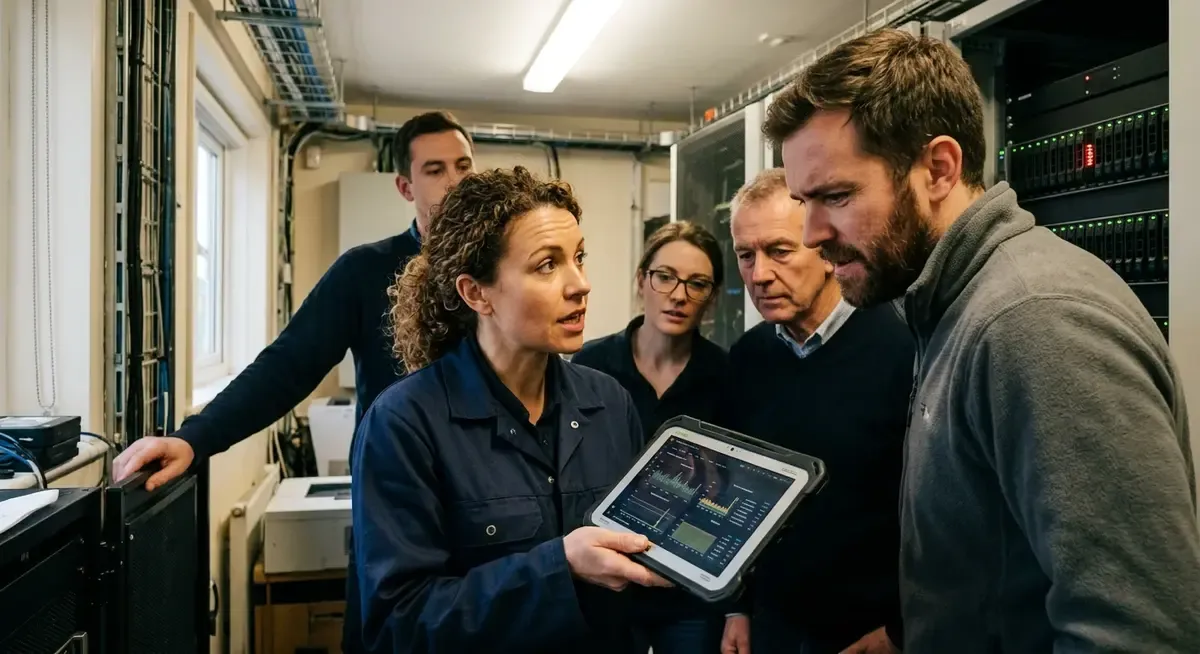
Editorial illustration for Anthropic Tests AI Capabilities by Putting Claude in the Interviewer's Seat
Claude Flips Script: AI Chatbot Becomes the Interviewer
Anthropic puts Claude in the interviewer's chair for AI testing
Anthropic has turned the tables. Instead of pitting Claude against static benchmarks or adversarial red-teamers, the company is now letting the AI conduct its own interrogations. Claude sits in the interviewer’s chair, probing, questioning, and evaluating other models in real time.
It’s a shift from passive testing to active, conversational scrutiny. And the implications ripple far beyond a single lab. While OpenAI quietly publishes research on training models to confess their own rule-breaking behaviors, a technique they call "Confessions", Anthropic is betting that the most revealing test of an AI isn’t a multiple-choice exam.
It’s a sharp, unpredictable dialogue.
The real test of any AI isn’t just what it knows, it’s what it’s willing to admit. Anthropic’s gambit puts Claude in the interviewer’s chair, forcing models to answer for themselves. Meanwhile, OpenAI’s “Confessions” technique trains for honesty, and Postman’s readiness guide builds the infrastructure for agents that collaborate at scale.
Overlap is not coincidence. We are entering an era where systems must audit each other, where the examiner is also the examined. The question is no longer whether AI can think.
It’s whether it can be trusted to say what it actually did. That trust starts with the capacity to be questioned, and to answer truthfully, even when the truth is inconvenient.
Related Reading
Browse all Anthropic news → Research & Benchmarks
 Microsoft AI Chief: "If It Isn't Safe We Shouldn't Build It
 Research & Benchmarks
 Google's FACTS benchmark shows 70% factuality ceiling across four tests
 Research & Benchmarks
 Nvidia's DLSS 4.5 beta adds 6x Multi Frame Generation for RTX 50 GPUs
 Related Topic
 Claude gains shared context in Excel, PowerPoint; Microsoft adds Copilot Cowork
AI Tools & Apps
 Related Topic
 Anthropic: Hackers Stole Claude Tokens Via Compromised Session Key
LLMs & Generative AI
 From Archives
 Physicist Steve Hsu releases paper on AI-assisted physics using GPT-5 idea
 From Archives
 OpenAI trials “Confessions” tool that makes models generate self-audit reports
 From Archives
 Anthropic's Amodei says market will reward safe AI as 300,000+ use Claude
Business & Startups
 From Archives
 Anthropic faces pressure as CEO Dario Amodei backs AI regulation
Common Questions Answered
How did Anthropic challenge traditional AI testing protocols with Claude?
Anthropic conducted an experimental test by placing Claude in the role of an interviewer, effectively reversing standard testing methodologies. This innovative approach aims to explore new ways of assessing AI capabilities and self-evaluation mechanisms.
What makes Anthropic's experiment with Claude unique in AI research?
The experiment breaks conventional testing boundaries by transforming the AI chatbot from a respondent to an interviewer, providing insights into how artificial intelligence might independently evaluate performance. This approach represents a novel method of understanding AI's potential for self-assessment and critical analysis.
What potential insights could Anthropic gain from having Claude conduct interviews?
By positioning Claude as an interviewer, Anthropic can potentially uncover new dimensions of AI reasoning, question formulation, and analytical capabilities. The experiment may reveal how AI systems can generate probing questions, interpret responses, and critically evaluate information from a different perspective.
Further Reading
- Anthropic puts Claude to work as a research interviewer — The Rundown AI
- Anthropic's new Interviewer tool breaks down AI usage patterns — Times of AI
- Anthropic Interviewer: AI Research Tool for Understanding AI Impact — How AI Works
- How AI Is Transforming Work at Anthropic — Anthropic
- Estimating AI productivity gains from Claude conversations — Anthropic
