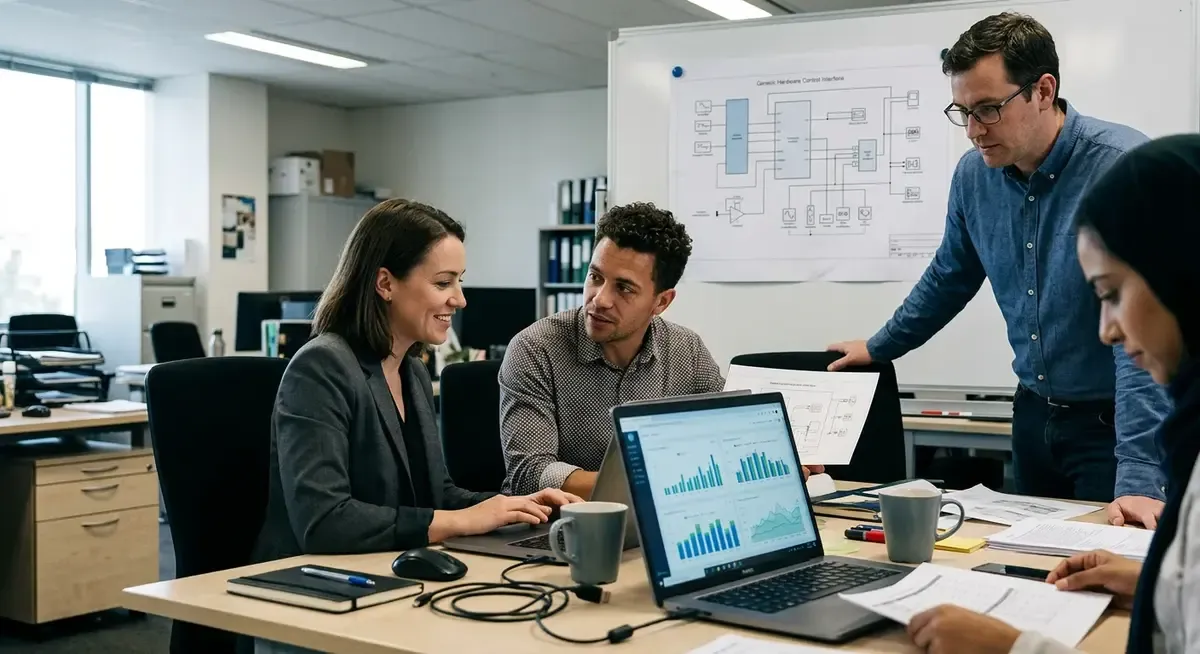
Editorial illustration for Anthropic Proposes Standard for AI to Control Physical Hardware
Anthropic's New Standard Lets AI Control Physical Hardware
Anthropic Proposes Standard for AI to Control Physical Hardware
Anthropic built the Model Context Protocol to let AI models talk to software tools without custom code for every connection. Now the company wants the same fix for physical hardware. On Thursday, Anthropic detailed the Model Hardware Standard, or MHS, a spec designed to let AI agents read data from and control equipment like microscopes and robotic arms in research labs and factories.
The problem it targets is familiar to anyone who has run a lab. A microscope from one manufacturer, a robotic arm from another, a spectrometer from a third: each with its own API, its own data format, its own control software. Wiring them together for an AI system to use has traditionally taken weeks or months of custom engineering. Anthropic built MHS with standardized drivers so devices show up in a common format, which the company says can cut that integration time down to hours or minutes.
The spec was developed with HHMI Janelia Research Campus and is going out first as a research preview. Anthropic has already run tests with lab partners, including on quantum computing hardware, to see how AI agents handle real physical equipment rather than just software interfaces.
Anthropic's Model Hardware Standard (MHS) gives AI agents a unified interface to physical devices like microscopes and robotic arms. Early tests in labs and on quantum computers cut integration time dramatically, though Claude still struggled with physical cause and effect.
Why this matters
MCP won because it solved a real integration headache for software agents, and Anthropic is betting the same pattern applies to lab benches and factory floors. If MHS delivers on the hours-not-months claim, it lowers the barrier for researchers and startups building AI agents that need to touch actual instruments, not just APIs. That matters for anyone in robotics or biotech tooling watching Anthropic extend its influence from chatbots into physical infrastructure.
But standards live or die on adoption, not specs. MCP had an obvious constituency of developers wiring up tools; MHS needs microscope makers, robotic arm manufacturers, and lab equipment vendors to actually write drivers against it. Anthropic developing this with HHMI signals it's courting scientific instrumentation first, which is a sensible beachhead but a narrow one.
Founders building hardware-facing AI products should watch whether device manufacturers beyond the initial partners commit, because a standard with one champion and a handful of drivers is just a proprietary interface with better branding.
Related Reading
Browse all Anthropic news → AI Tools & Apps
 Claude gains shared context in Excel, PowerPoint; Microsoft adds Copilot Cowork
 AI Tools & Apps
 OpenAI Developer: AI Agent "Swarms" Waste Tokens, Create "Coordination Tax
 AI Tools & Apps
 LG's recent webOS update adds Microsoft Copilot app, now removable
 Related Topic
 Anthropic: Hackers Stole Claude Tokens Via Compromised Session Key
LLMs & Generative AI
 Related Topic
 Trump cracks down on Anthropic after Amazon tip; staff largely foreign
Open Source
 From Archives
 Photoshop Adds 'AI Assisted Editor' With Simplified Toolbar
 From Archives
 Taiwan Firm: AI Tools Double Chinese State-Backed Cyberattacks
 From Archives
 Sony Music, Warner Chappell Sue Anthropic Over "Blatant Theft
Policy & Regulation
 From Archives
 Judge Rules Trump's Anthropic Blacklist Illegal
Policy & Regulation
Common Questions Answered
What is the Model Hardware Standard (MHS) that Anthropic proposed?
The Model Hardware Standard is a specification designed by Anthropic to let AI agents read data from and control physical equipment like microscopes and robotic arms in research labs and factories. It aims to provide a unified interface for AI models to interact with hardware devices, similar to how the Model Context Protocol solved integration challenges for software tools.
How does the Model Hardware Standard relate to Anthropic's Model Context Protocol?
Anthropic built the Model Context Protocol (MCP) to allow AI models to communicate with software tools without requiring custom code for each connection. The company is now applying the same solution approach to physical hardware through MHS, extending the standardized integration model from software to laboratory and factory equipment.
What problem does the Model Hardware Standard solve for researchers and labs?
The MHS addresses the integration headache of connecting different manufacturer equipment in labs, where devices like microscopes and robotic arms typically require custom code for each connection. Early tests show that MHS can cut integration time dramatically, lowering the barrier for researchers and startups building AI agents that need to control actual instruments rather than just accessing APIs.
What limitations did Claude experience during early testing of the Model Hardware Standard?
During early tests of MHS in labs and on quantum computers, Claude struggled with understanding physical cause and effect relationships. This limitation suggests that while MHS successfully provides the technical interface for hardware control, AI models still need improvement in reasoning about how physical systems respond to their actions.
Why does Anthropic's Model Hardware Standard matter for robotics and biotech companies?
MHS lowers the barrier for researchers and startups building AI agents that interact with physical instruments, potentially reducing integration time from months to hours. This standardized approach extends Anthropic's influence from chatbots into physical infrastructure, making it easier for robotics and biotech tooling companies to deploy AI-controlled equipment in their operations.
Further Reading
- Previewing the Model Hardware Standard - Anthropic
- Anthropic pushes into physical world with new standard to help AI agents operate machines - CNBC
- Anthropic tests new way for Claude to work with robots and scientific lab tools - Bloomberg
- Anthropic proposes plumbing spec to link AI agents to lab kit and robots - The Register
- Anthropic wants AI agents to control lab machines, giving Claude hands to work - India Today
