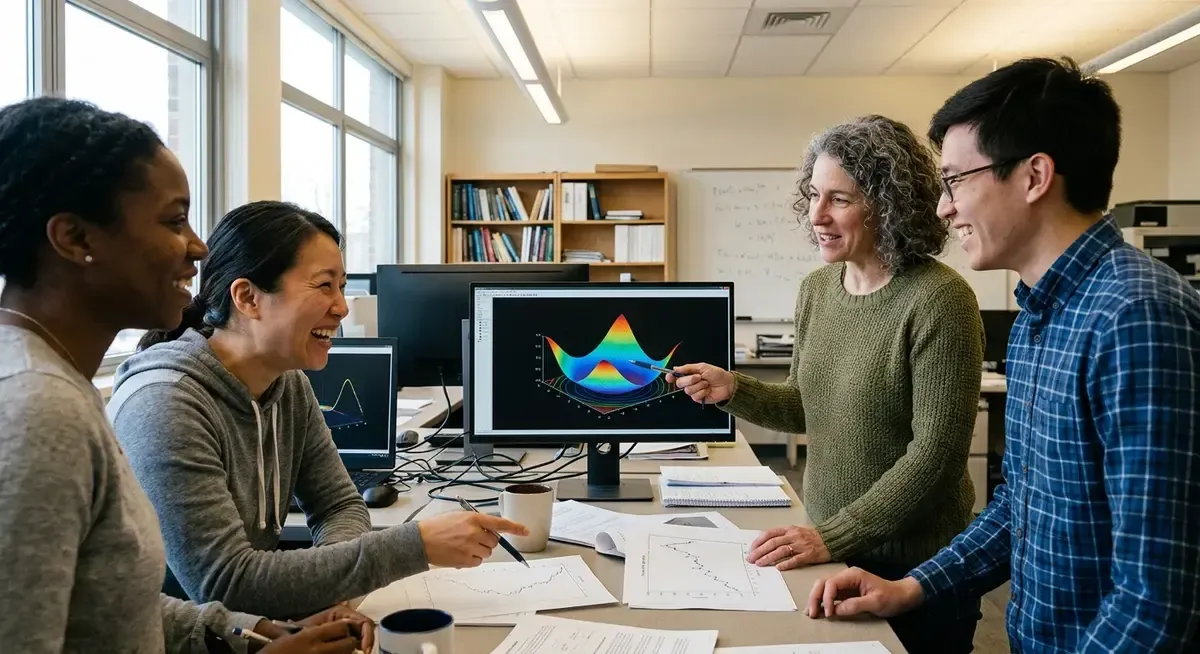
Editorial illustration for AI Milestones Arrived Years Early, Especially in Mathematics
AI Math Breakthroughs Beat Expert Predictions by Years
AI Milestones Arrived Years Early, Especially in Mathematics
The Forecasting Research Institute has spent three years asking some of the smartest people in AI to predict what the field will look like a few years out. The panels weren't casual guessers. FRI's first LEAP round pulled in 339 experts, including 76 computer scientists, 68 economists, and 119 AI policy specialists, plus superforecasters with track records of getting things right. Among the computer scientists were 30 professors at top-20 institutions and 10 of the 200 most-cited AI authors alive.
FRI's interim report, released this week, checks those forecasts against what actually happened. The gap, especially in mathematics, turns out to be large. Experts and superforecasters alike placed AI's biggest wins years further down the road than they arrived.
Some of these predictions came from before ChatGPT existed, in mid-2022, but FRI found the miscalibration didn't disappear once researchers had a chatbot in front of them. The forecasts kept lagging reality, round after round, survey after survey, even as the people making them updated their models of how fast things were moving.
The widest gap involves math. AI reached gold-medal level at the International Mathematical Olympiad in July 2025, five years before the median expert forecast and ten years before the median superforecaster forecast.
Why this matters
The gap between forecast and reality on the IMO benchmark should worry anyone who plans product roadmaps around expert timelines. Five to ten years is not a rounding error. It's the difference between "budget for this next decade" and "this is already happening." FRI's finding suggests the people we've relied on to pace this industry, tenured researchers, superforecasters, economists with track records, are systematically anchored to the wrong curve.
For developers and founders, the practical takeaway is blunt: treat expert consensus on AI capability timelines as a floor, not a ceiling. If gold-medal math performance arrived five years ahead of schedule, whatever benchmark you think is safely years away might land next quarter. That changes how you sequence bets, how much runway you assume you have before a capability commoditizes, and how skeptical you should be of any roadmap that says "not yet" without a specific technical bottleneck attached.
The uncomfortable question FRI's report raises isn't whether forecasters were wrong. It's why the same overconfidence keeps recurring, and what that means for the next milestone everyone's currently calling years out.
Related Reading
 Research & Benchmarks
 Microsoft AI Chief: "If It Isn't Safe We Shouldn't Build It
 Research & Benchmarks
 Google's FACTS benchmark shows 70% factuality ceiling across four tests
 Research & Benchmarks
 Nvidia's DLSS 4.5 beta adds 6x Multi Frame Generation for RTX 50 GPUs
 From Archives
 Muse Allows Download of Full Filesystem, Reveals Meta Data Details
 From Archives
 DeepMind’s Hiring Momentum Slows Under New Chief
Common Questions Answered
How much earlier did AI reach gold-medal level at the International Mathematical Olympiad compared to expert predictions?
AI achieved gold-medal performance at the International Mathematical Olympiad in July 2025, which was five years ahead of the median expert forecast and ten years ahead of the median superforecaster forecast. This represents a significant gap between what experts predicted and what actually occurred in the field of AI mathematics capabilities.
Who participated in the Forecasting Research Institute's LEAP round predictions?
The FRI's first LEAP round included 339 experts across multiple disciplines: 76 computer scientists (including 30 professors at top-20 institutions and 10 of the 200 most-cited AI authors), 68 economists, and 119 AI policy specialists. The panel also included superforecasters with established track records of making accurate predictions.
Why should product roadmap planners be concerned about the gap between AI forecasts and actual milestones?
A five to ten year gap between forecasted timelines and actual AI capabilities represents a critical difference between planning for the next decade versus recognizing that developments are already happening. This discrepancy suggests that tenured researchers, superforecasters, and economists have been systematically anchored to an incorrect growth curve for the field.
What does the study suggest about expert predictions for AI development timelines?
The Forecasting Research Institute's findings indicate that top AI experts, including computer scientists, economists, and superforecasters, have badly underestimated how fast the AI field is moving. The systematic underestimation suggests these experts are anchored to outdated assumptions about the pace of AI advancement.
Further Reading
- AI in Math: Data & Research - Epoch AI - Epoch AI
- AI Benchmarks & Capabilities - epoch.ai - Epoch AI
- HorizonMath: Measuring AI Progress Toward Mathematical ... - arXiv - arXiv
- The Gold Rush in AI4Math: Where Are We Now? - arXiv
- Technical Performance - Stanford HAI
