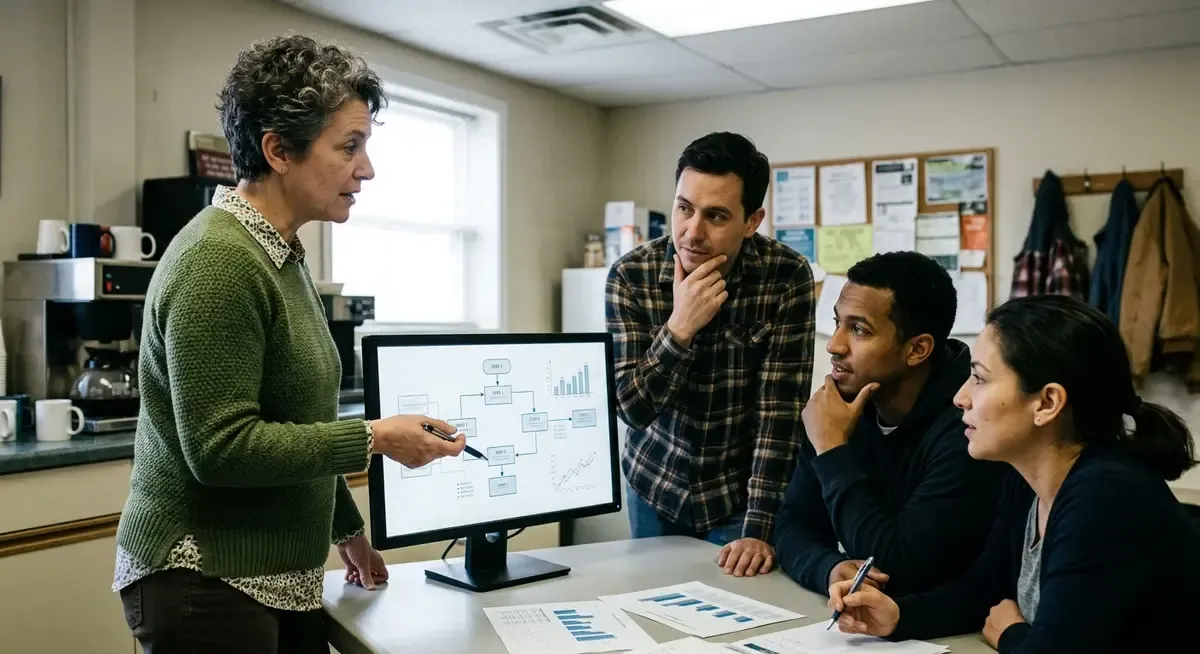
Editorial illustration for AI Helps Care Teams Spend More Time With Patients
AI Helps Care Teams Spend More Time With Patients
A patient's chart at a typical hospital can run thousands of pages, scattered across physicians' notes, imaging reads, lab results and discharge summaries written over years. No clinician has time to read all of it before a decision needs to get made. That gap, between what's recorded and what gets reviewed, is where a wave of AI tools is now stepping in.
Dyania Health, a clinical AI company based in New Jersey, built a system called Synapsis AI to close that gap. It reads across a patient's full record, linking findings that might be separated by years, and surfaces clinical signals that point care teams toward what needs attention and why. Every signal traces back to its source in the chart, and clinicians still make the call on what to do with it.
That's one example of a broader shift happening in health systems and startups right now. From matching patients to clinical trials to supporting radiologists and hospital staff, AI is taking over routine work so care teams can spend more time with the people in front of them. NVIDIA-accelerated computing runs much of it, with hospitals keeping patient data inside their own walls and clinicians reviewing every output before it becomes a decision.
Synapsis AI reasoned across each patient’s record, including every echocardiogram added in the years after surgery, and used this information to build a predictive model of valve deterioration and reintervention risk at the three-, five- and ten-year mark after a patient undergoes an aortic valve replacement procedure. The AI platform completed chart review across the full cohort that would have taken clinicians years to complete by hand.
Why this matters
For developers and founders building in health tech, the signal here isn't "AI diagnoses patients." It's that NVIDIA and partner health systems are positioning AI as infrastructure for the unglamorous work: trial matching, radiology triage, hospital logistics. That's a narrower, more defensible claim than most AI health pitches, and it's probably the right one. Clinicians reviewing outputs and making final calls isn't a regulatory footnote, it's the product design. Anyone building clinical AI tools should take note of that framing rather than trying to automate judgment calls that doctors are legally and ethically on the hook for.
We'd push back on one thing: "spend more time with patients" is a nice headline, but it's an outcome claim, not a feature. Nobody's published the time-motion data yet. Compute vendors and health systems both have incentive to tell this story.
Worth watching whether independent studies back up the time-savings claim, or whether this stays anecdotal. The real test is whether hospitals adopt these tools at scale once the NVIDIA press cycle fades.
Related Reading
 Industry Applications
Westinghouse teams with Google Cloud to build AI platform for nuclear power
 Industry Applications
NVIDIA NeMo powers telco reasoning model for autonomous network workflows
 Industry Applications
Month-1 Agent Adds Holistic Observability with Trace IDs and Token Tracking
 From Archives
eBay blocks third-party AI agents amid varying retailer comfort
 From Archives
Hexaware to Drive EBRD Banking Tech Ops for 5 Years With Three Platforms
Common Questions Answered
How does Synapsis AI help clinicians manage large patient charts?
Synapsis AI reads across a patient's complete medical record, including thousands of pages of physicians' notes, imaging reads, lab results, and discharge summaries that would be impossible for clinicians to review before making treatment decisions. By automating this chart review process, the system closes the gap between what's recorded and what gets reviewed in a timely manner.
What specific clinical application did Dyania Health demonstrate with Synapsis AI?
Dyania Health demonstrated Synapsis AI's capability by having it analyze patient records following aortic valve replacement procedures to build predictive models of valve deterioration and reintervention risk at three-, five-, and ten-year marks. The AI platform completed chart review across an entire patient cohort in a fraction of the time it would have taken clinicians to do manually over years.
What is the key positioning of AI in healthcare according to this article?
Rather than focusing on AI diagnosing patients, the article emphasizes that AI should be positioned as infrastructure for unglamorous but essential healthcare work like trial matching, radiology triage, and hospital logistics. This narrower, more defensible approach treats clinician review and final decision-making as core product design rather than a regulatory afterthought.
Why is clinician oversight important in AI health tech platforms?
Clinicians reviewing outputs and making final calls is presented as the product design itself, not merely a regulatory requirement or footnote. This approach ensures that AI tools augment clinical decision-making rather than replacing clinician judgment, maintaining accountability and safety in patient care.
Further Reading
- Inside Optum Health's push to make AI practical for clinicians - Healthcare IT News
- 6 Health Systems Enhancing Care Delivery with Ambient AI - American Hospital Association
- The Evolving Healthcare Workforce - Healthcare Executive
- Reclaiming the Clinical Story: Ambient AI and the Future of Documentation - American Academy of Family Physicians
- Large AI scribe study finds modest time savings, inconsistent use - STAT
