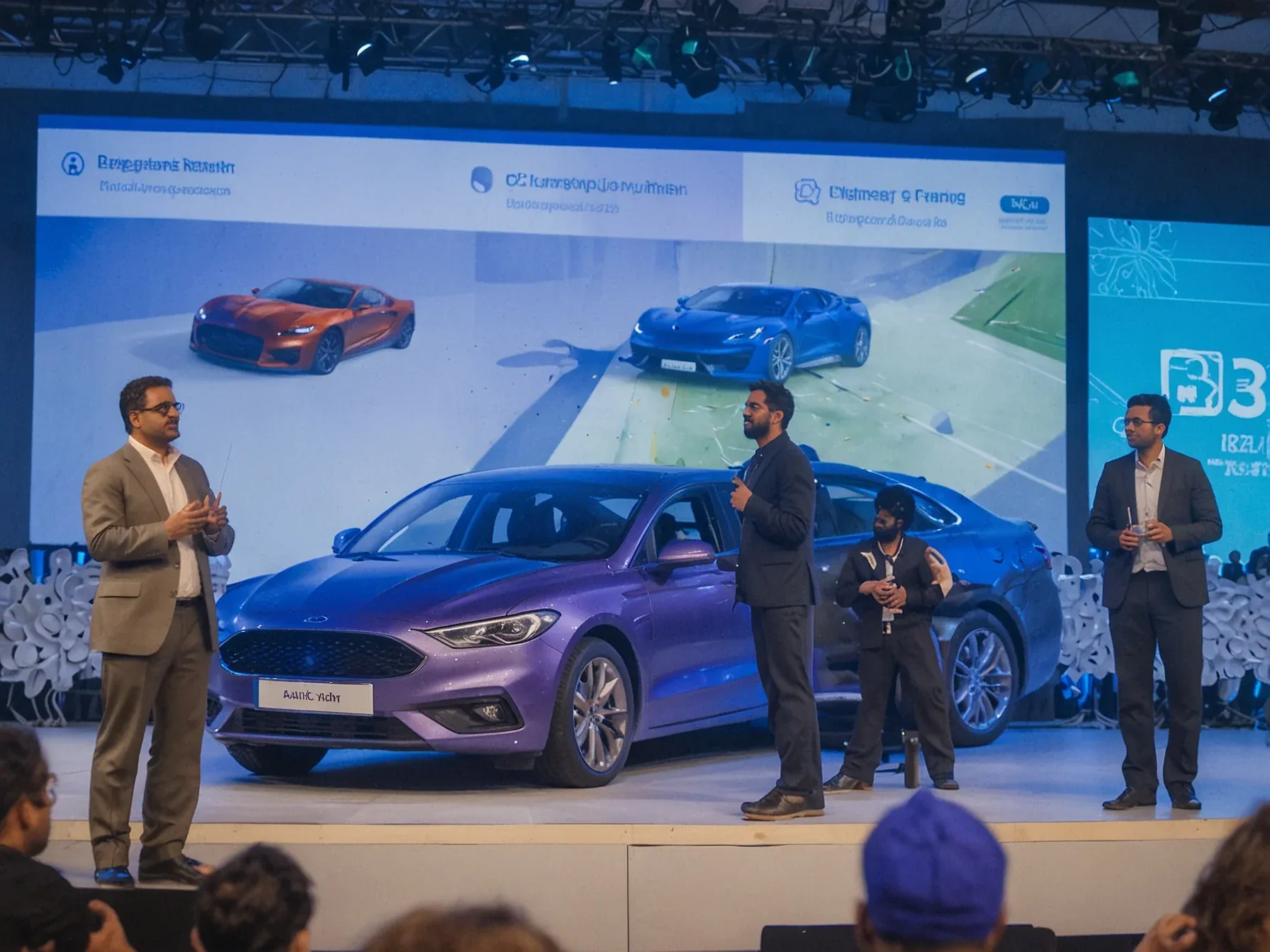
Editorial illustration for Ford AI Manager Reveals Multimodal Vehicle Inspection Tech at Data Hack 2025
Ford's AI Breakthrough: Multimodal Vehicle Inspection Tech
AI Engineering Manager Vignesh Kumar Shows AI Vehicle Checks at Data Hack 2025
Ford wants your next car inspection to be done by an AI, and they're using a tech conference to pitch it. Vignesh Kumar, an AI engineering manager at the company, is demonstrating a multimodal system at Data Hack 2025. It's meant to diagnose vehicle problems by analyzing video, sound, and performance data all at once.
Kumar is showing actual technology, not a concept. The goal is a machine that can spot mechanical issues faster and more consistently than a person.
Inconsistent inspections have always been a problem for repair shops. This is an attempt to fix that with software. It turns the subjective work of diagnosis into something a computer can measure.
The system watches a car. It listens to it. It reads its computer data.
Then it gives a single report. That's the core promise on display at the summit.
His keynote is essentially a technical reveal for how Ford thinks car maintenance should work.
This blog is based on a keynote delivered by Vignesh Kumar, AI Engineering Manager at Ford, during the Data Hack Summit 2025. His session, titled “Automating Vehicle Inspections with Multimodal AI”, explored how AI (artificial intelligence) is transforming the car servicing industry. It highlighted the scale of the challenge, the architecture of multimodal AI solutions, and the measurable business impact of deploying them at scale.
What follows is a detailed exploration of that vision and its implications for the industry. The car service world is no longer what it was a decade ago. Inspections used to be mechanical, manual, and heavily dependent on the eye of the technician.
Customers today expect speed, clarity, and proof. They want to see what is wrong with their vehicle and why it needs fixing. This is where electronic Vehicle Health Checks, or eVHCs, have become the industry’s answer.
A short video of the car can highlight issues better than a sheet of paper ever could. It gives technicians a way to document problems.
Ford’s move here is significant. It signals a shift from treating AI as a research project to deploying it on the greasy shop floor.
Combining different data streams for a single diagnostic is a logical, almost obvious, use for current AI. The real test is whether it works reliably outside a conference demo, in a thousand noisy dealerships with thousands of different car models.
Questions about cost, training, and what happens when the AI is wrong were likely glossed over in a keynote. They are the hard parts.
For Ford, this is a clear strategic bet. They are not just adding a feature. They are trying to rebuild a core service process around a machine's judgment.
The presentation at Data Hack 2025 was a polished look at a messy, complicated future. It assumes customers and mechanics will trust a black box with their brakes.
Further Reading
- Security flaws in a carmaker's web portal let one hacker remotely unlock cars from anywhere - TechCrunch
- Flaws in Major Automaker's Dealership Systems Allowed Car Hacking, Personal Data Theft - SecurityWeek
- Online portal exposed car and personal data, allowed anyone to remotely unlock cars - Malwarebytes
- 2025 Connected Car Cyber Safety Index - RunSafe Security
Related Reading
 LLMs & Generative AI
 ChatGPT's 'Nerdy' tweak rewards goblin metaphors in answers, study finds
 LLMs & Generative AI
 Google to End Free Access to Gemini AI for Non-Subscribers
 LLMs & Generative AI
 AI Engineers Face Rising Costs, Need New Strategies for Efficiency
 From Archives
 Andrej Karpathy says agentic AI years from meeting industry hype
 From Archives
 Pathway's '(Baby) Dragon Hatchling' swaps Transformers for neuron-synapse network
Common Questions Answered
How does Ford's multimodal AI technology improve vehicle inspections?
Ford's multimodal AI technology combines multiple data inputs to diagnose vehicle issues more accurately and quickly than traditional human mechanics. The approach allows for more comprehensive vehicle assessments by integrating different types of data and analysis techniques.
Who is Vignesh Kumar and what did he reveal at Data Hack 2025?
Vignesh Kumar is the AI Engineering Manager at Ford who presented a keynote on 'Automating Vehicle Inspections with Multimodal AI' during the Data Hack Summit 2025. His presentation explored how artificial intelligence can transform car servicing by creating more intelligent and precise diagnostic systems.
What potential benefits does Ford's multimodal AI approach offer for automotive servicing?
Ford's multimodal AI technology promises to simplify service processes and potentially reduce human error in vehicle diagnostics. By leveraging intelligent systems that can analyze multiple data inputs simultaneously, the approach could significantly improve the speed and accuracy of car maintenance and problem detection.
