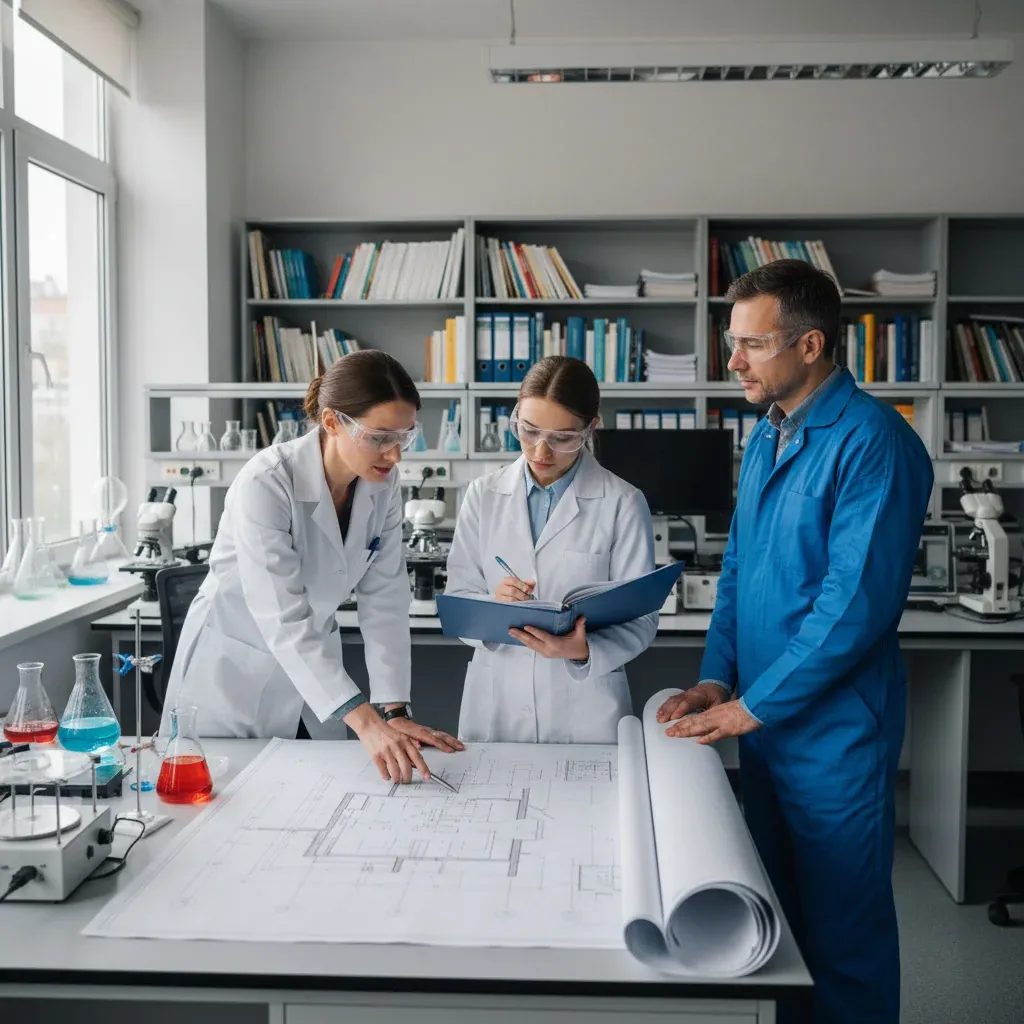
Editorial illustration for VideoWorld paper links prediction, simulation, reasoning in robotics
VideoWorld paper links prediction, simulation, reasoning...
Most AI research loudly announces progress. The best of it quietly, fundamentally, redefines the goal. Take 2025’s VideoWorld paper.
It didn’t just propose a better robot brain. Its core argument was radical: seeing, simulating, and acting are not separate engineering puzzles. They are facets of a single skill—learning a model of cause and effect directly from pixels.
This premise alone shifted the entire conversation about what a machine needs to understand a physical space.
ByteDance’s VideoWorld paper focused on helping AI systems learn physical understanding directly from unlabeled video data.
VideoWorld’s true significance snaps into focus when you see its company on that Analytics Vidhya list. Right beside it sat an AI that autonomously runs the scientific method, and another—OpenAI’s SWE-Lancer—graded on real freelance gigs. That’s the pattern.
The field is moving past sterile benchmarks. It’s now building for the open world, where tasks are poorly defined and failure is a real possibility. This research is converging on a single, messy reality.
The next leap forward won’t be measured in dataset accuracy. It will be measured in competence in a cluttered kitchen, a chaotic lab, or a client’s broken, urgent codebase.
Related Reading
 Research & Benchmarks
 Microsoft AI Chief: "If It Isn't Safe We Shouldn't Build It
 Research & Benchmarks
 Google's FACTS benchmark shows 70% factuality ceiling across four tests
 Research & Benchmarks
 Nvidia's DLSS 4.5 beta adds 6x Multi Frame Generation for RTX 50 GPUs
 From Archives
 Channel-independent tolerate modalities but falter on within-modality gaps
 From Archives
 Study Finds Current ToM Benchmarks Overlook First‑Person, Dynamic Interaction
Common Questions Answered
What is the core argument of the VideoWorld paper regarding robot perception and action?
VideoWorld's fundamental premise is that seeing, simulating, and acting are not separate engineering challenges but rather interconnected facets of a single skill. The paper argues that machines need to learn a model of cause and effect directly from pixels, which represents a radical shift in how we approach robot brain development and physical space understanding.
How does VideoWorld redefine the goals of AI research compared to traditional approaches?
Rather than announcing incremental progress on existing benchmarks, VideoWorld fundamentally redefines what it means for a machine to understand a physical space by unifying prediction, simulation, and reasoning into one cohesive framework. This shift moves the field away from sterile benchmarks toward building AI systems for the open world where tasks are poorly defined and failure is a real possibility.
What pattern does the VideoWorld paper exemplify alongside other 2025 AI research?
VideoWorld represents part of a broader trend where AI research is moving beyond traditional benchmarks toward systems built for real-world applications with genuine consequences. The paper sits alongside other significant work like autonomous scientific method systems and OpenAI's SWE-Lancer, all demonstrating the field's convergence on handling messy, real-world scenarios rather than controlled laboratory conditions.
Why is learning cause and effect directly from pixels significant for robotics according to VideoWorld?
By learning cause and effect relationships directly from visual input, robots can develop a unified understanding that integrates perception, prediction, and action planning into a single model. This approach eliminates the need to solve seeing, simulating, and acting as separate engineering problems, creating a more efficient and generalizable system for physical world interaction.
Further Reading
- VideoWorld 2: Learning Transferable Knowledge from Real-world Videos — arXiv
- Causal World Modeling for Robot Control — arXiv
- VideoWorld: Exploring Knowledge Learning from Unlabeled Videos — CVPR / OpenAccess
- Seed Research | Latest Breakthrough in Video Generation — ByteDance Seed
- V-JEPA 2 world model and new benchmarks for understanding, prediction, planning, and robot control — Meta AI
