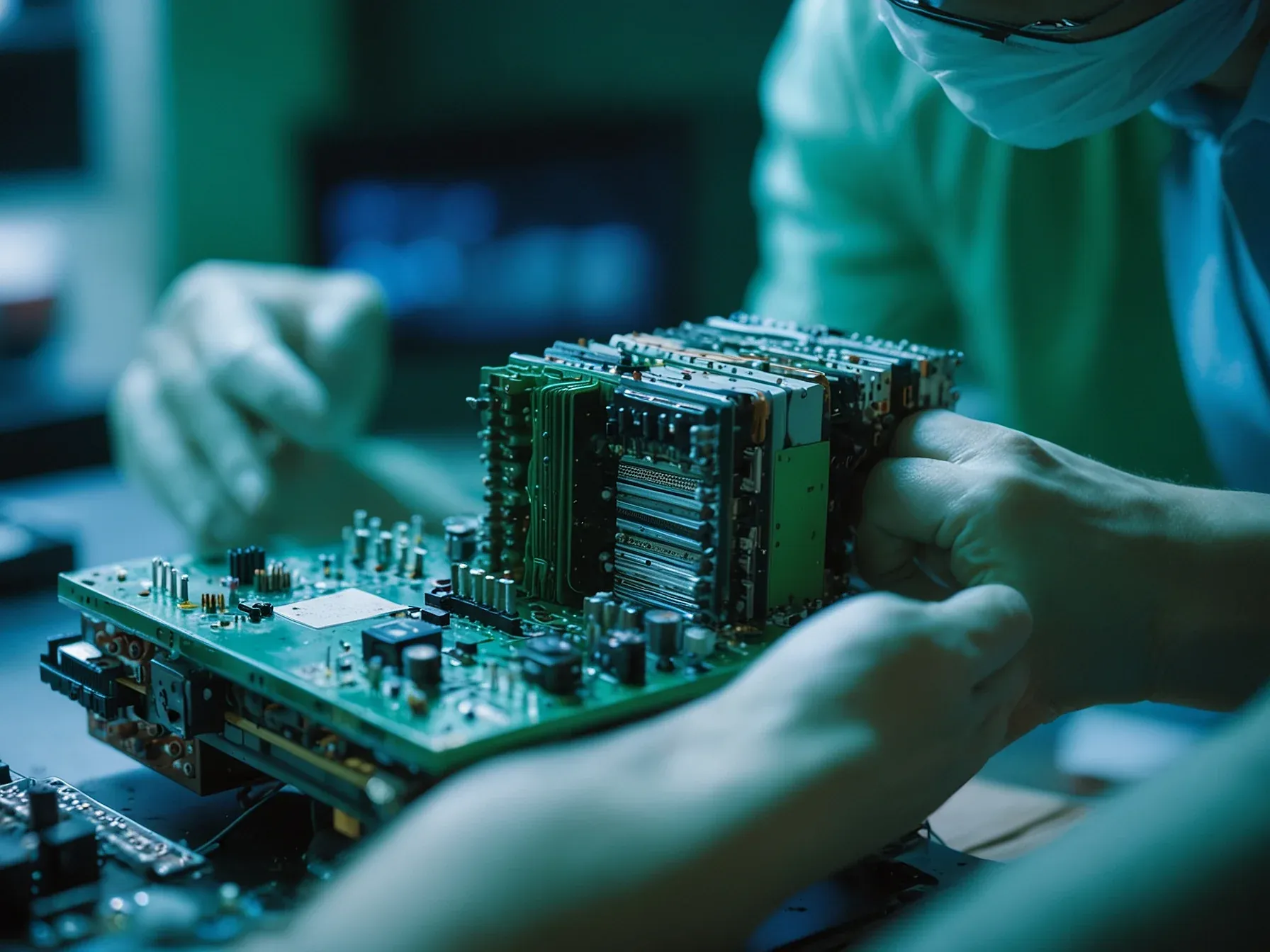
Editorial illustration for Google's TPUs Outshine GPUs in Deep Learning Performance Boost
TPUs Crush GPUs: Google's Breakthrough in ML Chip Design
TPUs Designed for Deep Learning Can Outperform GPUs in Many Workloads
The race for AI speed has no single winner. It's a brutal matchmaking exercise: pair the right silicon with the exact task. Take pure, industrial-scale deep learning.
Google built the TPU for that one brutal job—the repetitive, grinding math of neural networks. It's a specialist. Now consider the GPU.
It's a brilliant generalist, juggling video games and scientific simulations. That versatility costs efficiency. For processing nothing but vast blocks of data, the TPU's lean design cuts the noise.
Google's own Search and Recommendation engines run on them. The reason is brutally simple: for that specific, massive job, it's cheaper. It's faster.
The TPU architecture was designed with deep learning in mind, and as such, TPUs provide the following benefits over other architectures: TPUs can outperform GPUs in many situations where workloads take advantage of TPUs' high-density linear algebra capabilities while processing large tensors with minimal overhead. TPUs are utilized to handle the majority of AI workloads focusing on inference and take advantage of mass production in such tasks as Google Search, Recommendations, and Developers who can fit multiple workloads onto a single TPU (a cost effective way to scale in a cloud environment). Overall, TPUs excel at AI workloads, especially when training or deploying large deep learning models across many servers.
They aren't suited for tasks like 3D graphics rendering or traditional HPC, and instead focus on high-throughput deep neural network workloads. Deciding between GPUs and TPUs for AI/ML infrastructure will have trade-offs. GPUs can serve a wide range of applications, whereas TPUs are designed specifically for running deep learning workloads with high efficiency.
In 2025, this difference in capabilities will become apparent through benchmarks that establish important characteristics of GPUs and TPUs. Key differences of GPU vs TPU majorly reflect in the performance category. For example: According to the 2025 MLPerf benchmarks, there is a major difference between GPUs and TPUs for different types of workloads.
The 2025 MLPerf benchmarks laid it bare. For high-throughput neural network work, TPUs won. It wasn't close.
This was a foundational architectural bet paying off. So the choice is stark. Running a factory that makes one thing?
Use the scalpel. Need a workshop that builds a hundred different things today? You need the Swiss Army knife.
A TPU can't render graphics. A GPU wastes cycles on massive, homogeneous tensor work. Picking one isn't about finding the "best" chip.
It's an admission of what your business actually does. For vast, predictable AI pipelines, the specialist saves money. It saves time.
For everything else, the generalist stands ready. Your infrastructure now reflects your ambition. Choose.
Related Reading
 Research & Benchmarks
 Microsoft AI Chief: "If It Isn't Safe We Shouldn't Build It
 Research & Benchmarks
 Google's FACTS benchmark shows 70% factuality ceiling across four tests
 Research & Benchmarks
 Nvidia's DLSS 4.5 beta adds 6x Multi Frame Generation for RTX 50 GPUs
 From Archives
 Wipro partners with IISc and FSID for AI and quantum research collaboration
 From Archives
 Google expands AI partnership with Tel Aviv University, infrastructure for Gemma
Common Questions Answered
How do Google's TPUs differ from traditional GPUs in deep learning performance?
TPUs are custom-designed specifically for deep learning workloads, offering superior performance in linear algebra computations and tensor processing. Unlike GPUs, TPUs are optimized for handling large-scale AI tasks with minimal computational overhead, making them particularly efficient for inference-based applications.
What key platforms benefit most from Google's Tensor Processing Unit (TPU) architecture?
Google Search, recommendation systems, and developer platforms are the primary beneficiaries of TPU technology. These specialized chips excel at processing large-scale AI workloads, providing significant computational advantages in inference-focused tasks across Google's core services.
Why are TPUs considered a strategic advancement in deep learning hardware?
TPUs represent a targeted approach to AI computational challenges, designed explicitly with deep learning requirements in mind. Their high-density linear algebra capabilities and ability to process large tensors efficiently make them a potentially transformative technology in machine learning infrastructure.
Further Reading
- TPU vs. GPU: The Ultimate Guide to the AI Hardware War — BinaryVerse AI
- TPU vs GPU: Which Is Better for AI Infrastructure in 2025? — Tailscale
- TPU vs GPU: What's the Difference in 2025? — CloudOptimo
- The chip made for the AI inference era – the Google TPU — Uncover Alpha
- CPU, GPU, TPU & NPU: What to Use for AI Workloads (2025 Guide) — Fluence Network
