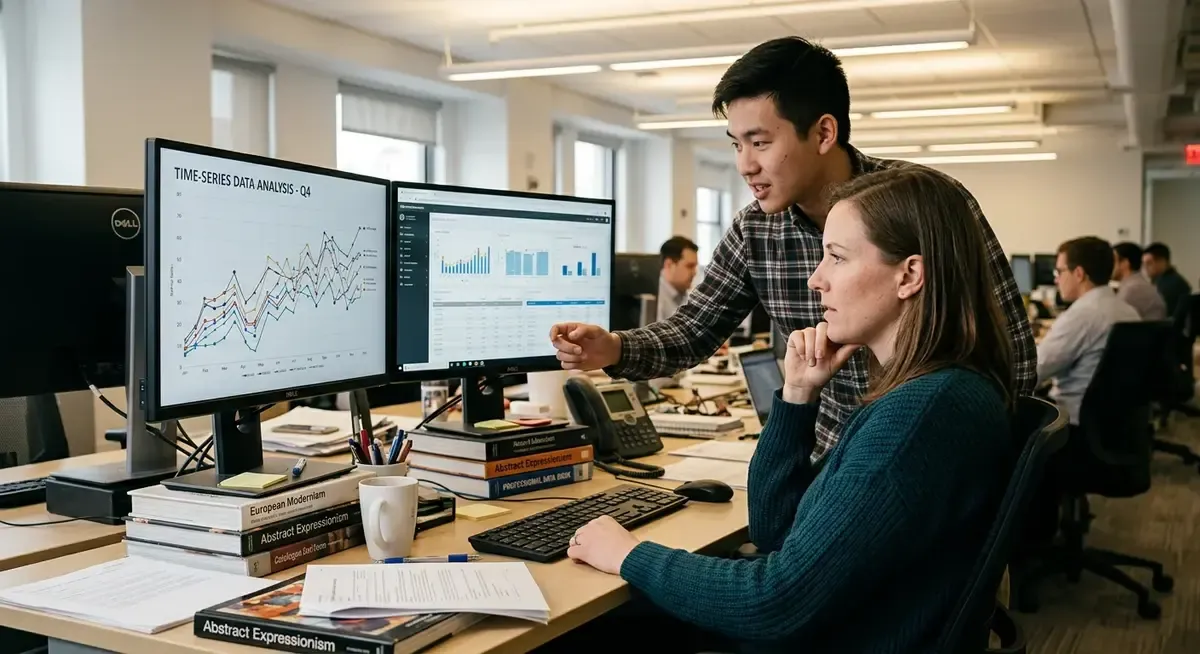
Editorial illustration for Sotheby's Data Scientist Builds Algorithms to Predict Art Prices
Sotheby's Uses AI to Predict Art Auction Prices
Sotheby's Data Scientist Builds Algorithms to Predict Art Prices
Kelly Shen ’17 spends her days figuring out what a painting might sell for before it ever hits the block. She works at Sotheby’s in New York, in a corner of the auction business known as art intelligence, where she builds algorithms that weigh buying trends and an artist’s market heat to forecast prices. The job isn’t all modeling. Shen has also worked on cataloguing systems and on making sure Sotheby’s website doesn’t buckle when thousands of bidders log on at once for a live sale.
Outside her day job, Shen stays tied to MIT. She serves as a class officer, sits as vice president of the Association of MIT Alumnae, and volunteers with the MIT Club of New York. She double-majored in computer science and math on campus, a combination that turned out to be good preparation for a field that didn't really exist when she started college. She also draws, a habit she's kept up since childhood and one that colors how she thinks about the art she now helps price.
Shen builds algorithms to predict prices, using factors like buying trends and artists’ popularity. She has also worked on such efforts as cataloguing and ensuring that real-time systems can handle thousands of potential bidders visiting the house’s website.
Why this matters
Sotheby's pricing algorithms are a reminder that machine learning has moved well past tech's usual playgrounds and into markets that ran for centuries on connoisseurship and gut instinct. Shen's work, folding buying trends and artist popularity into predictive models, treats fine art the way quants treat equities: as a data set with patterns worth mining. For builders and researchers, that's the real signal here. Any market with enough historical transaction data, however illiquid or subjective it looks from outside, is a candidate for this treatment.
The infrastructure side matters just as much as the modeling. Making sure a website holds up against thousands of simultaneous bidders is unglamorous, but it's the difference between a clever model and one that actually ships during a live auction. We'd flag some skepticism too: art valuation involves provenance, taste, and one-off events that resist clean quantification, so these tools probably work best as a supplement to expert judgment rather than a replacement for it. Worth watching whether Sotheby's or its rivals start publishing how much these models actually move final hammer prices.
Related Reading
 Market Trends
 AI drives three initiatives to accelerate global action for planet protection
 Market Trends
 Akamai data shows AI training bots and content‑fetching bots rise since July
 Market Trends
 NVIDIA and Google Cloud let developers scale AI from prototype to production
 From Archives
 AI Agents Drive 14x Surge in Token Usage on OpenRouter
 From Archives
 Stanford's Karen Liu on Generalist AI's Large-Scale Robot Data Collection
Common Questions Answered
What specific factors does Kelly Shen's algorithm use to predict art prices at Sotheby's?
Shen's algorithms weigh buying trends and an artist's market heat to forecast painting prices before they go to auction. These predictive models treat fine art similarly to how quantitative analysts approach equities, identifying patterns in historical transaction data that can inform price predictions.
Beyond price prediction algorithms, what other technical responsibilities does Shen handle at Sotheby's?
In addition to building pricing algorithms, Shen has worked on cataloguing systems and infrastructure to ensure Sotheby's website can handle the technical demands of live sales. Her work includes managing real-time systems that must support thousands of concurrent bidders logging on simultaneously during auctions.
How does machine learning application in art markets represent a shift from traditional auction house practices?
Sotheby's use of algorithms demonstrates that machine learning has expanded beyond technology companies into markets historically governed by connoisseurship and intuition. By applying data-driven quantitative methods to fine art pricing, the auction house treats art as a dataset with exploitable patterns rather than relying solely on expert judgment.
What does Shen's work at Sotheby's suggest about the future application of machine learning in other markets?
Shen's success building predictive models for art suggests that any market with sufficient historical transaction data—regardless of liquidity levels—could potentially benefit from machine learning analysis. This indicates that data-driven approaches are expanding into traditionally non-technical industries and markets that were previously dominated by human expertise and intuition.
Further Reading
- Sotheby's uses machine learning tools to assist human appraisers in estimating prices for artworks - AI Trace
- Deep Learning for Art Market Valuation - arXiv
- Machines and Masterpieces: Predicting Prices in the Art Auction Market - HAL
- Predicting Art Auction Prices using Metadata - University of Padua Thesis Repository
- Conformal Prediction Improves Model Reliability in the Prediction of Art Auction Price - NHSJS
