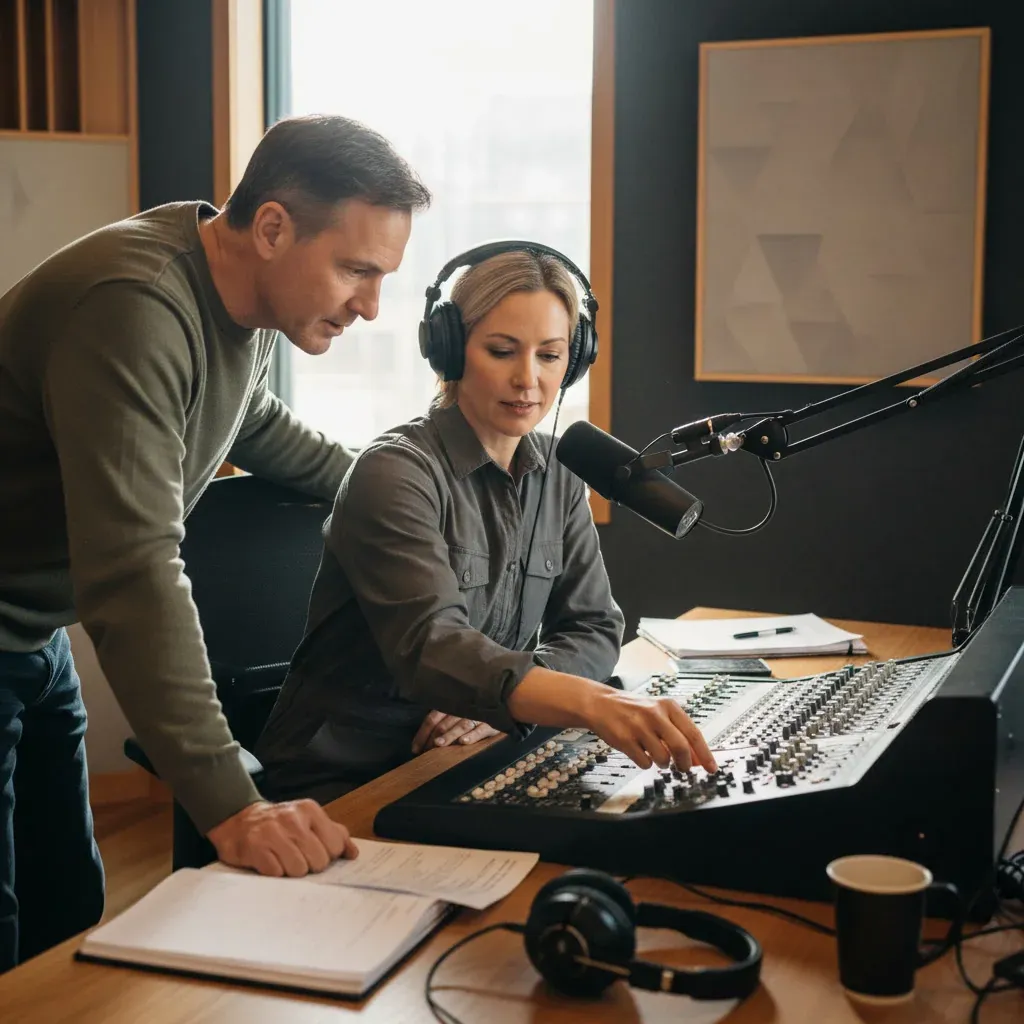
Editorial illustration for OpenMOSS releases MOSS‑Audio, encoding raw audio at 12.5 Hz for speech and music
OpenMOSS releases MOSS‑Audio, encoding raw audio at 12.5...
Audio is a flood, not a trickle. Every second of speech or music carries dense layers of meaning, pitch, rhythm, timbre, transient pops, background texture, all entangled in raw waveforms. Most models collapse that richness into a single high-level vector, discarding the very acoustic details that make audio alive.
MOSS‑Audio refuses that trade-off. OpenMOSS’s new foundation model compresses raw audio into continuous temporal representations at just 12.5 Hz, but that compressed stream is anything but sparse. The encoder was trained from scratch, purpose-built to preserve prosody, transients, and local time‑frequency structure.
Two architectural choices make this possible. One is a DeepStack‑inspired injection that pulls features from multiple encoder layers, not just the final one, and feeds them directly into the language model, ensuring low‑level acoustic grit survives alongside high‑level semantics. The other confronts a blind spot inherent to text models: time.
Audio lives in time, and MOSS‑Audio embeds that dimension explicitly, not as an afterthought. The result is a single open‑source model that reasons across speech, sound, music, and the temporal logic that ties them together.
Raw audio is first encoded by the MOSS-Audio-Encoder into continuous temporal representations at 12.5 Hz. Those representations are then projected into the language model’s embedding space through the adapter, and finally consumed by the LLM for auto-regressive text generation. The research team trained the encoder from scratch rather than relying on off-the-shelf audio frontends.
Their reasoning: a dedicated encoder delivers more robust speech representations, tighter temporal alignment, and better extensibility across acoustic domains. Two architectural innovations inside MOSS-Audio are worth understanding in detail. DeepStack Cross-Layer Feature Injection: A common weakness in audio models is that relying only on the encoder’s top-layer features tends to lose low-level acoustic information, things like prosody, transient events, and local time-frequency structure.
MOSS-Audio addresses this with a DeepStack-inspired cross-layer injection module between the encoder and the language model: in addition to the encoder’s final-layer output, features from earlier and intermediate layers are selected, independently projected, and injected into the language model’s early layers. This preserves multi-granularity information ranging from low-level acoustic details to high-level semantic abstractions, helping the model retain rhythm, timbre, transients, and background structure that a single high-level representation cannot fully capture. Time-Aware Representation: Time is a critical dimension in audio that text models aren’t naturally equipped to handle.
MOSS-Audio doesn’t just compress audio into a language model’s world, it rethinks what audio encoding should be. By training an encoder from scratch, the team sidesteps the brittle compromises of off-the-shelf frontends. They deliver temporal alignment tight enough to preserve a snare drum’s attack, prosody’s subtle rise, and the transient texture of a whispered word.
The DeepStack cross-layer injection is the real sleight of hand: it feeds the LLM not a single abstraction, but a layered map of acoustic detail, from raw timbre to high-level meaning. And the time-aware representation solves a fundamental mismatch, text models don’t naturally feel time, but MOSS-Audio makes them listen to it. This isn’t incremental progress.
It’s a foundation that treats speech, music, and sound as equally native languages. The future of audio reasoning just got a language model that finally hears the full picture.
Related Reading
 Open Source
 D&B rebuilds 642 million‑business database after AI agents hit limits
 Open Source
 Box CEO Aaron Levie Says AI Will Drive "Biggest Cybersecurity Upgrade
 Open Source
 Study: 6.7% of Deepfake Requests on Hugging Face Targeted Children
 From Archives
 Open-source orchestration spec 'Symphony' invites agents to build implementations
 From Archives
 Fast AI Power‑Use Estimator Aims to Prompt Developers, Operators to Cut Energy
Common Questions Answered
What is the key innovation of MOSS-Audio's encoding approach compared to traditional audio models?
MOSS-Audio compresses raw audio into continuous temporal representations at just 12.5 Hz while preserving acoustic details that traditional models typically discard. Rather than collapsing audio into a single high-level vector, this approach maintains the dense layers of meaning, pitch, rhythm, timbre, and transient textures that make audio rich and meaningful.
How does MOSS-Audio maintain temporal alignment for detailed acoustic features?
MOSS-Audio achieves tight temporal alignment through training an encoder from scratch, which sidesteps the brittle compromises of off-the-shelf audio frontends. This custom approach preserves fine acoustic details such as a snare drum's attack, prosody's subtle rise, and the transient texture of whispered words.
What is the DeepStack cross-layer injection technique in MOSS-Audio?
DeepStack cross-layer injection is a mechanism that feeds the language model not a single audio abstraction, but a layered map of acoustic information. This approach allows the model to access multiple levels of audio representation simultaneously, enabling more nuanced understanding of speech and music characteristics.
Why does OpenMOSS reject the traditional approach of collapsing audio into a single vector?
OpenMOSS recognizes that audio contains dense, entangled layers of meaning including pitch, rhythm, timbre, transient pops, and background texture that would be lost in a single high-level vector representation. By refusing this trade-off, MOSS-Audio preserves the acoustic richness that makes audio alive and meaningful for downstream applications.
Further Reading
- MOSS-Audio is an open-source foundation model for ... — GitHub - OpenMOSS
- [PDF] MOSS-TTS Technical Report — arXiv
- MOSS-TTS-Nano — OpenMOSS
- OpenMOSS/MOSS-Audio-Tokenizer — GitHub - OpenMOSS
