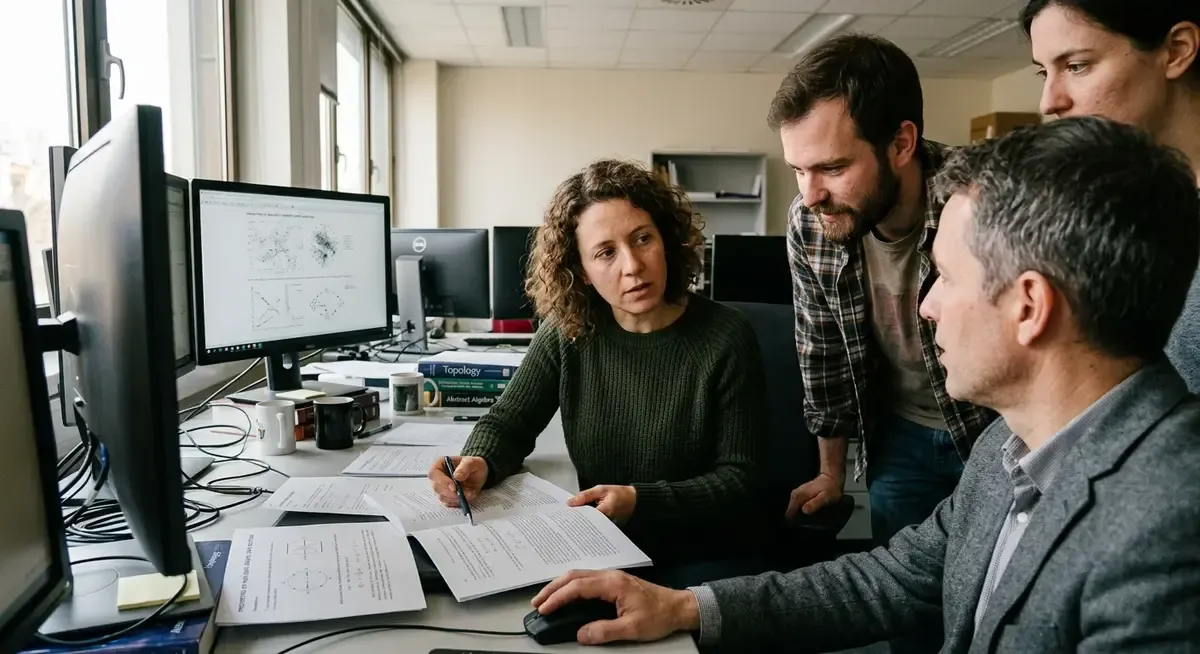
Editorial illustration for OpenAI's Math Breakthrough Relied on Our Work, Experts Say
OpenAI Math Breakthrough Faces Credit Claims
OpenAI's Math Breakthrough Relied on Our Work, Experts Say
A second mathematician has gone public with claims that OpenAI's models drew on his unpublished work without proper credit, days after a similar dispute erupted over a different researcher's findings. Andreas Thom, whose expertise centers on so-called non-sofic groups, laid out his concerns in a series of Mastodon posts, questioning whether conversations he'd had with ChatGPT fed into the company's later announcement of a mathematical breakthrough in his own field.
OpenAI touted the non-sofic groups result as one of ten major achievements unveiled last month, and the company itself acknowledged the work leaned heavily on research by Thom and mathematician Gábor Kun. That admission came only after mathematicians criticized the initial announcement for glossing over Thom and Kun's contributions, prompting OpenAI to revise its writeup without much fanfare.
Thom says he started scrutinizing his own exchanges with the chatbot after Tristan Buckmaster, a math professor at New York University, raised similar questions about whether his use of OpenAI's Codex tool had shaped the company's results. Non-sofic groups, for context, are infinite structures that resist approximation by finite ones, a niche corner of math now at the center of a very public argument about credit and data.
Thom said it “would be ethically indefensible” if nonpublic research supplied by users helped to improve models that the company then used to race those very same users to publication, without consent, proper disclosure, or credit.
Why this matters
Two mathematicians in a week is not a coincidence, it's a pattern. Thom's case is specific: OpenAI credited him and Gábor Kun for underlying work on non-sofic groups, but the acknowledgment came after the fanfare, not before it, and only because someone checked. For those of us tracking AI's claimed research output, that ordering matters more than the math itself.
Companies love announcing "10 new results" in a press cycle; they're far less eager to detail whose papers, whose proofs, whose years of unpaid labor got fed into the training pipeline first. If OpenAI wants credit for mathematical discovery, it needs to show its work, literally, with citations that precede the headline rather than patch it after mathematicians complain. Researchers and founders building on top of these models should be asking now whether "breakthrough" claims are audited against source material before release, not after a public dispute forces the issue.
Attribution isn't a PR afterthought here. It's the actual measure of what these systems are doing versus what they're claiming to do.
Related Reading
Browse all OpenAI news → Research & Benchmarks
 Microsoft AI Chief: "If It Isn't Safe We Shouldn't Build It
 Research & Benchmarks
 Google's FACTS benchmark shows 70% factuality ceiling across four tests
 Research & Benchmarks
 Nvidia's DLSS 4.5 beta adds 6x Multi Frame Generation for RTX 50 GPUs
 Related Topic
 OpenAI researcher quits, citing distrust over ad‑driven engagement metrics
LLMs & Generative AI
 Related Topic
 OpenAI launches GPT-Image 1.5 with precise editing for enterprise visuals
LLMs & Generative AI
 From Archives
 OpenAI Appoints AI Safety Researcher Paul Christiano to Board
 From Archives
 MERIT Tests LLM Memory in Tool-Use Tasks with Verified Fact Dependence
 From Archives
 OpenAI Says AI Solved Major Math Problem Using 10,000 Agents
Business & Startups
 From Archives
 OpenAI Offered Two Choices Over Navier-Stokes Solution Posting
Business & Startups
Common Questions Answered
What are non-sofic groups and why did OpenAI's breakthrough in this field raise concerns?
Non-sofic groups are a specialized area of mathematics that Andreas Thom studies. OpenAI announced a mathematical breakthrough in this field, but Thom raised concerns that the company's models may have drawn on his unpublished research and private conversations with ChatGPT without proper credit or consent.
Why does Andreas Thom believe OpenAI's use of his work would be ethically indefensible?
Thom argued that it would be ethically indefensible if nonpublic research supplied by users through conversations helped improve OpenAI's models, which the company then used to race those same researchers to publication without consent, proper disclosure, or credit. This creates a conflict of interest where users' private insights are leveraged against them.
How did OpenAI credit the mathematicians for their work on non-sofic groups?
OpenAI credited Andreas Thom and Gábor Kun for underlying work on non-sofic groups, but the acknowledgment came after the initial announcement and fanfare rather than before it. The credit was only discovered because someone specifically checked, raising questions about the transparency of OpenAI's attribution practices.
Is this the first time OpenAI has faced accusations of using researchers' unpublished work without proper credit?
No, this is the second such dispute in a week. Another mathematician previously raised similar claims that OpenAI's models drew on his unpublished work without proper credit, suggesting this may be part of a broader pattern rather than an isolated incident.
Further Reading
- OpenAI's latest math breakthroughs commit research misconduct, experts say - Scientific American
- OpenAI says model solved one of math’s hardest problems, researchers cry foul - France 24
- OpenAI's historic math solution overshadowed by credit controversy - Axios
- OpenAI claims to have solved maths problem that stumped humans for decades - The Guardian
- OpenAI says it didn't see any of Buckmaster and Alpöge's work while resolving Navier-Stokes - OfficeChai
