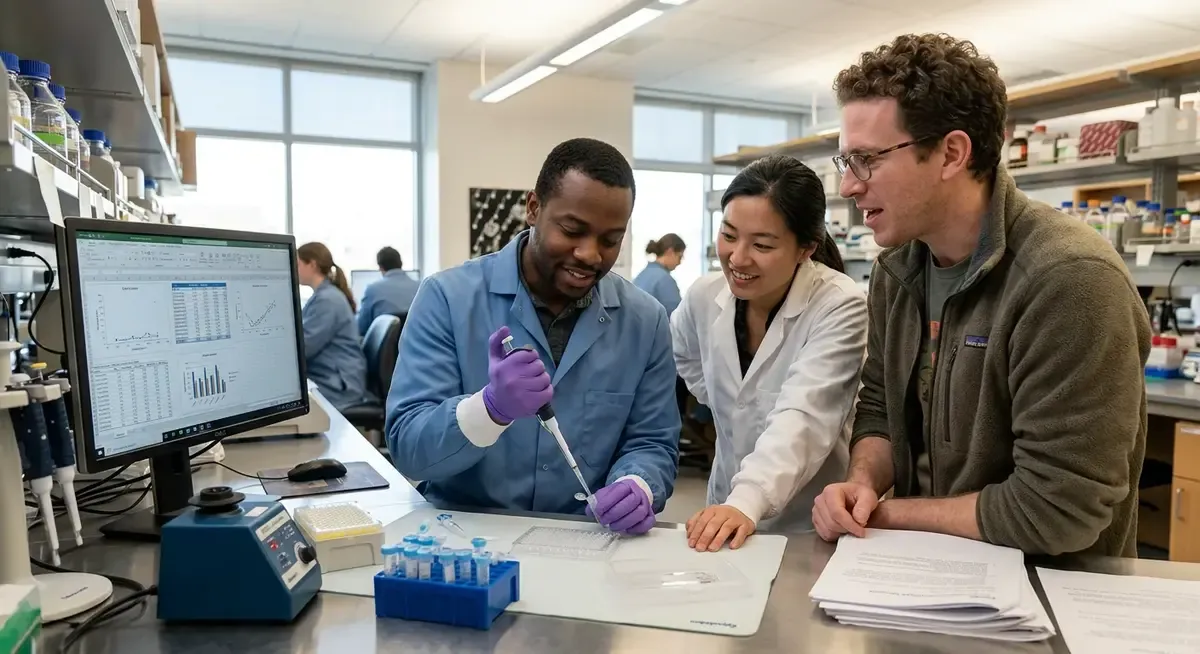
Editorial illustration for Anthropic co-founder Jack Clark moves self-improving AI prediction to 2027
Anthropic Co-founder Moves Self-Improving AI to 2027
Jack Clark has moved up his timeline. The Anthropic co-founder now says recursive self-improvement in AI systems, the point where models start building their own successors, could arrive by 2027. A year ago, he was pointing to 2028.
The shift comes from a new benchmark called TasteVal, built by a lab called P-Zero Research to measure something harder to quantify than raw model performance: whether an AI system can design its own experiments and correctly interpret what comes out of them. P-Zero calls this "research taste." Since December 2025, according to Clark, that capability has doubled roughly every three months. The best model tested beat a panel of 24 human experts, and did it for a fraction of what those experts cost.
Clark writes the Import AI newsletter, where he tracks exactly this kind of signal. TasteVal doesn't show AI already improving itself. It measures a narrower slice of the work, the part after someone has already decided what question is worth asking in the first place.
A new benchmark called TasteVal measures how well AI systems design experiments on their own and interpret the results. The findings show an unusually steep improvement curve.
Why this matters
Clark's revised timeline deserves scrutiny rather than alarm. A benchmark score doubling every three months sounds dramatic, but TasteVal measures something narrow: picking good experiments and reading results, not running the full research loop unsupervised. The Fudan study is the useful counterweight here.
AI agents generated up to 55 percent of methodology proposals in their own model's development, yet humans still made over 85 percent of final decisions. That gap between proposing and deciding is where the real work still happens, and it's the part benchmarks tend to undercount.
For researchers and founders, the lesson isn't to brace for 2027 as some hard cutoff. It's to watch whether "research taste" scores start translating into fewer human decisions, not just more AI-generated suggestions. If that 85 percent figure starts dropping over the next few quarters, that's the signal worth tracking. Until then, treat self-improving AI predictions as a pace-of-progress marker, not a countdown clock.
Related Reading
Browse all Anthropic news → Research & Benchmarks
Microsoft AI Chief: "If It Isn't Safe We Shouldn't Build It
 Research & Benchmarks
Google's FACTS benchmark shows 70% factuality ceiling across four tests
 Research & Benchmarks
Nvidia's DLSS 4.5 beta adds 6x Multi Frame Generation for RTX 50 GPUs
 Related Topic
Claude gains shared context in Excel, PowerPoint; Microsoft adds Copilot Cowork
AI Tools & Apps
 Related Topic
Anthropic: Hackers Stole Claude Tokens Via Compromised Session Key
LLMs & Generative AI
 From Archives
Microsoft's Agensh Multi-Agent Harness Scales to 1,024 AI Agents
 From Archives
Kimi K3.1 Pro Rivals Claude Opus in Coding and Reasoning
 From Archives
Anthropic: Single AI Agent With Skills Outperforms Multi-Agent Systems
Business & Startups
 From Archives
Eric Schmidt compares OpenAI and Anthropic to colonial trading companies
Business & Startups
Common Questions Answered
What is TasteVal and why did Jack Clark use it to revise his AI timeline?
TasteVal is a new benchmark created by P-Zero Research that measures whether AI systems can design their own experiments and correctly interpret the results, rather than just measuring raw model performance. Clark moved his prediction for recursive self-improvement forward to 2027 based on TasteVal's findings showing an unusually steep improvement curve in AI systems' ability to conduct independent research.
What does recursive self-improvement mean in the context of AI development?
Recursive self-improvement refers to the point where AI models start building their own successors, essentially creating improved versions of themselves without direct human intervention. Jack Clark previously predicted this capability would arrive by 2028, but has now accelerated that timeline to 2027 based on new benchmark data.
Why should Clark's revised 2027 timeline for self-improving AI be viewed with scrutiny?
While TasteVal shows dramatic improvement curves, it measures a narrow capability: selecting good experiments and interpreting results, not running the full research loop unsupervised. Additionally, a Fudan study showed that AI agents generated up to 55 percent of methodology proposals but humans still made over 85 percent of final decisions, indicating significant gaps remain before true autonomous self-improvement.
How much faster is the improvement curve shown in TasteVal benchmarks?
According to the article, TasteVal demonstrates a benchmark score that doubles every three months, which the article describes as sounding dramatic. However, this rapid improvement in the specific metric of experiment design and interpretation does not necessarily translate to full autonomous AI research capabilities.
Further Reading
- Anthropic’s Jack Clark moves AI self-improvement forecast to 2027 - The Rundown AI
- AI Could Start Improving Itself By 2027: Anthropic Co-Founder - NDTV
- Hope or Threat? Anthropic Cofounder on AI's Future - NHK World
- Inside the Race to Make AI Build Itself - TIME
- Recursive Self-Improvement in AI: From Bounded Optimization to Intelligence Explosion - arXiv
