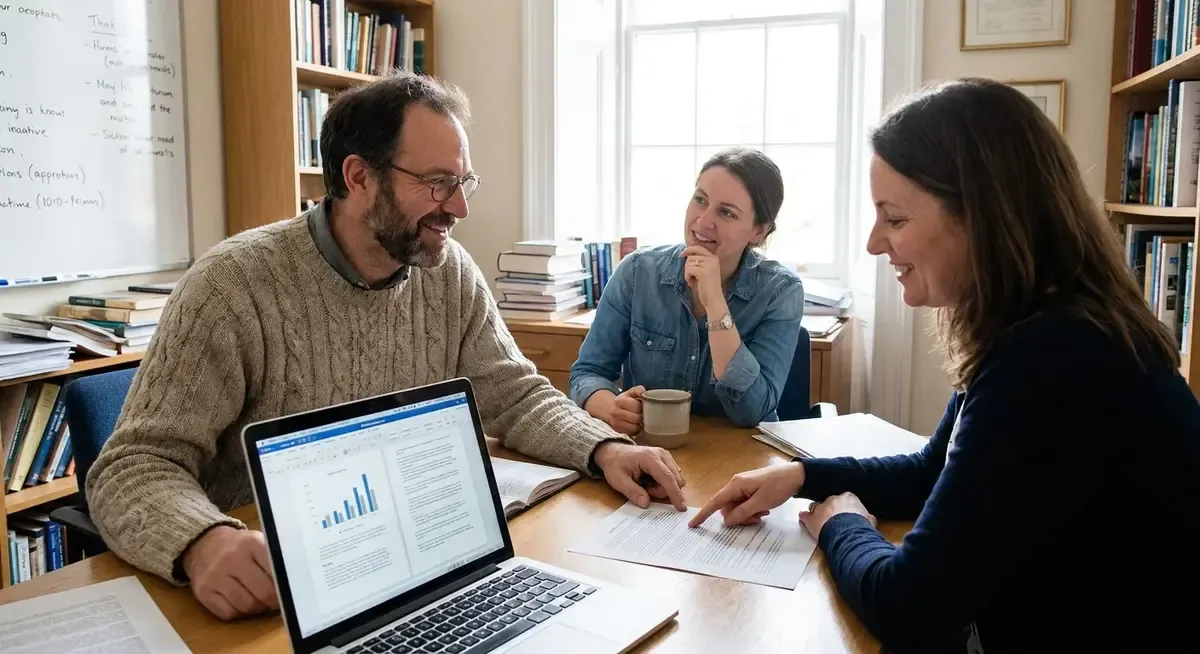
Editorial illustration for OpenAI Says Workers Use ChatGPT for 'Task Crossover' Jobs
ChatGPT Users Tackle Jobs Outside Their Role, OpenAI Finds
OpenAI Says Workers Use ChatGPT for 'Task Crossover' Jobs
OpenAI has been sifting through its own product logs for clues about how work is actually changing, and the company thinks it has found one. Looking at more than 800,000 work-related ChatGPT messages, OpenAI found that 43.5 percent of job-specific queries involved someone doing a task outside their own profession. The company has a name for this: "task crossover." Marketing staff are running engineering tasks, engineers are handling marketing work, and people across roles are picking up jobs that used to go straight to a specialist, from contract reviews to data analysis to fixing a broken website.
To sort this out, OpenAI used O*NET, the U.S. government's occupational database that maps specific activities to specific job profiles. Generic tasks like writing, summarizing, and scheduling got excluded, since those show up everywhere and would muddy the comparison. What's left is a picture of employees stretching into territory that used to belong to someone else's job description, and OpenAI says the pattern shows up more at smaller companies, where there's no dedicated specialist team to hand the work off to.
The effect is stronger at smaller companies, where dedicated specialist teams are less common. OpenAI sees the usage data as an early signal that job profiles are shifting, even before job titles or descriptions catch up.
Why this matters
For founders, this data point is worth more than the PR framing OpenAI put on it. A 43.5 percent crossover rate on job-specific queries means the line between "marketing person" and "engineer" is blurring faster than most org charts admit. If your hiring plan assumes specialists stay in their lanes, this survey suggests the lanes are already gone.
Contract review, data analysis, website troubleshooting: these were billable specialties a few years back, now they're prompts. Developers building tools for specific professions should read this as a warning about market size, not a compliment about adoption. The audience for your "engineering-only" tool might actually be marketers who never asked permission to use it.
Researchers studying labor and AI should note that OpenAI is self-reporting on its own usage logs, so treat the framing with some caution, but the underlying pattern, generalist tools eating specialist workflows, tracks with what we've seen anecdotally for over a year. The real question now is whether companies restructure roles around this crossover or keep pretending job titles still describe what people actually spend their day doing.
Related Reading
Browse all OpenAI news → LLMs & Generative AI
 ChatGPT's 'Nerdy' tweak rewards goblin metaphors in answers, study finds
 LLMs & Generative AI
 Google to End Free Access to Gemini AI for Non-Subscribers
 LLMs & Generative AI
 AI Engineers Face Rising Costs, Need New Strategies for Efficiency
 Related Topic
 OpenAI's GPT Transcribe Cuts Error Rate to 3.31%, Improving on GPT-4o
Open Source
 Related Topic
 OpenAI Developer: AI Agent "Swarms" Waste Tokens, Create "Coordination Tax
AI Tools & Apps
 From Archives
 Delhi High Court Rejects News Agency's Copyright Injunction Against OpenAI
 From Archives
 Search Engines Briefly Indexed Thousands of Shared Claude Chats
 From Archives
 OpenAI Tests Hacking Capabilities of GPT‑5.6 Sol and Newer Models
Open Source
 From Archives
 Nvidia and Microsoft form open AI security alliance, exclude OpenAI
Open Source
Common Questions Answered
What percentage of work-related ChatGPT queries involve task crossover according to OpenAI's analysis?
OpenAI found that 43.5 percent of job-specific queries involved someone doing a task outside their own profession, based on analysis of more than 800,000 work-related ChatGPT messages. This significant crossover rate suggests that workers are increasingly using ChatGPT to handle responsibilities traditionally associated with other roles and specializations.
How does task crossover usage differ between smaller and larger companies?
The effect of task crossover is stronger at smaller companies, where dedicated specialist teams are less common. This indicates that workers at smaller organizations are more frequently stepping outside their primary roles to handle tasks that would typically be assigned to specialists in larger enterprises.
What does OpenAI's task crossover data suggest about the future of job profiles?
OpenAI sees the usage data as an early signal that job profiles are shifting, even before job titles or descriptions catch up. This means that the actual work being performed by employees is changing faster than traditional organizational structures and hiring plans are adapting to reflect these changes.
Which types of work have transitioned from billable specialties to ChatGPT prompts according to the article?
Contract review, data analysis, and website troubleshooting are examples of tasks that were billable specialties a few years ago but are now being handled as ChatGPT prompts by workers across different roles. This shift demonstrates how AI tools are democratizing access to specialized knowledge and capabilities across organizations.
Further Reading
- How AI is expanding what people do at work - OpenAI
- OpenAI says more workers are using ChatGPT to do other people's jobs - The Decoder
- OpenAI Found That AI Is Blurring Career Boundaries: Workers Are Using LLMs to Do Other People's Tasks - Inkl / Axios republish
- OpenAI says ChatGPT users are doing other people's jobs - AI Insiders
- AI at Work: OpenAI's Workforce Blueprint - OpenAI
